United Nations Conference on the Human Environment (Stockholm, 1972)
1992 Earth Summit in Rio de Janeiro
Ramsar Convention 1971 on wetland conservation and sustainable use
The Montreal Protocol, finalized in 1987, is a global agreement to protect the stratospheric ozone layer by phasing out the production and consumption of ozone-depleting substances (ODS). ODS are substances that were commonly used in products such as refrigerators, air conditioners, fire extinguishers, and aerosols
India currently has 91 Ramsar sites, making it the country with the highest number of Ramsar-designated wetlands in Asia and third highest globally.
In 1972, India enacted the Wildlife Protection Act
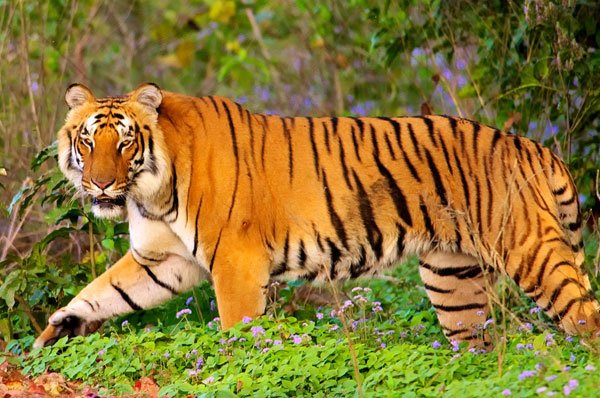
Project Tiger was launched in Jim Corbett National Park of Uttarakhand in 1973, and various tiger reserves were created in the country based on a ‘core-buffer’ strategy.
Project Elephant is a centrally sponsored scheme initiated by the Government of India in 1992 to safeguard the Indian elephant population and their habitats.
Under Project Cheetah, the Prime Minister of India released wild cheetahs in Kuno National Park in Madhya Pradesh. Cheetah became extinct from India in 1952
পশ্চিমবঙ্গের ভৌগোলিক এলাকার ১৪% বনভূমি , যা জাতীয় গড়ের ৩৩% এর চেয়ে কম।
জাতীয়উদ্যানএবংবন্যপ্রাণীঅভয়ারণ্য (WB)
বল্লভপুর বন্যপ্রাণী অভয়ারণ্য
বেথুয়াদহরি বন্যপ্রাণী অভয়ারণ্য
বিভূতিভূষণ বন্যপ্রাণী অভয়ারণ্য
বক্সা টাইগার রিজার্ভ
চাপরামারী বন্যপ্রাণী অভয়ারণ্য
চিলাপাতা বন
চিন্তামণি কর পাখি অভয়ারণ্য
গোরুমারা জাতীয় উদ্যান
হ্যালিডে দ্বীপ বন্যপ্রাণী অভয়ারণ্য
জলদাপাড়া জাতীয় উদ্যান
জোরে পোখরি বন্যপ্রাণী অভয়ারণ্য
লোথিয়ান দ্বীপ বন্যপ্রাণী অভয়ারণ্য
মহানন্দা বন্যপ্রাণী অভয়ারণ্য
নেওরা ভ্যালি জাতীয় উদ্যান
নরেন্দ্রপুর বন্যপ্রাণী অভয়ারণ্য
পাখি বিতান বন্যপ্রাণী অভয়ারণ্য
রায়গঞ্জ বন্যপ্রাণী অভয়ারণ্য
রামনবাগান বন্যপ্রাণী অভয়ারণ্য
রসিকবিল পাখি অভয়ারণ্য
সজনেখালি বন্যপ্রাণী অভয়ারণ্য
সেঞ্চল বন্যপ্রাণী অভয়ারণ্য
সিঙ্গালিলা জাতীয় উদ্যান
সুন্দরবন জাতীয় উদ্যান
ময়ূরঝর্ণা হাতি সংরক্ষণাগার
National Parks- Important facts
National Parks in India- 107
Oldest National Park- Jim Corbett NP (Uttarakhand)
Largest National Park- Hemis, Ladakh
Maximum NPs in India- Madhya Pradesh (11)
First NP in West Bengal- Sundarban (1984)
Latest National Park in WB- Jaldapara (1986)
Keibul Lamjao National Park, located in Manipur, is the only floating national park in the world, situated on Loktak Lake.
South Button Island National Park in the Andaman and Nicobar Islands is the smallest, with an area of just 5 square kilometers.
Satpura National Park in Madhya Pradesh is known for allowing walking safaris and camping within the park.
As of May 2024, India’s National Parks covers a total area of 44,378 sq km and account for about 1.35% of India’s total surface area.
The Sangai deer’ is found in Keibul Lamjao National Park (Manipur).
India’s first Golden Tiger was spotted in Kaziranga National Park.
Dachigam National Park (jammu and Kashmir) has been established for the conservation of the hangul or Kashmiri deer.
Punjab is the only Indian state which has no national park.
“National parks in West Bengal” (6)
Buxa Tiger Reserve
Gorumara
Jaldapara
Sundarban
Sigalila
Neora Valley
Difference Between Wildlife Sanctuary and National Park
Wildlife Sanctuary National Park
Human activities are allowed. No human activities are allowed.
Protects particular flora or fauna Wide range of flora and fauna
There are no fixed boundaries. Boundaries are fixed and defined.
It is open to the general public Not usually open to the public.
A sanctuary can be upgraded to a national park Cannot be downgraded to a sanctuary.
There are 18 biosphere reserves in India. They protect larger areas of natural habitat than a typical national park or animal sanctuary, and often include one or more national parks or reserves, along with buffer zones that are open to some economic uses. Protection is granted not only to the flora and fauna of the protected region, but also to the human communities who inhabit these regions, and their ways of life.
Sundarbans Biosphere Reserve-West Bengal
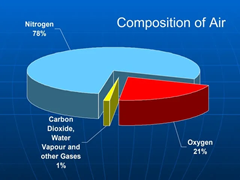
Air, the gaseous envelope surrounding Earth, is primarily composed of nitrogen and oxygen, with smaller amounts of other gases like argon, carbon dioxide, and trace amounts of other gases like helium and neon. Water vapor and dust particles are also present in varying amounts.
Here’s a breakdown of the major components:
Nitrogen (N₂): Approximately 78.09% of dry air.
Oxygen (O₂): Around 20.95% of dry air.
Argon (Ar): About 0.93% of dry air.
Carbon Dioxide (CO₂): A small but significant amount, around 0.04%.
Other Gases: Trace amounts of gases like helium, neon, krypton, and methane.
Water Vapor: The amount of water vapor in the air varies depending on location and weather conditions.
Dust Particles: Also present in varying amounts.
The five most abundant greenhouse gases in Earth’s atmosphere, listed in decreasing order of average global mole fraction, are water vapor, carbon dioxide, methane, nitrous oxide, ozone. Other greenhouse gases of concern include chlorofluorocarbons (CFCs and HCFCs), hydrofluorocarbons (HFCs), perfluorocarbons, SF6, and NF3. Water vapor causes about half of the greenhouse effect.
The Earth’s atmosphere is composed of five primary layers: the troposphere, stratosphere, mesosphere, thermosphere, and exosphere. These layers are defined by their temperature profiles and altitude ranges.
Here’s a breakdown of each layer:
1. Troposphere:
This is the lowest layer, extending from the Earth’s surface up to about 7 to 20 kilometers (4 to 12 miles) depending on the latitude. It’s where we live and where most weather occurs.
2. Stratosphere:
Located above the troposphere, the stratosphere extends from about 12 to 50 kilometers (7 to 31 miles). The ozone layer, which absorbs harmful UV radiation, is found within this layer. Unlike the troposphere, temperature increases with altitude in the stratosphere. The ozonosphere resides within the stratosphere, the second layer of Earth’s atmosphere, above the troposphere (where we live).
3. Mesosphere:
Situated above the stratosphere, the mesosphere extends from 50 to 85 kilometers (31 to 53 miles). It’s the coldest layer, with temperatures reaching as low as -90°C (-130°F) near the top. Most meteors burn up in the mesosphere.
4. Thermosphere:
This layer is above the mesosphere and extends from about 85 to 600 kilometers (53 to 372 miles). Temperatures in the thermosphere can be very high, but the air is so thin that it would feel cold to us. The aurora borealis and aurora australis occur in this layer.
5. Exosphere:
The outermost layer, the exosphere, extends from the top of the thermosphere to about 10,000 kilometers (6,200 miles). It gradually fades into interplanetary space. The air is extremely thin here, and particles can escape into space.
Major Environmental Movements in India
Bishnoi Movement
Year: 1700s
Place: Khejarli, Marwar region, Rajasthan state.
Leaders: Amrita Devi along with Bishnoi villagers in Khejarli and surrounding villages.
Aim: Save sacred trees from being cut down by the king’s soldiers for a new palace.
Chipko Movement
Year: 1973
Place: In Chamoli district and later in Tehri-Garhwal district of Uttarakhand.
Aim: The main objective was to protect the trees on the Himalayan slopes from the axes of contractors of the forest.
Silent Valley Movement
Year: 1978
Place: Silent Valley, an evergreen tropical forest in the Palakkad district of Kerala, India.
Leaders: The Kerala Sastra Sahitya Parishad (KSSP) an NGO, and the poet-activist Sughathakumari played an important role in the Silent Valley protests.
Aim: To protect the Silent Valley, the moist evergreen forest from being destroyed by a hydroelectric project.
Narmada Bachao Andholan (NBA)
Year: 1985
Place: Narmada River, which flows through the states of Gujarat, Madhya Pradesh and Maharashtra.
Leaders: Medha Patker, Baba Amte, Adivasis, farmers, environmentalists and human rights activists.
Aim: A social movement against several large dams being built across the Narmada River.
Tehri Dam Conflict
Year: 1990’s
Place: Bhagirathi River near Tehri in Uttarakhand.
Leaders: Sundarlal Bahuguna
Aim: The protest was against the displacement of town inhabitants and the environmental consequence of the weak ecosystem.
Here’s a list of common abbreviations related to environmental concepts, laws, and organizations:
EIA: Environmental Impact Assessment
EMP: Environmental Management Plan
EMS: Environmental Management System
BOD: Biochemical Oxygen Demand
COD: Chemical Oxygen Demand
DO: Dissolved Oxygen
GHG: Greenhouse Gas
EPA: Environment (Protection) Act, 1986
WPA: Wildlife Protection Act, 1972
FCA: Forest Conservation Act, 1980
WPA: Water (Prevention and Control of Pollution) Act, 1974
APA: Air (Prevention and Control of Pollution) Act, 1981
BD Act: Biological Diversity Act, 2002
CPCB: Central Pollution Control Board
SPCB: State Pollution Control Board
NGT: National Green Tribunal
UNEP: United Nations Environment Programme
WWF: World Wildlife Fund
IUCN: International Union for Conservation of Nature
IPCC: Intergovernmental Panel on Climate Change
SDG: Sustainable Development Goals
COP: Conference of the Parties (under the UNFCCC)
UNFCCC: United Nations Framework Convention on Climate Change
CSR: Corporate Social Responsibility
ODS: Ozone-Depleting Substances
HWM: Hazardous Waste Management
EPR: Extended Producer Responsibility
MSW: Municipal Solid Waste
RE: Renewable Energy
NRE: Non-Renewable Energy
EE: Energy Efficiency
CEA: Central Electricity Authority
1. মন্ট্রিয়ল প্রোটোকলের সঙ্গে জড়িত
[A] পারমাণবিক অস্ত্র
[B] ওজোন স্তরের ক্ষয়
[C] সমুদ্রের তলদেশ
[D] ল্যান্ডমাইন
Ans- b
2. মিনামাটা রোগের কারন হল –
[A] আর্সেনিক দূষণ
[B] পারদ দূষণ
[C] ক্যাডিয়াম দূষণ
[D] প্লাস্টিক দূষণ
Ans- B
3. জেনেটিক কোড আবিস্কারের জন্য কোন বিজ্ঞানী নোবেল পুরস্কার পেয়েছেন?
[A] প্রফুল্লচন্দ্র রায়
[B] হরগোবিন্দ খোরানা
[C] ডারউইন
[D] লফ্রেলোবেন
Ans- b
4. সালোকসংশ্লেষে অর্থাৎ খাদ্য তৈরিতে সক্ষম এমন প্রাণী হল –
[A] রাইবোজোম
[B] হাইড্রিলা
[C] ইউপ্লিনা
[D] অ্যাজোটোব্যাকটর
Ans-c
5. জলে ভাসমান আণুবীক্ষণিক উদ্ভিদগোষ্ঠীকে কী বলে?
[A] ফাইটোপ্লাংকটন
[B] বেনথস
[C] প্ল্যাংকটন
[D] জুপ্ল্যাংটন
Ans- A
6. লাল তথ্য পুস্তিকা বা ‘রেড ডাটা বুক’-এর তথ্যগুলি –
[A] লোহিত সাগরের প্রাণী সংক্রান্ত
[B] বিপন্ন প্রাণী সংক্রান্ত
[C] অপরাধজগৎ সংক্রান্ত
[D] বিপ্লবী তথ্য সংক্রান্ত
Ans- B
7. সিগারেটের ধোঁয়ায় অবস্থিত ক্যান্সার সৃষ্টিকারী উপাদানটি হল-
[A] কার্বন মনোক্সাইড
[B] বেঞ্জয়িক অ্যাসিড
[C] ক্লোরোবেঞ্জিন
[D] ডাই অক্সিজেন
Ans- C
8. পাখির দ্বারা বিস্তার লাভ করে সেই রোগের নাম-
[A] ভাইরাল
[B] মাইকোসিস
[C] অরনিথোসিস
[D] জুনটিক
Ans- C
9. ভারতের বৃহত্তম সরকারি তাপবিদ্যুৎ সংস্থা কোনটি?
[A] SAARC
[B] NTPC
[C] OPEC
[D] ONGC
Ans- B
10. 84. তামাক পাতায় উপস্থিত ক্ষতিকারক ধাতুর নাম –
[A] আয়রন
[B] মার্কারি
[C] ক্যাডমিয়াম
[D] আর্সেনিক
Ans- C
Important National Parks of India
Name State
Corbett National Park Uttarakhand
Kanha National Park Madhya Pradesh
Tadoba National Park Maharashtra
Madhav National Park Madhya Pradesh
Bandhavgarh National Park Madhya Pradesh
Kaziranga National Park Assam
Bandipur National Park Karnataka
Bannerghatta National Park Karnataka
Gir National Park Gujarat
Gugamal National Park Maharashtra
Pench National Park Madhya Pradesh
Blackbuck National Park Gujarat
Guindy National Park Tamil Nadu
Keibul-Lamjao National Park Manipur
Khangchendzonga National Park Sikkim
Dudhwa National Park Uttar Pradesh
Eravikulam National Park Kerala
Vansda National Park Gujarat
Van Vihar National Park Madhya Pradesh
Simlipal National Park Odisha
Ranthambore National Park Rajasthan
Gulf of Mannar Marine National Park Tamil Nadu
Dachigam National Park Jammu & Kashmir
Hemis National Park Jammu & Kashmir
Kishtwar National Park Jammu & Kashmir
Panna National Park Madhya Pradesh
Sanjay National Park Madhya Pradesh
Satpura National Park Madhya Pradesh
Keoladeo Ghana National Park Rajasthan
Indravati National Park Chhattisgarh
Kanger Valley National Park Chhattisgarh
Marine National Park Gujarat
Periyar National Park Kerala
Nanda Devi National Park Uttarakhand
Valley of Flowers National Park Uttarakhand
Mahatma Gandhi Marine National Park Andaman & Nicobar Islands
Namdapha National Park Arunachal Pradesh
Fossil National Park Madhya Pradesh
Sanjay Gandhi National Park Maharashtra
Rajaji National Park Uttarakhand
Silent Valley National Park Kerala
Sunderban National Park West Bengal
Balpakram National Park Meghalaya
Mouling National Park Arunachal Pradesh
Betla National Park Jharkhand
Nokrek Ridge National Park Meghalaya
Neora Valley National Park West Bengal
Singalila National Park West Bengal
Middle Button Island National Park Andaman & Nicobar Islands
Mount Harriet National Park Andaman & Nicobar Islands
North Button Island National Park Andaman & Nicobar Islands
Saddle Peak National Park Andaman & Nicobar Islands
South Button Island National Park Andaman & Nicobar Islands
Pin Valley National Park Himachal Pradesh
Kudremukh National Park Karnataka
Nagarahole (Rajiv Gandhi) National Park Karnataka
Bhitarkanika National Park Odisha
Sri Venkateswara National Park Andhra Pradesh
Valmiki National Park Bihar
Sultan National Park Haryana
Indira Gandhi (Annamalai) National Park Tamil Nadu
Gangotri National Park Uttarakhand
Manas National Park Assam
Mudumalai National Park Tamil Nadu
Govind National Park Uttarakhand
Murlen National Park Mizoram
Campbell Bay National Park Andaman & Nicobar Islands
Mollem National Park Goa
City Forest (Salim Ali) National Park Jammu & Kashmir
Phawngpui Blue Mountain National Park Mizoram
Desert National Park Rajasthan
Sariska National Park Rajasthan
Buxa National Park West Bengal
Gorumara National Park West Bengal
Intanki National Park Nagaland
Mahaveer Harina Vanasthali National Park Telangana
Rani Jhansi Marine National Park Andaman & Nicobar Islands
Nameri National Park Assam
Dibru-Saikhowa National Park Assam
Rajiv Gandhi Orang National Park Assam
Kalesar National Park Haryana
Anamudi Shola National Park Kerala
Chandoli National Park Maharashtra
Clouded Leopard National Park Tripura
Bison National Park Tripura
Jaldapara National Park West Bengal
For getting our guidance for PSC Miscellaneous Mains/ WBCS , pls call or whatsapp now- 6295350330
West Bengal has an adolescent (10-19 years) population of 1.73 Crores, out of which 48.11% are girls. At this period of adolescence, child marriage and trafficking are issues of major social concern which adversely affect the education, health, nutritional status, growth and development of girls. In this context Kanyashree Prakalpa is an innovative scheme of the Government of West Bengal with the power of creating an enabling environment to elevate the education, health and nutrition status of women and children throughout the State.
14 August is celebrated as Kanyashree Day to promote the scheme throughout the state. On August 14, 2013 state wide events were held to publicize the scheme.
The Scheme has two conditional cash benefit components.
The first is K1, an annual scholarship of Rs. 1000/- to be paid annually to the girls from 13 to 18 years of age group for every year that they remain in education, provided they are unmarried at the time. (Note: During the years 2013–14 and 2014-1 the annual scholarship was Rs. 500/-).
The second benefit is K2, a one-time grant of 25,000/-, to be paid when girls turn 18, provided that they are engaged in an academic or occupations pursuit and are unmarried at the time.
The term ‘education’ encompasses secondary and higher secondary education, as well as the various vocational, technical and sports courses available for this age group. To ensure an equity focus, the scheme is open only to girls from families whose annual income is R. 1,20,000/- or less. For girls with special needs, girls who have lost both parents, as well as for girls currently residing in Juvenile Justice homes, this criterion is waived. Although the annual scholarship is payable only when girls reach Class VIII, this criterion is waived for girls with special needs whose disability is 40% or more.
Kanyashree Prakalpa seeks to improve the status and well-being of girls, specifically those from socio-economically disadvantaged families through Conditional Cash Transfers by:
Incentivizing them to continue in education for a longer period, and complete secondary or higher secondary education, or equivalent in technical or vocational steams, thereby giving them a better footing in both the economic and social spheres.
Disincentivizing marriage till at least the age of 18, the legal age of marriage, thereby reducing the risks of early pregnancies, associated risks of maternal and child mortality, and other debilitating health conditions, including that malnutrition.
It was also decided that the Scheme should confer more than just monetary support; it should be a means of financial inclusion and a tool of empowerment for adolescent girls. The scheme’s benefits are therefore paid directly to bank accounts in the girls’ names, leaving the decision of utilizing the money in their hands.
To reinforce the positive impact of increased education and delayed marriages, the scheme also works to enhance the social power and self-esteem of girls through a targeted behaviour change communication strategy. The communication strategy not only builds awareness of the scheme, but includes adolescent-friendly approaches like events, competitions, and Kanyashree clubs, and the endorsement of strong women figures as role models to promote social and psychological empowerment.
As more and more girls remain in school, it is envisaged that they will use the opportunity to gain skills and knowledge to help them become economically independent. Even if girls do get married soon after they turn 18, it is expected that their education and enhanced social and emotional development will give them a better foundation for their adult lives. And over time, as entire generations of women enter marriages only after they have some degree of economic independence, it is expected that the practice of child marriage will be completely eradicated. Women will attain their right to health, education, and socio-economic equality.
The main objective of the scheme is to prevent child marriage and promote education among girls. It also aims to improve the health and nutrition of girls and empower them by building their skills and capacities.
The scheme is implemented through a network of school teachers, community workers, and government officials. The scheme has been recognized as a best practice in girl-child empowerment by the United Nations. Kanyashree was ranked the best among 552 such social sector schemes from across 62 countries that were nominated for the coveted award.
For getting our guidance for PSC Miscellaneous Mains, pls call or whatsapp now- 6295350330
The UNSC is – theoretically – the most powerful political UN body, with a mandate to maintain international peace and security. It has 15 members: five permanent and 10 elected. The five permanent members are China, France, Russia, the United Kingdom and the United States. The non-permanent members are elected for a term of two years. The Security Council can establish peacekeeping operations, impose sanctions or arms embargoes, instruct human rights investigations, authorize the use of force, create international criminal tribunals and refer cases to the International Criminal Court.
The US made a proposal to India in August 1950 through the Indian Ambassador in the U.S. It expressed the American desire to remove China from permanent membership of the UNSC and possibly replace it with India. Nehru allegedly refused to take this suggestion seriously and thus abdicated India’s opportunity to become a permanent member of the UNSC. However, the complexity of the international situation might justify Nehru’s stance then.
The above events took place in August 1950 when the Cold War was in its early stages. The two superpowers were in eyeball-to-eyeball confrontation that threatened nuclear catastrophe. The People’s Republic of China had just emerged from a bloody civil war and was seen at the time as the Soviets’ closest ally. It was prevented from taking its permanent seat in the UNSC because of American opposition based on Cold War logic. Furthermore, war was intense in the Korean peninsula. The U.S. and allied troops were locked in fierce combat with North Korean forces supported by China and the Soviet Union.
Nehru, at that time, was trying to carve a policy that ensured India’s security, strategic autonomy and state-led industrialisation. He anticipated that pushing China out, as the U.S. wished to do, would result in a perpetual conflict that could engulf all of Asia. To him, the Korean War appeared a forerunner to more such conflicts in Asia that could even turn nuclear. The U.S. had dropped nuclear bombs on Japan only 5 years ago and it would possibly not hesitate to do so again in an Asian conflict. This is especially since nuclear deterrence had not become a recognised reality then. So given these, Nehru did not want India to get embroiled in hazardous Cold War conflicts as it would risk India’s own security. He understood that peace could not be assured in Asia without accommodating a potential great power like China.
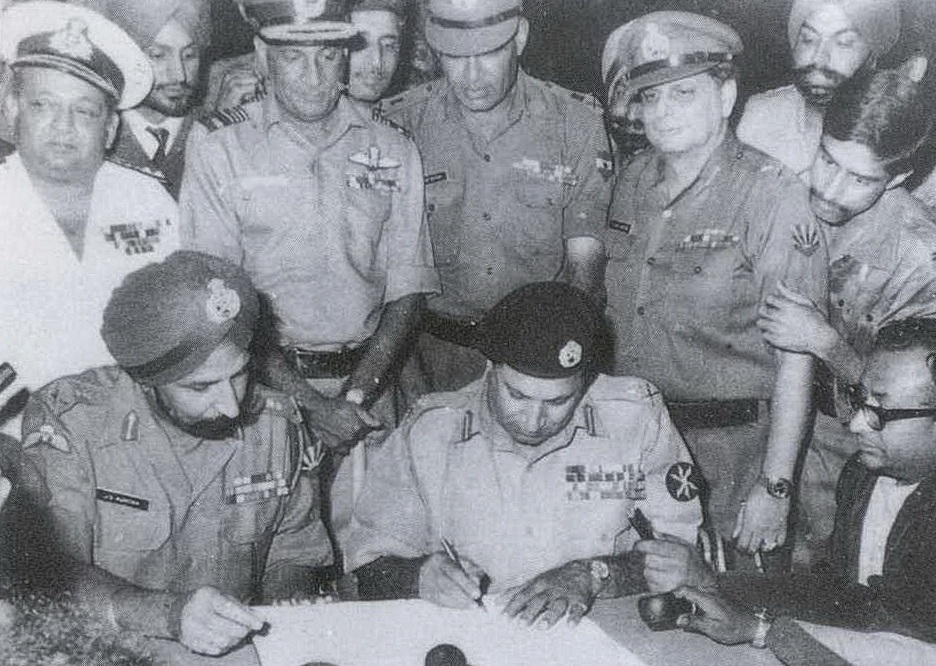
To be precise, America’s proposal was not an offer but merely a vague sensor to explore Indian reactions to such a contingency. The U.S. intended the offer to be a bait to attract India into an alliance with the West against the Sino-Soviet bloc. The US aimed at pulling India into the “defence” organisations that it was setting up in Asia to contain the presumed “Communist expansionism”. Nehru was well aware of this and the fact that Washington was only interested in using India for its own ends. Had India accepted the American bait, it would have meant enduring enmity with China without the achievement of a permanent seat in the UNSC. Moreover, even if accepted, the Soviet Union, then China’s closest ally, would have vetoed such move. As, it would have required amendment of the UN Charter that is subject to the veto of the permanent members. It would have also strained the relations between India and the Soviet Union, affecting the possibility of a close political and military relationship with Moscow later. The ties, in fact, became necessary once the U.S. entered into an alliance relationship with Pakistan. Moreover, the Indo-Soviet relationship paid immense dividends to India during the Bangladesh war of 1971.
Over the years since then there has been much talk of late about the possibility of India joining the UN Security Council (UNSC) as a permanent member, while most of the current permanent members have expressed public support for expansion of the UNSC.
India has been falling far short of its domestic and international human rights obligations, and its desire to expand its role in the UN presents an opportunity to assess its record of engagement as a member of other UN political bodies, including the UN Human Rights Council (UNHRC).
It’s important to review India’s pattern of engagement with the human rights architecture as a whole, including with the Office of the High Commissioner for Human Rights (OHCHR) and UN human rights treaty bodies.
Indian politicians have argued for decades that the nation deserves to be a member of the United Nations Security Council (UNSC). An aspirational superpower, India believes that it has been unfairly denied a seat at the high table.
Several visiting foreign political dignitaries and international coalitions that have pushed for UNSC reforms have also voiced support for India’s candidacy for permanent membership of the Security Council. However, despite persistent lobbying by India, experts are not hopeful of change in the near future.
There are four key challenges India must overcome before it secures veto power in the United Nations.
China’s Opposition
Among the five permanent security council members all except China – the United States, the United Kingdom, France, and Russia – have categorically supported India’s candidature in the past. As a close competitor of India in regional and international politics, China is unwilling to endorse New Delhi’s position.
China is the only Asian country with a permanent Security Council seat. This adds to its power and international prestige, and China is unlikely to want to share this space with India. What’s more, particularly amid an ongoing border dispute with India, China will resist any attempt by any of the four members to change the composition of the UNSC.
China is also uncomfortable with Japan, a close U.S. ally that, like India, is a strong contender for a permanent seat. Comprising Brazil, Germany, India, and Japan, the G-4 countries support each other’s bids for permanent seats on the Security Council.
China has unofficially dropped hints that it may back India, provided New Delhi doesn’t endorse Japan’s bid. China knows that New Delhi will not break the unity of the G-4 and thus, considers it is a safe bet to pit India against Japan.
Disagreement on Membership Without Veto Power
Some parties have raised the prospect of India gaining UNSC membership without veto power.
Groups including Uniting for Consensus (UfC) – a powerful coalition led by Italy, with other members including Canada, Mexico, Spain, Pakistan, South Korea, and Turkey – have advocated reinforcing the working of the General Assembly and increasing the number of non-permanent members.
Its argument is that the addition of non-permanent members will make the U.N. more accountable and representative by accommodating relevant regional voices in the decision-making process. In doing so, the group argues, this solution would mean there are more than a few select chief custodians of the international system.
But there are questions about what happens if India gets a high seat without veto power. Could this be considered a piecemeal approach toward achieving the larger objective?
Despite some parties saying they prefer this kind of arrangement, New Delhi is not comfortable with this proposition. India’s position is that all new permanent members to the Security Council must possess a veto. Thus, it is unlikely this outcome will unfold.
Western Concerns that India May Not Align with U.S. Priorities
The United States has, in principle, endorsed India gaining a permanent seat on the Security Council. But not everyone believes U.S. policymakers will actually support such a reform in practice.
Indeed, in the past, P-5 countries have displayed “a habit of being non-commital” when it comes to actual decision-making on veto powers. As former U.S. Under Secretary of State for Political Affairs Nicholas Burns said in 2008: “We want to preserve the veto, and we do not want to extend a veto to new permanent members.”
Prominent U.S.-based South Asian expert Ashley Tellis recently penned a piece in Foreign Affairs magazine arguing that the United States cannot be sure of India’s support on significant strategic matters. Ashley later defended this position in an interview, saying “the current war in Ukraine is a good example … India defines its interest in ways that are not always identical to our own.”
It is true that India has not always voted with the West in the United Nations and has maintained an independent position on several critical subjects (e.g., India abstaining on the Russian invasion of Ukraine). Due to this, many think India is a fence-sitter and see it as an unreliable partner. Despite developing closer strategic ties with the West, India remained uncommitted on supporting sanctions on Russia. While China’s response was anticipated, for the West, foot dragging by New Delhi in criticizing Russia was no less than a shock.
In these changed circumstances, it is difficult to imagine that the West, particularly the U.S., will go ahead with a reformed Security Council where India has veto power.
The Regional Conundrum
India also faces formidable challenges to its leadership emanating from its own region. India influences the region, but not in absolute terms. Indeed, as instability in the region has increased, so too have New Delhi’s troubles.
South Asia has, for example, become a battleground of India-China competition. And while the India-Pakistan rivalry captures most attention, there are major India-related issues that agitate people in Nepal, Bangladesh, Sri Lanka, the Maldives, and even in Bhutan.
With its recent change of government, Bangladesh is no longer on the same page. Queries over India’s regional leadership raises questions over its claims to be a global power.
What is Next for India?
There are convincing arguments that the U.N. is in desperate need of reform, particularly the Security Council. Expanding the Security Council’s membership to include developing countries like India would benefit the U.N. and the international community. However, New Delhi must make more concerted efforts to address criticisms to further legitimize its demand for permanent membership.
India’s geographical, political, and social influence in South Asia cannot be ignored. Recent criticism around its increasing political intolerance – which is directly linked to the state of democracy in India – must be addressed and resolved.
India’s failure to improve its ranking in the Human Development Index, the issue of economic inequality, and its lack of world-class infrastructure all contribute to the nation’s global image.
Therefore, there are structural and more prominent geopolitical factors that overshadow India’s chances to acquire Security Council permanent membership.
India needs better engagement with the region and much more internal work to strengthen its claim further.
For getting our guidance for PSC Miscellaneous Mains, pls call or whatsapp now- 6295350330
Operation Barga was a land reform movement, throughout rural West Bengal for recording the names of sharecroppers (bargadars) while avoiding the time-consuming method of recording through the settlement machinery. It bestowed on the bargadars, the legal protection against eviction by the landlords (jotedars), and entitled them to the due share of the produce. Operation Barga was launched in 1978 and concluded by the mid-1980s. Introduced in 1978, and given legal backing in 1979 and 1980, Operation Barga became a popular but controversial measure for land reforms. The ultimate aim of these land reforms was to facilitate the conversion of the state’s bargadars into landowners, in line with the Directive Principles of State Policy of the Indian Constitution. To date, Op Barga has recorded the names of approximately 1.5 million bargadars. The initiative has been studied and admired as a model for land reform in other regions, emphasizing the importance of recognizing and protecting the rights of marginalized farmers.
The operation was divided into the following five distinct steps:
Identification of the priority pockets with large concentration of bargadars.
Camping by the Government Officials at the priority pockets.
Meeting between the bargadars and the government officials.
The collective participation of the villagers in the reconnaissance and field verification to establish the claims of sharecroppers.
Issue of temporary certificates called ‘parchas’ to confirm sharecroppers as evidence of their rights enabling them to obtain bank credit.
To begin with, group meetings between Officials and Bargadars were organized during “settlement camps” (also called “Reorientation camps”), where the bargadars could discuss their grievances. The first such camp was held at Halusai in Polba taluk in Hooghly district from 18 to 20 May 1978. An empirical analysis of the impact of Operation Barga on agricultural production, productivity, employment, income including its distribution and on the qualitative improvement in the utilization of barga land was conducted during the period 1986–88 in the three districts of Birbhum, Burdwan and Jalpaiguri in West Bengal.
Operation Barga was successful in enumerating the Bargadars. Over the period 1977–90, the fraction of registered sharecroppers rose from 23 to 65%. During the same period of time in West Bengal, there was expansion in public and private irrigation and there was technological change as well. These reforms, along with the guaranteed crop share and bargadar’s increased stake in the land led to an increase in agricultural output. By the end of 1982 about 1.2 million sharecroppers were recorded, out of the total estimated number of about 2.0-3.5 million.
By the end of June 1994 around 1460,000 bargadars had been recorded over an area of over 451,800 hectares. The most remarkable achievement of the programme, as reported in the 1986-88 study, was that it enhanced social status of the bargadars and security of tenancy.
West Bengal enjoyed a subsequent dramatic increase in farm output per unit of land, as well as farming incomes. By comparing the output of farms before and after the implementation of Operation Barga, economists concluded that both improved work motivation and investment occurred. One study suggested that Operation Barga was responsible for around 28% of the regional growth in agricultural productivity from 1979 to 1993. The empowerment of the bargadars also had positive spillover effects, as local governments became more responsive to the needs of poor farmers.
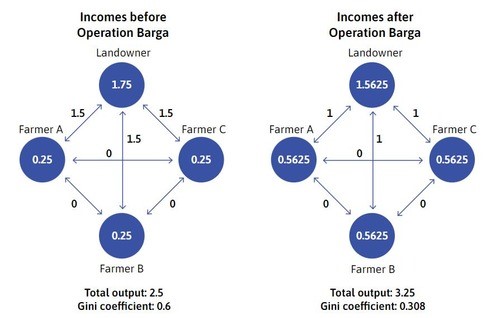
The above image shows how Operation Barga reduced Gini coefficient in WB
Operation Barga (and West Bengal’s land reforms in general) have been criticized for their small scope and inability to solve all the major problems. This criticism has been mainly due to policies not accounting for the high population-to-landmass ratio in Bengal (the highest in the country), the small and highly segregated land holding patterns and failure of the Government to develop agri-industrial markets for farm produce. These failures, critics contend, have distributed poverty rather than creating prosperity.
The United Nations is an international organization founded in 1945 after the Second World War by 51 countries committed to maintaining international peace and security, developing friendly relations among nations and promoting social progress, better living standards and human rights.
Despite the problems encountered by the League of Nations in arbitrating conflict and ensuring international peace and security prior to World War II, the major Allied powers agreed during the war to establish a new global organization to help manage international affairs. This agreement was first articulated when U.S. President Franklin D. Roosevelt and British Prime Minister Winston Churchill signed the Atlantic Charter in August 1941. The name United Nations was originally used to denote the countries allied against Germany, Italy, and Japan. On January 1, 1942, 26 countries signed the Declaration by United Nations, which set forth the war aims of the Allied powers.
As the Second World War raged, the leaders of the United Kingdom, China, the United States and the Soviet Union, under intense pressure from the press and public, discussed the details of a post-war organization. In 1944 representatives meeting at Dumbarton Oaks in Washington, DC, prepared a blueprint for an international organization. Towards the end of the war representatives of 50 countries gathered in San Francisco between April and June 1945 to hammer out the final text that would lay the foundations of international cooperation. This was the Charter of the United Nations, signed on 26 June by 50 countries. Poland, the 51st country, was not able to send a representative to the San Francisco conference but is considered an original member.
Purposes of the United Nations
Due to its unique international character, and the powers vested in its founding Charter, the Organization can take action on a wide range of issues, and provide a forum for its Member States to express their views.
The UN has 4 main purposes
To keep peace throughout the world;
To develop friendly relations among nations;
To help nations work together to improve the lives of poor people, to conquer hunger, disease and illiteracy, and to encourage respect for each other’s rights and freedoms;
To be a centre for harmonizing the actions of nations to achieve these goals.
Structure and Organization of the United Nations The Charter established six principal organs of the United Nations: the General Assembly, the Security Council, the Economic and Social Council, the Trusteeship Council, the International Court of Justice, and the Secretariat. The United Nations family, however, is much larger, encompassing 15 agencies and several programmes and bodies
General Assembly
The General Assembly is the main deliberative organ of the UN and is composed of representatives of all Member States. The work of the United Nations year-round derives largely from the mandates given by the General Assembly. Comprising all Member States of the United Nations, it provides a unique forum for multilateral discussion of the full spectrum of international issues covered by the Charter. The General Assembly is the main deliberative, policymaking and representative organ of the UN. All 193 Member States of the UN are represented in the General Assembly, making it the only UN body with universal representation. Each year, in September, the full UN membership meets in the General Assembly Hall in New York for the annual General Assembly session, and general debate, which many heads of state attend and address. Decisions on important questions, such as those on peace and security, admission of new members and budgetary matters, require a two-thirds majority of the General Assembly. Decisions on other questions are by simple majority. The General Assembly, each year, elects a GA President to serve a one-year term of office.
Security Council
The Security Council has primary responsibility, under the UN Charter, for the maintenance of international peace and security. The Council is composed of five permanent members – China, France, Russian Federation, the United Kingdom and the United States – and ten non-permanent members. The non-permanent members are elected by the General Assembly for two-year terms. Each Council member has one vote. Decisions on procedural matters are made by an affirmative vote of at least nine of the 15 members. Decisions on substantive matters require nine votes, including the concurring votes of all five permanent members. This rule is often referred to as the “veto” power. A reform of the Security Council, including its membership, is under consideration.
Since its first meeting, the Security Council has taken permanent residence at the United Nations Headquarters in New York City.
Economic and Social Council
The Economic and Social Council (ECOSOC) is the principal organ to coordinate the economic, social and related work of the United Nations and the specialized agencies and institutions. Voting in the Council is by simple majority; each member has one vote. The United Nations Economic and Social Council (ECOSOC) is headquartered in New York City
International Court of Justice
The International Court of Justice, located at the Hague in the Netherlands, is the principal judicial organ of the United Nations. It settles legal disputes between States and gives advisory opinions to the UN and its specialized agencies. Its Statute is an integral part of the United Nations Charter.
Trusteeship Council
The Trusteeship Council was established in 1945 by the UN Charter to provide international supervision for 11 Trust Territories placed under the administration of 7 Member States, and ensure that adequate steps were taken to prepare the Territories for self-government and independence. By 1994, all Trust Territories had attained self-government or independence. Its work completed, the Council has amended its rules of procedure to meet as and where occasion may require.
Secretariat
The Secretariat – an international staff working in duty stations around the world – carries out the diverse day-to-day work of the Organization. It services the other principal organs of the United Nations and administers the programmes and policies laid down by them.
At its head is the Secretary-General, who is appointed by the General Assembly on the recommendation of the Security Council for a five-year, renewable term. The Secretary-General is a symbol of United Nations ideals and a spokesman for the interests of the world’s peoples, in particular the poor and vulnerable among them.
The duties carried out by the Secretariat are as varied as the problems dealt with by the United Nations. These range from administering peacekeeping operations to mediating international disputes, from surveying economic and social trends and problems to preparing studies on human rights and sustainable development. Secretariat staff also inform the world’s communications media about the work of the United Nations; organize international conferences on issues of worldwide concern; and interpret speeches and translate documents into the Organization’s official languages.
As international civil servants, staff members and the Secretary-General answer to the United Nations alone for their activities, and take an oath not to seek or receive instructions from any Government or outside authority. Under the Charter, each Member State undertakes to respect the exclusively international character of the responsibilities of the Secretary-General and the staff and to refrain from seeking to influence them improperly in the discharge of their duties.
The United Nations, while headquartered in New York, maintains a significant presence in Addis Ababa, Bangkok, Beirut, Geneva, Nairobi, Santiago and Vienna, and has offices all over the world. Currently, the United Nations has 193 Member States.
How does a country become a Member of the United Nations?
Membership in the United Nations, in accordance with the Charter, “is open to all peace-loving States that accept the obligations contained in the United Nations Charter and, in the judgment of the Organization, are able to carry out these obligations”. The recognition of a new State or Government is an act that only other States and Governments may grant or withhold. It generally implies readiness to assume diplomatic relations. The United Nations is neither a State nor a Government, and therefore does not possess any authority to recognize either a State or a Government. As an organization of independent States, it may admit a new State to its membership or accept the credentials of the representatives of a new Government.
States are admitted to membership in the United Nations by decision of the General Assembly upon the recommendation of the Security Council. The procedure is briefly as follows:
The State submits an application to the Secretary-General and a letter formally stating that it accepts the obligations under the Charter.
The Security Council considers the application. Any recommendation for admission must receive the affirmative votes of 9 of the 15 members of the Council, provided that none of its five permanent members have voted against the application.
If the Council recommends admission, the recommendation is presented to the General Assembly for consideration. A two-thirds majority vote is necessary in the Assembly for admission of a new State.
Membership becomes effective the date the resolution for admission is adopted.
Funding
The UN budget for 2024 was $3.59 billion, not including additional resources donated by members, such as peacekeeping forces. Including specialized agencies of the UN, the UN System Chief Executives Board for Coordination reports total expenses of $67.4 billion in 2022 for 43 United Nations entities.
The UN is financed from assessed and voluntary contributions from its member states. The General Assembly approves the regular budget and determines the assessment for each member. This is broadly based on the relative capacity of each nation to pay, as measured by its gross national income (or GNI), with adjustments for external debt and low per capita income.
The Assembly has established the principle that the UN should not be unduly dependent on any one member to finance its operations. Thus, there is a “ceiling” rate, setting the maximum amount that any member can be assessed for the regular budget. In December 2000, the Assembly revised the scale of assessments in response to pressure from the United States. As part of that revision, the regular budget ceiling was reduced from 25% to 22%. For the least developed countries (or LDCs), a ceiling rate of 0.01% is applied. In addition to the ceiling rates, the minimum amount assessed to any member nation (or “floor” rate) is set at 0.001% of the UN budget ($31,000 for the two-year budget 2021–2022).
A large share of the UN’s expenditure addresses its core mission of peace and security, and this budget is assessed separately from the main organizational budget. The peacekeeping budget for the 2021–2022 fiscal year is $6.38 billion, supporting 66,839 personnel deployed in 12 missions worldwide. UN peace operations are funded by assessments, using a formula derived from the regular funding scale that includes a weighted surcharge for the five permanent Security Council members, who must approve all peacekeeping operations. This surcharge serves to offset discounted peacekeeping assessment rates for less developed countries. The largest contributors to the UN peacekeeping budget for 2023–2024 are: the United States (26.94%), China (18.68%), Japan (8.03%), Germany (6.11%), the United Kingdom (5.35%), France (5.28%), Italy (3.18%), Canada (2.62%), South Korea (2.57%) and Russia (2.28%).
Special UN programmes not included in the regular budget, such as UNICEF and the World Food Programme, are financed by voluntary contributions from member governments, corporations, and private individuals.
Awards
A number of agencies and individuals associated with the UN have won the Nobel Peace Prize in recognition of their works. Two secretaries-general, Dag Hammarskjöld and Kofi Annan, were each awarded the prize; as were Ralph Bunche, a UN negotiator, René Cassin, a contributor to the Universal Declaration of Human Rights, and the American Secretary of State Cordell Hull for his role in the organization’s founding. Lester B. Pearson, the Canadian Secretary of State for External Affairs, was awarded the prize in 1957 for his role in organizing the UN’s first peacekeeping force to resolve the Suez Crisis.
UNICEF won the prize in 1965, the International Labour Organization in 1969, the UN Peacekeeping Forces in 1988, the International Atomic Energy Agency (which reports to the UN) in 2005, and the UN-supported Organisation for the Prohibition of Chemical Weapons in 2013. The UN High Commissioner for Refugees was awarded the prize in 1954 and 1981, becoming one of only two recipients to win the prize twice. The UN as a whole was awarded the prize in 2001, sharing it with Annan. In 2007, the IPCC received the prize “for their efforts to build up and disseminate greater knowledge about man-made climate change, and to lay the foundations for the measures that are needed to counteract such change.
UN Programs
UNDP
Headquarters: New York City, USA
The United Nations Development Programme (UNDP) works in nearly 170 countries and territories, helping to eradicate poverty, reduce inequalities and build resilience so countries can sustain progress. As the UN’s development agency, UNDP plays a critical role in helping countries achieve the Sustainable Development Goals.
UNEP
Headquarters: Nairobi, Kenya
The United Nations Environment Programme (UNEP) established in 1972, is the voice for the environment within the United Nations system. UNEP acts as a catalyst, advocate, educator and facilitator to promote the wise use and sustainable development of the global environment.
UNFPA
Headquarters: New York City, USA
The United Nations Population Fund (UNFPA) is the lead UN agency for delivering a world where every pregnancy is wanted, every birth is safe, and every young person’s potential is fulfilled.
UN-HABITAT
Headquarters: Nairobi, Kenya
The mission of the United Nations Human Settlements Programme (UN-HABITAT) is to promote socially and environmentally sustainable human settlements development and the achievement of adequate shelter for all.
UNICEF
Headquarters: New York City, USA
The United Nations Children’s Fund (UNICEF) works in 190 countries and territories to save children’s lives, to defend their rights, and to help them fulfil their potential, from early childhood through adolescence.
WFP
Headquarters: Rome, Italy
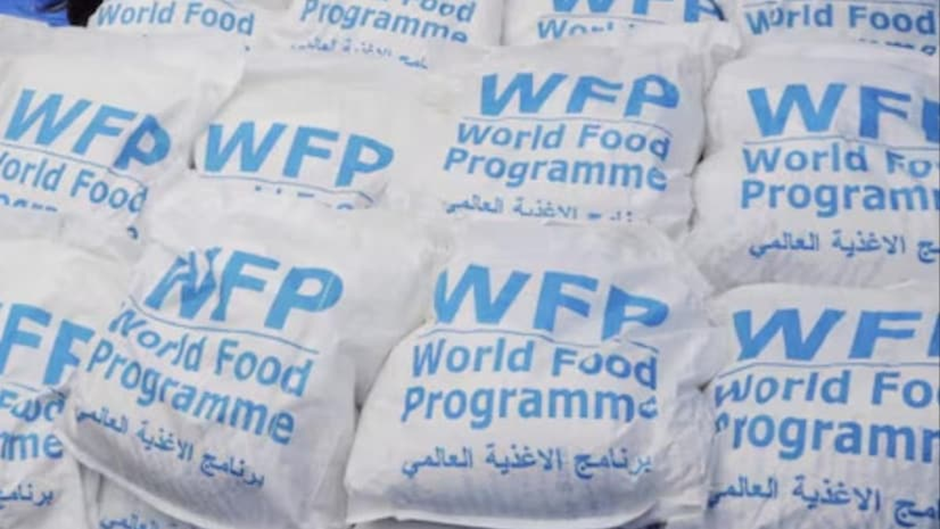
The World Food Programme aims to eradicate hunger and malnutrition. The world’s largest humanitarian agency, WFP helps almost 100 million people in approximately 88 countries with assistance every year through food or cash distributions and more. The World Food Programme was awarded the Nobel Peace Prize in 2020.
UN Specialized Agencies
The UN specialized agencies are autonomous international organizations working with the United Nations. All were brought into relationship with the UN through negotiated agreements. Some existed before the First World War. Some were associated with the League of Nations. Others were created almost simultaneously with the UN or later.
FAO
Headquarters: Rome, Italy
The Food and Agriculture Organization leads international efforts to fight hunger. It is both a forum for negotiating agreements between developing and developed countries and a source of technical knowledge and information to aid development.
ICAO
Headquarters: Montreal, Canada
The International Civil Aviation Organization develops standards for global air transport and assists its 192 Member States in sharing the world’s skies to their socio-economic benefit.
IFAD
Headquarters: Rome, Italy
The International Fund for Agricultural Development, since it was created in 1977, has focused exclusively on rural poverty reduction, working with poor rural populations in developing countries to eliminate poverty, hunger and malnutrition; raise their productivity and incomes; and improve the quality of their lives.
ILO
Headquarters: Geneva, Switzerland
The International Labour Organization promotes international labour rights by formulating international standards on the freedom to associate, collective bargaining, the abolition of forced labour, and equality of opportunity and treatment.
IMF
Headquarters: Washington, DC, USA
The International Monetary Fund fosters economic growth and employment by providing temporary financial assistance to countries to help ease balance of payments adjustment and technical assistance. The IMF currently has $28 billion in outstanding loans to 74 nations.
IMO
Headquarters: London, United Kingdom
The International Maritime Organization has created a comprehensive shipping regulatory framework, addressing safety and environmental concerns, legal matters, technical cooperation, security, and efficiency.
ITU
Headquarters: Geneva, Switzerland
The International Telecommunication Union is the United Nations specialized agency for information and communication technologies. It is committed to connecting all the world’s people – wherever they live and whatever their means. Through our work, we protect and support everyone’s fundamental right to communication.
UNESCO
Headquarters: Paris, France
The United Nations Educational, Scientific and Cultural Organization focuses on everything from teacher training to helping improve education worldwide to protecting important historical and cultural sites around the world.
UNIDO
Headquarters: Vienna, Austria
The United Nations Industrial Development Organization is the specialized agency of the United Nations that promotes industrial development for poverty reduction, inclusive globalization and environmental sustainability.
UN Tourism
Headquarters: Madrid, Spain
The World Tourism Organization is the United Nations agency responsible for the promotion of responsible, sustainable and universally accessible tourism.
UPU
Headquarters: Bern, Switzerland
The Universal Postal Union is the primary forum for cooperation between postal sector players. It helps to ensure a truly universal network of up-to-date products and services.
WHO
Headquarters: Geneva, Switzerland
The World Health Organization is the directing and coordinating authority on international health within the United Nations system. The objective of WHO is the attainment by all peoples of the highest possible level of health. Health, as defined in the WHO Constitution, is a state of complete physical, mental and social well-being and not merely the absence of disease or infirmity.
WIPO
Headquarters: Geneva, Switzerland
The World Intellectual Property Organization protects intellectual property throughout the world through 23 international treaties.
WMO
Headquarters: Geneva, Switzerland
The World Meteorological Organization facilitates the free international exchange of meteorological data and information and the furtherance of its use in aviation, shipping, security, and agriculture, among other things.
World Bank
Headquarters: Washington, DC, USA
The World Bank focuses on poverty reduction and the improvement of living standards worldwide by providing low-interest loans, interest-free credit, and grants to developing countries for education, health, infrastructure, and communications, among other things. The World Bank works in over 100 countries.
International Bank for Reconstruction and Development (IBRD)
International Centre for Settlement of Investment Disputes (ICSID)*
International Development Association (IDA)
International Finance Corporation (IFC)
Multilateral Investment Guarantee Agency (MIGA)*
* International Centre for Settlement of Investment Disputes (ICSID) and Multilateral Investment Guarantee Agency (MIGA) are not specialized agencies in accordance with Articles 57 and 63 of the Charter, but are part of the World Bank Group.
Other Entities and Bodies
UNAIDS
Headquarters: Geneva, Switzerland
The Joint United Nations Programme on HIV/AIDS (UNAIDS) leads and inspires the world to achieve its shared vision of zero new HIV infections, zero discrimination and zero AIDS-related deaths. UNAIDS unites the efforts of 11 UN organizations—UNHCR, UNICEF, WFP, UNDP, UNFPA, UNODC, UN Women, ILO, UNESCO, WHO and the World Bank—and works closely with global and national partners towards ending the AIDS epidemic by 2030 as part of the Sustainable Development Goals.
UNHCR
Headquarters: Geneva, Switzerland
The United Nations High Commissioner for Refugees – UNHCR protects refugees worldwide and facilitates their return home or resettlement.
UNIDIR
Headquarters: Geneva, Switzerland
The United Nations Institute for Disarmament Research is a voluntarily funded autonomous institute within the United Nations. An impartial actor, the Institute generates ideas and promotes action on disarmament and security. UNIDIR brings together states, international organizations, civil society, the private sector and academia to work together—internationally, regionally and locally—to build and implement creative solutions that will benefit all states and peoples.
UNITAR
Headquarters: Geneva, Switzerland
An autonomous UN body established in 1963, the United Nations Institute for Training and Research is a training arm of the United Nations System, and has the mandate to enhance the effectiveness of the UN through diplomatic training, and to increase the impact of national actions through public awareness-raising, education and training of public policy officials.
UNOPS
Headquarters: Copenhagen, Denmark
The mission of the United Nations Office for Project Services is to help people build better lives and help countries achieve peace and sustainable development. UNOPS helps the UN, governments and other partners to manage projects, and deliver sustainable infrastructure and procurement in an efficient way.
CTBTO
Headquarters: Vienna, Austria
The Preparatory Commission for the Comprehensive Nuclear-Test-Ban Treaty Organization promotes the Comprehensive Nuclear-Test-Ban Treaty (which is not yet in force) and the build-up of the verification regime so that it is operational when the Treaty enters into force.
IAEA
Headquarters: Vienna, Austria
The International Atomic Energy Agency, is the world’s centre for cooperation in the nuclear field. The Agency works with its Member States and multiple partners worldwide to promote the safe, secure and peaceful use of nuclear technologies.
ICC
Headquarters: The Hague, Netherlands
The International Criminal Court investigates and, where warranted, tries individuals charged with the gravest crimes of concern to the international community: genocide, war crimes, crimes against humanity and the crime of aggression. As a court of last resort, it seeks to complement, not replace, national courts.
IOM
Headquarters: Geneva, Switzerland
The International Organization for Migration works to help ensure the orderly and humane management of migration, to promote international cooperation on migration issues, to assist in the search for practical solutions to migration problems and to provide humanitarian assistance to migrants in need, including refugees and internally displaced people.
OPCW
Headquarters: The Hague, Netherlands
The Organisation for the Prohibition of Chemical Weapons is the implementing body of the Chemical Weapons Convention (CWC), which entered into force in 1997. OPCW Member States work together to achieve a world free of chemical weapons.
UNFCCC
Headquarters: Bonn, Germany
The UNFCCC Secretariat (UN Climate Change) was established in 1992 when countries adopted the United Nations Framework Convention on Climate Change (UNFCCC). With the subsequent adoption of the Kyoto Protocol in 1997 and the Paris Agreement in 2015, Parties to these three agreements have progressively reaffirmed the Secretariat’s role as the United Nations entity tasked with supporting the global response to the threat of climate change.
WTO
Headquarters: Geneva, Switzerland
The World Trade Organization is a forum for governments to negotiate trade agreements, and a place where member governments try to sort out the trade problems, they face with each other.
ITC
Headquarters: Geneva, Switzerland
The International Trade Centre (ITC) is the only development agency that is fully dedicated to supporting the internationalization of small and medium-sized enterprises (SMEs). Established in 1964, the ITC is the joint agency of the World Trade Organization and the United Nations.
The work of the United Nations today
The work of the United Nations reaches every corner of the globe. Although best known for peacekeeping, peacebuilding, conflict prevention and humanitarian assistance, there are many other ways the United Nations and its System (specialized agencies, funds and programmes) affect our lives and make the world a better place. The Organization works on a broad range of fundamental issues, from sustainable development, environment and refugees protection, disaster relief, counter terrorism, disarmament and non-proliferation, to promoting democracy, human rights, gender equality and the advancement of women, governance, economic and social development and international health, clearing landmines, expanding food production, and more, in order to achieve its goals and coordinate efforts for a safer world for this and future generations.
Present Heads
António Guterres (Chair of CEB) Secretary-General of the United Nations
Qu Dongyu, Director-General, FAO
Gilbert F. Houngbo, Director-General, ILO
Audrey Azoulay, Director-General, UNESCO
Juan Carlos Salazar, Secretary-General, ICAO
Ajay Banga, President, World Bank Group
Kristalina Georgieva, Managing Director, IMF
Adhanom Ghebreyesus, Director-General, WHO
Celeste Saulo, Secretary-General, WMO
Arsenio Dominguez, Secretary-General, IMO
Daren Tang, Director-General, WIPO
Gerd Müller, Director-General, UNIDO
Rafael Mariano Grossi, Director-General, IAEA
Ngozi Okonjo-Iweala, Director-General, WTO
Rebeca Grynspan, Secretary-General, UNCTAD
Achim Steiner, Administrator, UNDP
Inger Andersen, Executive Director, UNEP
Filippo Grandi, High Commissioner, UNHCR
Catherine M. Russell, Executive Director, UNICEF
Challenges before the UN today.
The challenges are multifaceted. Climate change has reached an unforeseen peak. Polar ice meltdown, catastrophic storms, inundations, earthquakes have made millions of people homeless. Terrorism has shaken the very root of the whole world. The first year of the new millennium witnessed the horrifying incident of 9/11 attack on America. Even after 25 years, terrorism remains one of the principal concerns of the UN as evident in the statement of the UNSC after the heinous attacks on the civilians on the soil of J&K in India. The UNSC has “condemned in the strongest terms” the terrorist attack in Jammu and Kashmir, stressing that those responsible should be held accountable and the organisers and sponsors of this “reprehensible act of terrorism” should be brought to justice.
Preventing the spread of nuclear weapons and promoting disarmament are critical goals for the UN. The proliferation of nuclear technology and tensions between nuclear-armed states, such as the United States, Russia, and North Korea, present ongoing challenges to international security. Human Rights and Humanitarian Crises
The UN is tasked with promoting and protecting human rights worldwide. Humanitarian crises, such as those in Syria, Myanmar, and Venezuela, pose significant challenges to upholding human rights. Balancing the principles of sovereignty and the responsibility to protect is an ongoing debate within the UN system.
The 21st century has seen a significant increase in forced migration and refugee crises. Large-scale population-forced migration is a global calamity that calls for coordinated action from the international community under the direction of world leaders. A record-breaking number of migrants and refugees are crossing international boundaries to escape war, persecution, poverty, and other severe situations. Large-scale population relocation affects the social, economic, and political landscape in ways that go beyond casualties. The UN High Commissioner for Refugees (UNHCR) works to provide protection and assistance to displaced persons, but issues related to immigration policies, border control, and xenophobia have complicated efforts to address this challenge.
Political Divisions among Member States of the United Nations also remains a major concern for the UN. We have seen how the ongoing war between Russia and Ukraine has caused unimaginable sufferings to millions.
Global health concern is another area the UN has to battle with. We have seen how helpless the world felt during the Covid pandemic.
The need for UN reform is imperative to adapt to the evolving global landscape and to fulfil its mission of promoting international peace, security, and development effectively. This reform should be pursued to enhance the UN’s capacity to address current and future challenges while upholding the principles of equality, justice, and cooperation among nations. The world today is vastly different from what it was in 1945 when the UN was established. New global powers have emerged, and the geopolitical landscape has shifted dramatically. Reforming the UN’s decision-making structures, particularly the Security Council, is essential to reflect these changes and ensure equitable representation among nations. Ensuring that UN resources are allocated efficiently and transparently is essential. Reform should focus on optimising budgetary practices and eliminating waste to ensure that funds are directed toward programs that have a real impact on global development.
To get Saptarshi Sir’s guidance for English/Economy or for overall WBCS/ PSC Miscellaneous Main or other exam preparation, call or WhatsApp us @6295350330. Classes for PSC Miscellaneous Main have already started. WBCS New batch is also going on. You can also download our app for online guidance using the link
This list is cuarted for any competitive examinations from UPSC, State Civil Services examinations, PSC Miscellaneous and various other relevant examinations.
AAI- Airport Authority of India
ADB: Asian Development Bank
ADR: American Depositary Receipt
AVC: Army Veterinary Corps
ASSOCHAM- The Associated Chambers of Commerce and Industry of India
ASTO -Association of Sea Training Organizations
APEC: Asia-Pacific Economic Cooperation
APL: Above Poverty Line
ASEAN: Association of South-East Asian Nations
ATM: Automated teller machine
AC Alternating Current
AG- Accountant General
AIEEE- All India Engineering Entrance Examination
AICC: All India Congress Committee
AIR- All India Radio
ALH- Advanced Light Helicopter
AM: Antemeridian
AMFI- Association of Mutual Funds in India
ABM: Anti Ballistic Missiles
APY- Atal Prnsion Yojana
AC: Alternating Current; Ashoka Chakra
ADF: Asian Development Fund
ADIDAS: All Day I Dream about sports
AIDS: Acquired Immune Deficiency Syndrome
AllMS: All India Institute of Medical Sciences
am: ante meridiem; before noon
APK- Android Package
AT&T: American telegraphic and Telephone Co. Ltd.
ASCII: American Standard Code for Information
ATC: Air Traffic Controller
ATP- Association of Tennis Professionals
ATR: Action Taken Report
AUDI : Auto Union Deutschland Ingolstadt
AWACS: Airborne Warning and Control System
ASCI: Advanced Strategic Computing Initiative
BBC: British Broadcasting Corporation
BBL- Big Bash League
BC: Before Christ
BCG: Bacillus Calmette Guerin
BEd: Bachelor of Education
BEL- Bharat Electronics Limited
BHEL- Bharat Heavy Electricals Limited
BSF: Border Security Force
BARC: Bhabha Atomic Research Centre
BCCI- Board of Control for Cricket in India
BSF: Border Security Force
BSNL: Bharat Sanchar Nigam Ltd
BCBS: Basel committee for Banking Supervision
BIFR: Board of Industrial and Financial Reconstruction
BIMSTEC-Bay of Bengal Initiative for Multi-Sectoral Technical and Economic Cooperation
BIS: Bank for International Settlements, Bureau of Indian Standards
BOP: Balance of Payments
BOT: Build, Operate and Transfer
BPL: Below Poverty Line
BPO: Business Process Outsourcing
BRICS- Brazil, Russsia, India, China, South Africa
BSCS: Basel Committee on Banking Supervision
BSE: Bombay Stock Exchange
BTIS- Bio-Technology Information System
C & AG: Comptroller & Auditor General
CABE: Central Advisory Board of Education
CACP: Commission of Agriculture Cost and Price
CAD: Capital Account Deficit
CAPART: Council for People’s Action and Advancement of Rural Technology
CAR: Capital adequacy ratio
CARE: Credit Analysis & Research Ltd.
CBS: Core banking solution
CBDT-Central Board of of Direct Taxes
CPI Consumer Price Index
CPI (AL) Consumer Price Index for Agricultural Labors
CPI (IW) Consumer Price Index for Industrial Workers
CPI (RL) Consumer Price Index for Rural Labors
CBRI- Central Building Research Institute
CITES- Convention on International Trade in Endangered Species
CDRI- Central Drug Research Institute
CDS- Chief of Defence Staff
CISF- Central Industrial Security Force
CERN- Conseil européen pour la Recherche Nucléaire
(European Organisation for Nuclear Research)
CC: Cash Credit
CII- Confederation of Indian Industry
COD: Cash on Delivery
CPC Central Pay Commission
CPSE Central Public Sector Enterprises
CMD Chairman-cum-Managing Director
CEO Chief Executive Officer
CFO Chief Finance Officer
COO Chief Operating Officer
CCA City Compensatory Allowance
CRS Compulsory Retirement Scheme
CTC Cost to the Company
CAMELS C – Capital adequacy, A – Asset quality, M – Management quality, E – Earnings, L – Liquidity, S – Sensitivity to Market Risk
CPCB: Central Pollution Control Board
CPU: Central Processing Unit
CRAC: Cyber Regulation Advisory Council
CRISIL: Credit Rating Information Services of India Limited
CRM: Customer Relationship Management
CRPF: Central Reserve Police Force
CRR: Cash Reserve Ratio
CSIR: Council of Scientific and Industrial Research
CTBT: Comprehensive Test Ban Treaty
CTT: Commodities Transaction Tax
DA: Dearness Allowance; Daily Allowance
DAP: Development Action Plan
DBOD: Department of Banking Operations and Development
DBS Bank Ltd: The Development Bank of Singapore Limited.
DCA: Department of Company Affairs
DCM: Department of Currency Management
DD: Demand Draft
DAP- Diammonium Phosphate (Urea)
DDS: Data Dissemination Standards
DICGC: Deposit Insurance and Credit Guarantee Corporation of India
DMA: Departmentalized Ministries Account
DMIC: Delhi-Mumbai Industrial Corridor
DPEP: District Primary Education Program
DC: Direct Current
DDT: Dichloro Diphenyl Trichloro-Ethane
DLO: Dead Letter Office
DAVP: Directorate of Advertising and Visual Publicity
DNA: Deoxy-ribo Nucleic Acid
DO: Demi-official (letter)
DOD: Department of Ocean Development
DRDO: Defence Research and Development Organisation
DSIR- Department of Scientific & Industrial Research
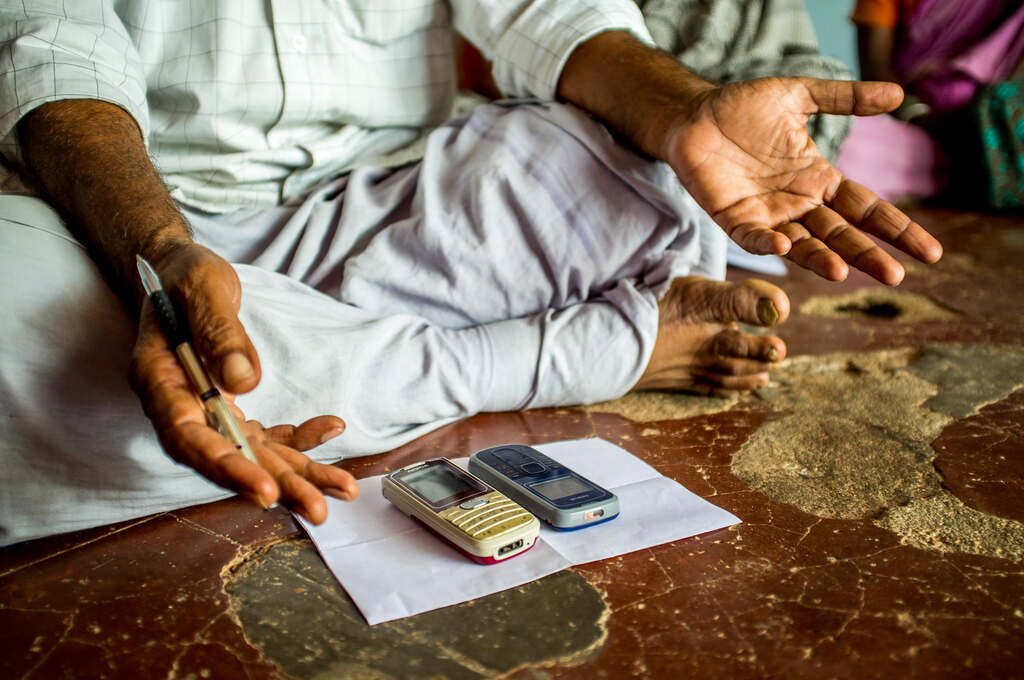
The digital age presents a double-edged sword. While urban centres flourish with advanced technology and internet access, rural communities struggle to bridge the digital divide. This lack of access creates a significant barrier to education, healthcare, and economic progress, further widening the social gap. The digital divide is the gap created by unequal access to modern telecommunications technology among different demographic groups and regions. This can include inequalities in access to computers, smartphones, and the internet.
When the term “digital divide” was first used in the late 20th century, it described the gap between those with cell phone access and those without it. The term has since expanded to include the technical and financial ability to use available technology and access the internet. However, the meaning of the “digital divide” is constantly shifting with the development of technology.
In India, this ‘Divide’ is far more prominent than other developing nations. The digital divide in the access and usage of ICTs and the internet has also led to an exclusionary consequence in three sectors of utmost significance: education, health and finance. In a country plagued by high socioeconomic inequality, the digitalisation process cannot be posited as the panacea for the inherent challenges of the physical world. It becomes particularly problematic when half of the population neither has access to gadgets and the internet or the technological know-how to move to a digital environment. In such circumstances, the digitalisation process becomes unequal, favouring the digitally connected while excluding the rest, and in certain cases, exacerbating the already existing inequalities.
India, the largest democracy and the most populous nation in the world having a population of almost 1.4 billion people, out of which approximately 350 million people are uneducated and only a paltry percentage of the people have access to the internet. But surprisingly, despite such demoralizing numbers, India presently serves as one of the worlds’ leading IT hubs. Though superficially, this might seem to be paradoxical, in reality, there is a lot more to it. Digitalization and Information and Communication Technology (ICT) serve as the basis of modern society. The development of ICTs and the rapid pace of digitalization have necessitated multiple social, economic, and environmental changes globally. While on India is happy to go cashless and order daily consumable items by just a click, the other India continues to suffer from the plight of poverty, illiteracy both academic and digital, hunger and alienation from the rest of India.
The reasons behind such divide are not hard to find. While poverty, lack of education, lack of intent, poor infrastructure, lack of electrification, improper connectivity, difficult terrains all contribute to such gap, the implications of this divide are even more concerning. Socio-economic immobility, rising unemployment, denial of access to basic amenities and several government schemes, digital fraud for the newbies, increasing socio-economic and digital inequality, unfulfillment of potential of a substantial share of a population are to name a few. Unfortunately, almost every government schemes are today being implemented through digital platforms. Every beneficiary must be digitally incorporated in the databases to have access to the facilities the Central or the state Governments are providing. However, as the beneficiaries mostly are digitally illiterate especially in the rural areas, they are often misled and cheated by unscrupulous middlemen. While the deserving is left uncared for, the shrewd undeserving lot takes the advantage of digital knowledge. This leads to widespread corruption at the grassroot level.
Addressing the digital divide is crucial to unlock India’s economic potential and promote social equality. Government initiatives like the National Digital Literacy Mission and the Pradhan Mantri Gramin Digital Saksharta Abhiyan have been introduced to increase digital literacy. National Education Policy, 2020 also aims at making “India a global knowledge superpower” by introducing several changes from the school to college level in the Indian education system with special emphasis on digital education. However, there is a need to ramp up efforts to improve digital infrastructure, particularly in rural areas, and ensure physical access to ICT for all sections of society.
Further, underprivileged groups need to be motivated to incorporate technology into their daily lives, and digital skills must be imparted to bridge the gap. Stronger regulation and efforts to reduce the cost of Edtech products can improve access to online education. Initiatives like the NDHM (National Digital Health Mission) should be accompanied by measures to enhance digital infrastructure and promote digital literacy to ensure the effective delivery of healthcare services.
India has grand growth aspirations, but bridging India’s digital divide is crucial for inclusive growth and to harness the full potential of technology. By addressing disparities in internet usage, mobile ownership, and access to digital services, India can create a more equitable society and unlock economic opportunities for all its citizens.
While AI (Artificial Intelligence) is defining the new age, for a substantial part of Indian population, the A and the I should start with Am I digitally literate?
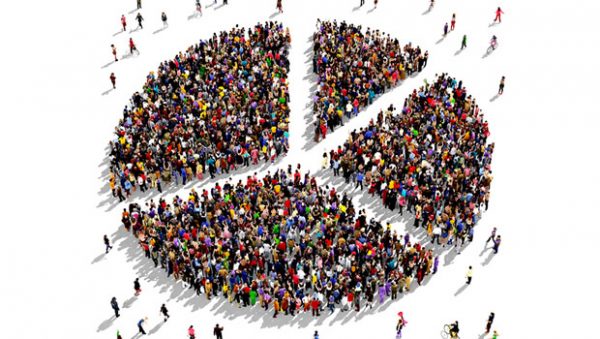
Demographic dividends occur in countries that see declines in both fertility and mortality rates. A country that experiences low birth rates in conjunction with low death rates receives an economic dividend or benefit from the increase in productivity of the working population that ensues. As fewer births are registered, the number of young dependents grows smaller relative to the working population. With fewer people to support and more people in the labour force, an economy’s resources are freed up and invested in other areas to accelerate a country’s economic development and the future prosperity of its populace.
To receive a demographic dividend, a country must go through a demographic transition where it switches from a largely rural agrarian economy with high fertility and mortality rates to an urban industrial society characterized by low fertility and mortality rates. In the initial stages of this transition, fertility rates fall, leading to a labour force that is temporarily growing faster than the population dependent on it. All else being equal, per capita income grows more rapidly during this time too. This economic benefit is the first dividend received by a country that has gone through the demographic transition.
There are four main areas where a country can find demographic dividends:
Savings: During the demographic period, personal savings grow and can be used to stimulate the economy.
Labor supply: More workers are added to the labour force, including more women.
Human capital: With fewer births, parents are able to allocate more resources per child, leading to better educational and health outcomes.
Economic growth: GDP per capita is increased due to a decrease in the dependency ratio.
According to United Nations Population Fund (UNFPA), demographic dividend means, “the economic growth potential that can result from shifts in a population’s age structure, mainly when the share of the working-age population (15 to 64) is larger than the non-working-age share of the population (14 and younger, and 65 and older)”.
Where the world economies are struggling with declining birth rates, tight labour markets and an ageing population, India is standing at the cusp of an unprecedented opportunity—all thanks to its demographic. With the world’s largest youth population1 with the median age of 28.4 years, India is not only strengthening its competitive advantage but also setting trends in consumer and discretionary spending. India will have 1.04 billion working age persons by 2030, highest of any large economy.
So, what is a youth? As defined by the National Youth Policy, the population in the age group of 18-29 years is considered youth. India has over 371.4 million youth, as per 2021 census projections, making up for approximately 27% of the total population.
Imagine a country where half of the population is in its prime working years. Here, innovation meets ambition as the youthful workforce is poised to redefine global growth. That’s India for you.
More than four in 10 people in India are under 25 years old. For investors seeking expansion opportunities, this offers a substantial pool of potential workers across various industries, including technology, manufacturing and services.
A young population can help India’s economic growth and innovation since it represents a larger workforce with the potential for improved productivity and increased consumer demand. India’s demographics offer various advantages for investors, notably among which are:
A trained workforce boosts economic prosperity with the potential to boost economic output, innovation and productivity in the nation.
A rising young population increases demand for products and services, driving economic activity.
A young population that openly embraces technology breakthroughs and invests in digital infrastructure can help India overcome development challenges and become a global technological leader.
Investments in infrastructure, especially in metropolitan and rural areas, are crucial to tapping and promoting the potential for productivity and economic growth among the nation’s youth.
India’s booming IT and BPO services export story is a testament to its ability to capitalise on demographic advantages. It has the largest pool of English-speaking science, technology, engineering and mathematics (STEM) graduates of an estimated two million. Thereby providing a competitive edge over other regions. The nation will have nearly 18 million STEM graduates by 2027, a sign of India’s growing influence in the science and tech sector. According to the All-India Higher Education survey, women constituted 42.6% of total STEM graduates in 2021-22, which makes a compelling argument for inclusive development and gender equality. Although we have a substantial pool of female STEM graduates, it remains underutilised mainly because women either do not join the mainstream workforce or drop out early in this field. This presents an opportunity not only for the government and policymakers but also for investors to foster equitable growth.
“India still has some time to benefit from its demographic dividend for economic growth but is aging faster than many realize,” McKinsey Global Institute said in its report ‘Dependency and depopulation? Confronting the consequences of a new demographic reality’. “Despite very fast progress, India is still a low-income country, so it needs to “get rich before it gets old,” it added.
In absolute numbers, India will have 1.04b working age persons by 2030. Correspondingly, India’s dependency ratio would be the lowest in its history by 2030 at 31.2%. India’s young dependency ratio —the number of children below 15 years of age relative to total population — is expected to overtake the old dependency ratio (ratio of population aged above 65 years relative to total population) by 2056.
India would remain the largest provider of human resources in the world. About 24.3% of the incremental global workforce over the next decade will come from India. This is significant considering the rapidly ageing population in the developed world, creating potential challenges to labour supply in various sectors of the global economy.
The fact that India has a relatively young population with a median age of 28.4 years is equally important. Approximately 26% of the population is below 14 years and ~67% is between the age of 15 to 64 years and 7% above the age of 65. In contrast, the population over 65 years in US is ~17% and Europe is over ~21%.
The potential contribution of the growing population to India’s GDP growth would depend, among other factors, on the rate of growth and size of total population and its contribution to the size of working age population who may be absorbed in productive employment.
This young population not only reinforces India’s competitive advantage in the services and manufacturing sectors, but also unleashes the consumption power of a young population towards discretionary expenditure.
Challenges associated with Demographic Dividend in India
Unemployment is still the biggest monster in India. While we boast of magical economic progress in the past decade or so, have we really been able to allow our younger generation to reap the fruit? It has been shared recently that the central government has been able to produce only around 2 million jobs in the past decade in stark contrast to 20 million jobs promised a decade earlier. As per the India Employment Report 2024, India’s working population increased from 61% in 2011 to 64% in 2021, and it is projected to reach 65 % in 2036. On the other hand, the percentage of youth involved in economic activities declined to 37% in 2022.
Most jobs created in the future will demand high skills, and the lack of skills in the workforce of India is a big challenge. It might result in India not being able to take advantage of the opportunities because of lack of skills and low human capital base. India still suffers from the lack of skill-based education.
India holds the 130th rank out of the 189 countries in the UNDP’s Human Development Index. Hence, the education and health parameters have to be substantially enhanced to make the workforce of India skilled and efficient.
According to the India Ageing Report 2023 of United Nations Population Fund, India’s elderly population is growing rapidly, with a decadal growth rate of 41% and by 2050, over 20% of India’s population will be elderly.
Resource Scarcity- The rapid growth of the population has a negative effect on resource usage and its access.
For example- Cities like Delhi and Bangalore and the State of Rajasthan have been facing severe water stress.
Also, as per a recent survey of the Central Water Commission, India’s per capita water availability has dropped from 1,816 cubic metres in 2001 to approximately 1,486 cubic metres in 2024, leading the country towards water stress.
Unplanned Urbanisation: It comes with issues such as overburdened infrastructure, traffic congestion and pollution, slum growth on the outskirts of cities, housing challenges and environmental degradation.
India’s urban population is expected to grow from 410 million in 2014 to 814 million by 2050. India is projected to add 4 new megacities by 2030 which could lead to more unplanned urbanisation and slum related issues.
India’s informal nature of economy would prove to be another obstacle in yielding the opportunity for major economic growth during the demographic transition in India. Almost 92% of the total workforce in India is in unorganized sector.
The Labour Force Participation Rate (LFPR) in India, which represents the percentage of working-age individuals engaged in or seeking work, has not been too much encouraging. In May 2025, the overall LFPR was 54.8%. These results lead to a big concern that the growth in the future could turn out to be jobless growth because of de-globalisation, deindustrialisation, the fourth industrial revolution and technological progress.
What is the way-out?
Forward-looking policies
Countries like Singapore, Taiwan and South Korea have already shown us how demographic dividend can be reaped to achieve incredible economic growth by adopting forward-looking policies and programmes to empower the youth in terms of their education, skills and health choices. Enhancement of quality and accessibility of education across all demographics, focusing on marginalized communities is the need of the hour. We need to promote vocational training and skill development aligned with industry needs to enhance employability. We must invest in digital literacy and technological skills to meet the demands of a digital economy.
Inclusion Growth and Gender Equality
Implementation of policies promoting gender equality and empowerment, ensuring equal access to education and employment.
Supporting initiatives that enhance social cohesion and reduce inequalities.
According to International Labour Organization estimates, only 24% of women were participating in the workforce in 2022, so getting more women to enter the workforce will be pivotal for future growth.
To invest more in children and adolescents
India ranks poorly in Asia in terms of private and public human capital spending. It needs to invest more in children and adolescents, particularly in nutrition and learning during early childhood. Given that India’s workforce starts at a younger age, a greater focus needs to be on transitioning from secondary education to universal skilling and entrepreneurship, as done in South Korea.
Investing in Healthcare
Health spending has not kept pace with India’s economic growth. The public spending on health has remained flat at around 1% of GDP. Evidence suggests that better health facilitates improved economic production. Hence, it is important to draft policies to promote health during the demographic dividend. We need more finance for health as well as better health facilities from the available funding. We need to provide universal access to high-quality primary education and basic healthcare. The unmet need for family planning in India at 9.4% as per the latest National Family Health Survey-5 (2019-21) is high as compared to 3.3% in China and 6.6% in South Korea, which needs to be bridged.
Are our states equal to us?
India needs to address the diversity between States. While India is a young country, the status and pace of population ageing vary among States. Southern States, which are advanced in demographic transition, already have a higher percentage of older people. These differences in age structure reflect differences in economic development and health – and remind us of States’ very different starting points at the outset of the 2030 Sustainable Development Goals Agenda. But this also offers boundless opportunities for States to work together, especially on demographic transition, with the north-central region as the reservoir of India’s workforce.
Progressive Federal Outlook
India needs to address the diversity, heterogeneity and disparity among the States. While India is a young country, the status and pace of population ageing vary among States. Southern States, which are advanced in demographic transition, already have a higher percentage of older people. These differences in age structure reflect differences in economic development and health – and remind us of States’ very different starting points at the outset of the 2030 Sustainable Development Goals Agenda. But this also offers boundless opportunities for States to work together, especially on demographic transition, with the north-central region as the reservoir of India’s workforce.
Tackling Urban Migration
By 2030, India’s urban population is projected to reach 600 million, with over 40% of the country’s population living in urban areas. This rapid urbanization is driven by migration from rural areas, seeking better economic opportunities and lifestyles. This influx of people will put significant strain on urban infrastructure and resources, requiring substantial investments in infrastructure development and urban planning. There is a need to focus on urban policy planning to give the migrating people access to basic amenities, healthcare services, and social services.
Harnessing the trend
Leveraging consumption trends like e-commerce and fintech, the digital revolution, rising internet access and the youth’s strong online engagement, there is immense potential for online shopping and financial services. The expanding middle class and urbanisation also contribute to an increasing demand for food delivery and home services.
Indian Foreign Policy has gone through various changes with the test of the time. The South Asian giant gained its independence from the British Empire in 1947 after long fought freedom struggle. The time also saw an unimaginable India- Pakistan hostility on the lines of religion as soon as they were divided. The bloody, tiny episodes wrapped in history gives us an understanding of why India has always had a protectionist policy. Pandit Jawaharlal Nehru and the then Indian Foreign Policy makers had already seen plenty of wars and its unsolicited destruction. Jawaharlal Nehru forged a policy that tried to keep India out of any bloc. Despite the two World Wars taking place in just a span of decades, the World was looking at yet another global conflict. This time, two partner countries that came out as victorious from the second World War decided to see each other eye to eye in lieu of ideological differences. US and the West were in one camp while USSR and certain communist countries from Eastern Europe and South America were in the opposite camp. It soon became a West vs East conflict. But the difference here was not many countries from the Global East were interested to pick sides. Similarly, India under the leadership of Jawaharlal Nehru had other visions for a new India that had to look inwards first to better provide to a massive population that had just gotten out from the brunt of colonialism. And playing around a conflict was certainly not that vision but completely opposite of what was to be achieved. India and other newly independent countries from different colonies wanted to have strategic autonomy in their internal and external affairs. They didn’t wish to get dictated regarding their domestic and foreign policies through ideological lenses. Gaining, independence was a crucial achievement for these countries and maintaining it away from external influence was another challenge. Non-Alignment Movement became an answer for these countries in such a critical moment.
Non-Alignment Movement began as a response to the two strategic military blocs (US, USSR) being formed amidst the Cold War in the early 1950’s. The specific term of Non-Alignment Movement was coined by V.K Menon in 1953. However, Non-Alignment Movement is also known to be the brain child of Jawaharlal Nehru. The founding members of the movement were the then Indian Prime Minister Jawaharlal Nehru, President of the Socialist Federal Republic of Yugoslavia Josip Broz Tito, President of Egypt Gamal Abdel Nasser, President of the Republic of Indonesia Sukarno and President of Ghana Kwame Nkrumah. The Bandung Asian-African Conference in 1955 laid the stones for a formal organization. However, the organization named Movement of Non-Aligned Countries was formed in 1960. Its first conference was held in 1961 in Belgrade where 25 countries attended it. The early days of the Indian Foreign Policy were driven by the principles of non-alignment.
Nehruvian Idealism was the driving force behind much of the policy frame work. India walked the path of moral and idealism during its early years. It trusted countries like China very easily without confirming deeper realities which had their own repercussions set in the far future. India acted calmly in the matters of conflict and concerns from the beginning itself. Panchsheel, Five Principles of Peaceful Coexistence also became an important element for Indian Foreign Policy. The five Principles of Panchsheel were – Mutual respect for each other’s territorial integrity and sovereignty, Mutual non-aggression, Mutual noninterference in each other’s internal affairs, Equality and mutual benefit, Peaceful co-existence. However, the border clashes with China came as a shell shock not only to India but to the non-alignment countries. The India China War in 1962 exposed the harsh realities to the Indian Foreign Policy makers. A large part of Eastern Kashmir (Aksai Chin) was annexed by China. India lost the war by an embarrassing margin. This shook the belief of Jawaharlal Nehru and thereafter, India slowly sought its journey towards Strategic Realism. In this period, the Indian Foreign Policy put greater emphasis on National Interest.
India under the leadership of Indira Gandhi further emphasized on national interest. India took tough decisions under the stern central leadership. The major change was evident during the 1971 India Pakistan War. A lot of changes were visible from a Foreign Policy stand point. The Indian leadership was aware of the human rights violations happening in the then East Pakistan Region. However, initially, India’s response was that of a non-interventionist. India was still vocal at the U.N. as it raised the issue multiple times at the global forum. But it was tough not to act as India saw an inflow of millions of refugees from East Pakistan. During the war in East Pakistan, in 1971, which led to the formation of Bangladesh, around 10 million refugees (80 percent of them Hindu) crossed the border into India of which an estimated 35,000 remained in India, mostly in West Bengal.
The then Assistant for National Security Affairs Henry Kissinger visited India in July, 1971. He warned Indira Gandhi against any attack on Pakistan. However, just a month later, India did something no one would have expected in the international realm. India and Soviet Union signed a security pact with each other in August, 1971. This was a major moment for Indian Foreign Policy which also showcased India’s move away from its non-alignment strategy. The South Asian giant broke away from its non-alignment strategy and principle in favour of its national interest. It was indeed a major turning point in the history of Indian Foreign Policy. Indira Gandhi outwitted West and Pakistan with this move. Pakistan pre-emptively attacked India on December 3rd. This paved the way for a full-fledged war between India and Pakistan. U.S. tried to bluff India by sending their war ships to Bay of Bengal. However, India’s security pact with the Soviet Union made sure Soviet’s send their warships as well to counter U.S. U. S’s bluff was called out and India won the war against Pakistan on December 16. It was a major Indian Foreign Policy win by external force. India not only diffused a possible three front war scenario but also split half their enemy nation. It was a major moment for the India Soviet partnership as well. The Soviets were more sensitive to India’s causes like that of the Kashmir issue. USSR vetoed UN resolutions on the Kashmir issue in 1957, 1962 and 1971. In total, they vetoed six times in favour of India in the U.N. India’s strategic alliance with Soviet Union in 1971 saw them moving away from Non-Alignment Movement.
However, the Soviet Union was doomed as the Berlin Wall fell in 1989. The Cold War symbol, Berlin Wall was brought down thus uniting West Berlin and East Berlin. Soon after, various Soviet Republics began announcing their independence and Soviet Union’s flag furled for the last time in 1991. This was shocking for India as one of their strategic allies was brought down. India was dependent on Soviet Union for a lot of things out of which military equipments contributed the most. The break-up of the Union therefore disrupted defence production and deliveries to foreign customers. Indian officials spent some time trying to identify the estimated 3500 suppliers scattered around the new republics who manufactured the military equipment that India needed.
India had to reshape it’s Foreign Policy in a new reality of the world that was a unipolar world order. In the absence of Soviet Union, U.S. became the sole superpower in the world. India already had an improvement of relations with the U.S. from 1980’s. India’s economic crisis in 1991 paved the way for the LPG (liberalization, privatization and globalization) reforms. As a result, Indian economy opened up and India moved towards economic pragmatism. They had an inflow of foreign capital especially from the Western countries. This led to globalization of Indian economy. Relations with the West went in the upward trajectory from the 90’s. However, the 1999 Kargil War with Pakistan enhanced opportunities for multi alignment. U.S.A played a role of non-interference as it did not support any country publicly during the war. It also cut off the access of GPS to India to balance the odds and deprive India of any major advantage in the war against Pakistan. The U.S. took a moral high ground when India needed its support. But Sweden provided indirect military support to India through the immediate sale of Bofors artillery guns. Russia and France swiftly delivered spare parts for some of India’s fighter jets while Israel quickly delivered Heron Unmanned Aerial Vehicle, laser-guided bombs. At a time when certain countries delayed military equipment orders during the Kargil War, certain other countries came in support of India by providing quick delivery of military equipment. Israel’s military help during the Kargil War kick started ministerial level meetings between the two nations for the first time in history. On the other side, Russia saw a major power change as Vladimir Putin became the Russian President in 1999. Though the power shift was not immediate but the appointment held a massive change for the coming years.
Another milestone that further pushed India towards the U.S. was the India – U.S. nuclear deal in 2008. The 123 agreements between the two nations paved the way for India to trade with other countries for civil nuclear deals. All this while maintaining their stance of not signing the NPT agreement. Despite, China’s protest against the deal, U.S. worked through its clout to make the deal happen which showcased India’s growing strategic relationship with the West.
However, the 2008 terrorist attack in Mumbai caused a lot of disbalances. India highly advocated for tough sanctions on Pakistan and its proxy terrorists. But the call fell on deaf ears. Multilateral forums and countries could only condemn of what happened. U.S. did not do much to hurt Pakistan for its misadventure across the border. This has been a major issue for India where Pakistan uses its proxy terrorists, trains them and sends them to India to destabilize the country. India has been advocating for a tough action on certain individuals as well as Pakistan as a country but so far not much has been achieved.
Soon, Narendra Modi bagged a massive majority on 16th May 2014. The Prime Minister elect showed early signs of a robust foreign policy as he invited all the SAARC (South Asian Association for Regional Cooperation) leaders for his swearing in ceremony. All the leaders accepted the invitation and attended the event. Surprisingly, the then Pakistan Prime Minister, Nawaz Sharif too accepted the invitation and attended Narendra Modi’s swearing in ceremony. This was a perfect start for Narendra Modi’s Neighbourhood First Policy with all the regional head of states attending his oath taking ceremony. The year 2014 showed what was to come in terms of foreign policy for India under the new leadership. Prime Minister Narendra Modi visited various countries in his first year of power itself. He started off by visiting Bhutan. Narendra Modi then made trips to Brazil, Nepal, Japan, U.S., Myanmar, Australia, Fiji and again Nepal in his first year in power. Narendra Modi attended a SAARC Summit, BRICS Summit and UN General Assembly Session. He also hosted Chinese Premier Xi Jinping in Ahmedabad the same year. Narendra Modi reached out to multiple poles of power to further strengthen India’s role in the global order. It was important for the Prime Minister to start on such a strong note and repair some relationships with other countries. Relationship with the U.S. grew stronger in the initial years of Narendra Modi’s leadership. He also batted for further strengthening ties with Russia giving mixed signals to Washington. Back home, he also sought to give more prominence to the neighbourhood by attending SAARC summits.
However, Pakistan’s constant misadventure nullified India’s efforts vis a vis SAARC. The last functional SAARC summit that happened was back in 2014 in Nepal. The next nation to host the SAARC summit was Pakistan and since then the summit is consistently getting cancelled as India has refused to visit Pakistan until it amends its ways vis a vis India and Kashmir. However, boycotting SAARC gave a lifeline to BIMSTEC. BIMSTEC like SAARC is a regional organization that consists of South Asian Countries. Bay of Bengal Initiative for Multi-Sectoral Technical and Economic Cooperation (BIMSTEC) consists of Bangladesh, Bhutan, India, Nepal, Sri Lanka, Myanmar, Thailand. Though only three summits of BIMSTEC have taken place since 2014, but its prominence has massively increased as a regional multilateral forum for India. India is also a key funder of the projects in BIMSTEC led initiatives. Important game changing projects like Kaladan Multimodal Project (linking India and Myanmar), Asian Trilateral Highway (linking India and Thailand through Myanmar) are already underway. The passage holds the potential to link India and a handful of ASEAN countries. In terms of trade and strategic importance, BIMSTEC is a key multilateral organization in the region.
India, with a population of 1.5 billion people, landmass such big that it holds the position of 7th largest country in the world. India is also the fourth largest economy in the world. However, it has still not gotten its fair share at the United Nations Organization. Narendra Modi and his foreign policy makers have been aggressively advocating for U.N. reforms and permanent U.N. Security Council membership. India has been constantly working with other nations to get as much support as it can muster for its pursuit of a permanent seat in the United Nations Security Council. It has already bagged support from four permanent members of the Security Council – U.S., Russia, U.K., France. Similarly, India garnered votes of many countries to get into the NSG group. But China had a tough stance every time and India was blocked the entry.
The China challenge for India has been ever growing in these few years. The Doklam crisis in 2017 warned India of what was to come. India was tight lipped about China under the leadership of Narendra Modi until 2020 Border clashes with China. The border clashes came as a shock to many but it was long expected in the strategic circles that an aggressive China would definitely make a move against India sooner than later. China is also a factor in India’s multi alignment approach. China’s string of pearls move has led India to counter with another strategy. The term ‘String of Pearls’ was initially published in 2005, in a document titled ‘Energy Futures in Asia’ presented to the United States Secretary of Defence Donald H Rumsfeld by Booz Allen Hamilton. The strategy of the ‘String of Pearls’ revolves around the construction of infrastructure networks in littoral countries from the South China Sea to the Middle East.
India has been working with different countries to counter China’s string of pearls. So far, India is building a deep-sea Port in Sabang, Indonesia. India built a deep-water port in Sittwe in 2016. India has signed agreements to access strategically located Naval facilities in Oman. India has signed an agreement to access Changi Naval Base of Singapore. India has also aligned itself with the QUAD group under its multi alignment approach to counter China in the Indian Ocean. Australia, US, Japan and India currently hold the QUAD membership. Though, the members themselves say it is not a security pact or organization but QUAD could well be the answer to China’s aggression in the Indian Ocean Region. QUAD stands for an open, prosperous and inclusive Indo Pacific region. Currently, India is working with the QUAD members in various fields like Vaccines, Technology, AI etc. However, this does not mean that India is completely aligned with the West like every other country in the QUAD group. India is also a part of BRICS, SCO group which seeks for a change in the global order that also challenges the authority of the U.S. and the West in the current global order. BRICS has been a major voice for the developing countries. SCO, too has helped India let her voice be heard in the global arena of geopolitics. India still gets an invitation for nearly every G7 summit including the latest one in Canada. This shows that both West and (Russia, China led groups) see India as a responsible and important player in the global order. India’s presence in QUAD, SCO, BRICS groups shows its multilateral approach in today’s world order. When it comes to bilateral engagements, India has maintained warm relations with every major country barring a few with which it has strategic concerns like Turkey, Canada (Relation with Canada may see a change in the coming future though) China.
The Indian Foreign Policy has been under tremendous pressure in the course of the Russian-Ukraine war. India has been wooed by both Russia and Ukraine with West to take a particular side that suits their own interests. However, India rather took a stance which supports its interests in the domestic and international realm. As a result of that, India has come under massive criticism from the Western circles be it media or even the citizens. Everyone has an opinion on India’s moral encompass. The West cannot entirely be trusted entirely either, that is why a multi-lateral approach is the best way forward. However, during these testing times, India has to walk on a tight rope to sustain on a path of national interest. Under the China challenge, the present government has not been able to make much progress. Even the Russia Ukraine conflict can be taken as an example where there is much more room for improvement vis a vis India’s overall approach.
With Western alliances weakening, particularly in the wake of Donald Trump’s return to power, India’s diplomatic agility becomes even more critical. Trump’s unpredictable stance on NATO and his reluctance to engage in European security challenges suggest a weakening of traditional Western cohesion. Meanwhile, Russia’s resurgence and China’s expansionist policies in the Indo-Pacific further complicate global alignments.
India has always played a long game in diplomacy, avoiding permanent entanglements. This strategic flexibility allows it to engage with both the West and its historical allies without being constrained by ideological divisions. It also underscores India’s role as a stabilising force in an increasingly multipolar world.
The war in Ukraine, instability in the Middle East, and Trump’s political resurgence have shaken the foundations of transatlantic unity. Trump’s transactional approach to global leadership—undermining NATO, questioning America’s commitment to Europe, and advocating isolationist policies—contradicts the post-World War II liberal order. His disdain for Europe, his willingness to engage with autocrats like Vladimir Putin, and his unpredictable foreign policy have left traditional allies scrambling for new strategies.
In this fractured landscape, India’s balancing act becomes even more significant. While the US and its allies push for a more rigid ideological alignment, India continues to assert its independence. Its response to the Russia-Ukraine war—prioritising energy security over Western pressure—demonstrates its commitment to national interest over ideological conformity. Similarly, India’s role in the Indo-Pacific, countering China’s assertiveness through QUAD, while maintaining economic engagement with Beijing, underscores its strategic dexterity.
India’s multi-alignment is not just about hedging bets; it is about positioning itself as a stabilising force. This approach is evident in its engagement with West Asia, where it maintains strong ties with Israel, the Gulf nations, and Iran, ensuring both economic security and diplomatic influence.
As the US retreats into unpredictability and Europe struggles with its strategic identity, India emerges as a key global player. Its leadership in the Global South, advocacy for climate justice, and role in emerging economic corridors like the India-Middle East-Europe Corridor (IMEC) signal its growing influence. India’s foreign policy trajectory will continue to emphasise strategic autonomy while deepening ties with key players. The Atmanirbhar Bharat initiative focuses on self-reliance in defence and technology, reinforcing India’s ability to act independently. As PM Narendra Modi stated: “A strong and self-reliant India will contribute to a stable and prosperous world.”
Ultimately, India’s global role is no longer that of a passive observer but an active shaper of international governance. As Kautilya (Chanakya) advised in Arthashastra: “A wise king neither rushes into alliances nor rejects them outright but chooses them based on national interest.” India’s evolving strategy exemplifies this timeless principle, positioning it as a pivotal player in global geopolitics. And in such a scenario, multi-alignment policy is not an option for India, it is a mandatory agenda for becoming a global superpower and for using its own leverage in the ever-changing geopolitical dynamism in the New Global Order.
Sources- BRICS Portal, PIB, MoEA( GOI), The Indian Express, EPW, IJFMR, SAARC Secretariat.
The Group of Seven (G7) is an intergovernmental political and economic forum consisting of Canada, France, Germany, Italy, Japan, the United Kingdom and the United States and the European Union (EU) as a “non-enumerated member”. It is organized around lofty values of socio-economic and cultural pluralism, liberal democracy, and representative governance. G7 members are major IMF advanced economies.
The concept of a forum for the capitalist world’s major industrialized countries emerged before the 1973 oil crisis. On 25 March 1973, the United States secretary of the treasury, George Shultz, convened an informal gathering of finance ministers from West Germany (Helmut Schmidt), France (Valéry Giscard d’Estaing), and the United Kingdom (Anthony Barber) before an upcoming meeting in Washington, DC. The informal gathering of senior financial officials from the United States, United Kingdom, West Germany, Japan, and France became known as the “Group of Five”.
At the initiative of Giscard d’Estaing and his German counterpart, Helmut Schmidt, France hosted a three-day summit in November 1975, inviting the Group of Five plus Italy, forming the “Group of Six” (G6). Taking place at the Château de Rambouillet( even though the place is known for sheep rearing, cunning foxes incidentally met to promote their aggrandizement), the meeting focused on several major economic issues, including the oil crisis, the collapse of the Bretton Woods system, and the ongoing global recession.
In 1976, Canada became the 7th member of the forum making it G-7. In 1981, EU became a ‘Non-Enumerated Member’ of the forum. In 1998, Russia became the 8th member thus making it G-8, a forum of the world’s strongest economies to discuss about the global challenges and maintaining a world equilibrium in terms of wealth, politics and other issues like climate, peace and regional development.
This year the 51st G-7 summit was held in Kananaskis of the Alberta province of Canada from 16th-17th June with Mark Carney, the Economist PM of Canada as the Chairperson. India as has been the recent trend was one of the regular invitee members. Australia, Brazil, South Korea, South Afrika, Ukraine and Mexico were the other invitees. NATO, the UN and the World Bank also participated. Notably, Saudi Arabia, Indonesia and UAE did not attend the summit even after being invited. Does this send any message to the West?
For Mark Carney, it has been a mammoth task to chair the summit. Earlier, in 2018 Donald Trump had ridiculed Canada as the ‘51st State of the USA’ and chided the then Canadian PM Justin Trudeau as ‘Dishonest and Weak’. The tariff war started by Trump and critical international issues like Russia-Ukraine conflict, Iran-Israel war or the Israel-Palestine conflict made the situation even more precarious.
Unfortunately, right from the onset, the forum did not hesitate to manifest its partisan feelings towards its favoured nations. While the forum was vociferous for ceasefire at the Gaza strip, it unequivocally supported Isarel in its violent pursuits against Iran. US President Trump left the summit early leaving room for the onlookers to surmise whether another ‘credit claim’ like what he had claimed for India-Pakistan crisis following the heinous Pahalgam terror attack was on the cards.
Routine issues like Global economy and Trade, Climate Change, a call for a Global South (presumably to counter China), Geopolitical issues, Digital governance, Quantum and AI were discussed. Critically though, no pathbreaking resolution was adapted. Apart from showing its biasness towards its favoured nations and displaying opulence and wealth, the member countries did not take any unforeseen step to sincerely address the issues destabilizing world peace at the very moment. Rather than rebuking Pakistan for its continuous terror trials in India, the forum strangely asked India and Pakistan to practise restraint even though the Pahalgam attack was unanimously criticized.
For India, it was a wonderful opportunity to corner its hostile neighbour nation Pakistan and to bring its soured relation with Canada back on track. This was the first time PM Modi met his Canadian counterpart Mark Carney and this brought back the memories of the initiatives taken by Modi and the then Canada PM Stephen Harper to engage in a strategic partnership a decade back. Since then, the two countries saw the downward spiralling of their bilateral relation due to pro-Khalsitani stand of Canada and continued unabashed attack on India’s sovereignty verbally or indirectly. There were hopes that the two nations may soon resume the Early Progress Trade Agreement and talks over food security, minerals, AI, Green energy may restart soon. However, the Canadian PM has not shown any signs of taking a strict stance against Khalistani terrorism hatched on their soil. Even after PM Modi’s sincere efforts to awaken the world to the horrors inflicted to India by Pakistan over the years, the world media was curious to know what was the ‘secret talk’ between Italian PM Meloni and the French President Emmanuel Macron.
After Trump’s early exit, the G-7 leaders failed to reach substantial joint-agreements making it clear that the world politics without the participation of behemoths like China and Russia or in the absence the US Supremo cannot thrive on its own. Trump, however ambitious he may have sounded, did not leave a chance to invoke ambiguity while he confessed that ‘Removing Russia in 2014 was a mistake’ or ‘Inclusion of China in the forum is on the cards’. The world order remains the same even after G-7 summit. Israel continues to be a ‘destiny’s favoured child’ after the summit. Global hunger index does not rise by even minuscule decimals after the summit. Global peace is still an elusive dream. So, what basically is the significance of such summit? A food for thought.