
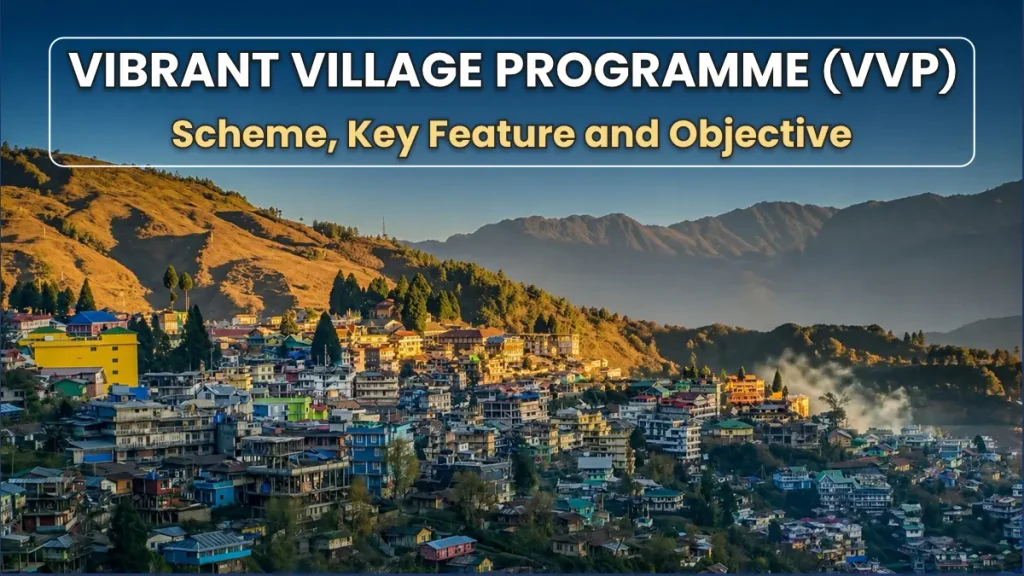
Vibrant Villages Programme (VVP)

Vibrant Villages Programme (VVP) is a flagship initiative of the Ministry of Home Affairs (MHA) aimed at the comprehensive development of strategically located villages along India’s international land borders. It seeks to transform border villages from remote outposts into “first villages of India,” improve quality of life, create livelihood opportunities, reverse out-migration, and strengthen national security by treating border residents as the “eyes and ears” of the border-guarding forces.

The programme aligns with the vision of Viksit Bharat@2047 for “Safe, Secured & Vibrant land borders.” It builds upon the earlier Border Area Development Programme (BADP) by focusing intensively on selected strategic villages through a combination of direct interventions and convergence of existing schemes.

Objectives

  • Create better living conditions and adequate livelihood opportunities in border villages.
  • Reduce/out-migration and encourage reverse migration.
  • Strengthen border security and control trans-border crime.
  • Assimilate the border population with the national mainstream.
  • Promote tourism, culture, skill development, entrepreneurship, and local economic activities (agriculture, horticulture, medicinal plants, cooperatives, SHGs, FPOs).
  • Ensure saturation of key infrastructure through convergence.

Two Phases

Vibrant Villages Programme – Phase-wise Comparison

VVP-I
Approval: 15 February 2023
Launch: 10 April 2023 from Kibithoo, Anjaw district, Arunachal Pradesh
Type: Centrally Sponsored Scheme
Outlay: ₹4,800 crore (2022-23 to 2025-26/2026-27), of which ₹2,500 crore is for all-weather road connectivity
Coverage: Northern border (mainly China-facing)
Villages: 662 priority villages
Blocks/Districts: 46 blocks in 19 districts
States/UTs: Arunachal Pradesh, Himachal Pradesh, Sikkim, Uttarakhand, and Ladakh
Village break-up: Arunachal Pradesh – 455, Himachal Pradesh – 75, Sikkim – 46, Uttarakhand – 51, Ladakh – 35
Population covered: About 1.42 lakh

VVP-II
Approval: 2 April 2025
Launch: 20 February 2026 from Nathanpur village, Cachar district, Assam
Type: Central Sector Scheme (100% Centre funding)
Outlay: ₹6,839 crore (till FY 2028-29)
Coverage: Other international land borders (excluding northern border blocks already covered under VVP-I)
Villages: 1,954 strategic villages
Blocks: 334 blocks
States/UTs: Arunachal Pradesh, Assam, Bihar, Gujarat, Jammu & Kashmir (UT), Ladakh (UT), Manipur, Meghalaya, Mizoram, Nagaland, Punjab, Rajasthan, Sikkim, Tripura, Uttarakhand, Uttar Pradesh, and West Bengal

Combined (VVP-I + VVP-II)
Total villages: More than 2,616
Total outlay: ₹11,639 crore

VVP-I State-wise priority villages: Arunachal Pradesh (455), Himachal Pradesh (75), Sikkim (46), Uttarakhand (51), Ladakh (35). Population covered: ~1.42 lakh.

VVP-II excludes northern border blocks already covered under VVP-I to avoid duplication.

Key Focus Areas of Intervention

  1. Livelihood generation (agriculture, horticulture, medicinal plants/herbs, one-block-one-product, tourism).
  2. All-weather road connectivity (largely through PMGSY-IV convergence).
  3. Energization (grid + off-grid solar, micro-hydel).
  4. Village infrastructure (housing, health facilities, multi-purpose centres).
  5. Financial inclusion.
  6. Youth empowerment and skill development.
  7. Cooperatives, SHGs, and FPOs.
  8. Promotion of tourism, culture, and outreach activities.
  9. Education infrastructure (including SMART classes).
  10. Television and telecom connectivity.

The programme also aims for saturation of all villages in identified border blocks in four thematic areas: all-weather road connectivity, telecom connectivity, television connectivity, and electrification.

Interventions are guided by Village Action Plans prepared collaboratively, with border-specific, state-specific, and village-specific components. A High-Powered Committee chaired by the Cabinet Secretary can recommend relaxations in scheme guidelines for unique border challenges.

Implementation Progress (VVP-I, as of mid-2026)

  • MHA has sanctioned ~1,248 projects (outlay ~₹3,020 crore).
  • Additional ~1,655 projects sanctioned through convergence by other Central Ministries/Departments.
  • Funds released to States/UT: ~₹953–960 crore.
  • Projects completed: ~283–316.
  • Roads: 111 projects (₹2,481.93 crore) to connect 134 previously unconnected villages.
  • Connectivity: 528 villages with 4G; 625 with piped drinking water; 621 with electricity (on-grid/off-grid).
  • Renewable energy: 140 off-grid solar projects + 7 micro-hydel projects.
  • Tourism: 327 projects (~₹145 crore).
  • Outreach: Over 8,500–8,800 activities (awareness camps, health/veterinary camps, fairs, skill training, etc.).

Recent reports (November 2026) indicate positive outcomes, including reverse migration in 40 border villages in Arunachal Pradesh, as stated by Home Minister Amit Shah. Local procurement by border forces (e.g., ITBP) is also providing assured markets to villagers.

Relevance for West Bengal

West Bengal is covered under VVP-II. Several villages along the India-Bangladesh and India-Bhutan borders have been selected, including:

Approximate allocation is around ₹3 crore per village in many cases, focusing on roads, digital connectivity, health, education, and livelihoods.

Strategic Significance

  • India shares over 15,000 km of land border with seven countries.
  • Border communities historically served as the first line of defence (e.g., local reports during the 1999 Kargil intrusion).
  • By improving living standards and economic opportunities, VVP aims to maintain a settled, confident population that supports border management and internal security.

Official portal: vvp.mha.gov.in
Nodal Ministry: Ministry of Home Affairs (Department of Border Management)

The programme represents a shift from viewing border villages as the “last villages” to recognising them as the “first villages” of India, integrating development with security objectives.
Indian Railways- Amazing Facts

Contrary to popular belief, the first train in India was the Red Hill Railway, which ran from Red Hills to Chintadripet bridge in 1837. Sir Arthur Cotton was credited with building the train, which was mainly used for transporting granite. However, India’s first passenger train started its service on 16 April 1853, covering a stretch of 33 km from Mumbai to Thane. The train carried 400 passengers. Interestingly, this day was also declared a public holiday.

The first electric train in India ran on 3 February 1925, between Bombay Victoria Terminal and Kurla Harbour. Later, the electric line was extended to Nashik’s Igatpuri district and then to Pune.

​​​​​​​Bholu the guard elephant is the mascot of the Indian Railways. Bholu was designed by the National Institute of Design in 2002 in honour of the 150th anniversary of the Indian Railways. Bholu is seen holding a signal lamp with a green light in it, which symbolises movement, assurance to trains and passengers to go ahead without fear.

The Vivek Express (Train Number 22503/22504) is the longest train route in India, running between Dibrugarh and Kanyakumari

The first Rajdhani Express train in India was the Howrah-New Delhi Rajdhani Express, which began operations on March 1, 1969

In 1956, the first air-conditioned train plied between Howrah and New Delhi.

Hubli station in Karnataka now has the longest railway platform in India surpassing the earlier renewed platform at Gorakhpur Railway Station in Uttar Pradesh.

Indian Railways’ longest tunnel is Pir Panjal that links Kashmir Valley with Banihal in Jammu.

Station with the shortest name is Odisha

Venkatanarasimharajuvaripeta is the station with the longest name.

Lalu Prasad Yadav, who remained Railways Minister from 2004 to May 2009, presented the railway budget 6 times in a row.

In 1986, computerized ticketing and reservations were introduced

In 1994, the first live telecast of the railway budget took place.

Four sites of Indian Railways have been declared as “World Heritage sites” by the UNESCO. They are Darjeeling-Himalayan Railway, Nilgiri Mountain, Mumbai CST, and Kalka-Shimla Railways.

The world’s highest rail bridge is owned by Indian Railways, and it is being constructed over Chenab River in Jammu and Kashmir. It is five times the length of the Qutub Minar.

In 1988, the first Shatabdi Express was introduced between New Delhi and Jhansi.

As of 2025, it manages the fourth largest national railway system in the world.

​​​​​​​Bori Bunder, located in Mumbai was the first railway station in India.

In the year 1999, Mamata Banerjee became the first female Railway Minister. In 2000, she became the first female to present the Railway budget and is the only woman to do so for two different governing coalitions (NDA and UPA).

Indian Railways is divided into 18 administrative zones (17 operational), headed by general managers which are further subdivided into 68 operating divisions, headed by divisional railway managers (DRM)

The first locomotive manufacturing unit was commissioned in 1950 at Chittaranjan with the first coach manufacturing unit set-up at Madras in 1955.

John Matthai presented the first Railway Budget for Independent India on 20 November,1947 which was Interim Railway Budget and only after 3 months he presented his second Railway Budget on 24 February,1948

In 1951, the Indian Railways was established by the amalgamation of 42 different railway companies operating in the country, spanning a total of 55,000 km (34,000 mi).

The first railway budget was presented in 1924.

The Railway Budget was presented every year, a few days before the Union budget, till 2016. Modi government on 21 September 2016 approved merger of the Rail and General budgets from the next year, ending a 92-year-old practice of a separate budget for the nation’s largest transporter.

​​​​​​​Mathura junction is the largest railway junction in India, with as many as 7 routes emerging from this station. Mathura junction also has 10 platforms, with connectivity to all major cities of India.

India’s Bid for UNSC Permanent Membership- Challenges Ahead

The UNSC is – theoretically – the most powerful political UN body, with a mandate to maintain international peace and security. It has 15 members: five permanent and 10 elected. The five permanent members are China, France, Russia, the United Kingdom and the United States. The non-permanent members are elected for a term of two years. The Security Council can establish peacekeeping operations, impose sanctions or arms embargoes, instruct human rights investigations, authorize the use of force, create international criminal tribunals and refer cases to the International Criminal Court.

The US made a proposal to India in August 1950 through the Indian Ambassador in the U.S. It expressed the American desire to remove China from permanent membership of the UNSC and possibly replace it with India. Nehru allegedly refused to take this suggestion seriously and thus abdicated India’s opportunity to become a permanent member of the UNSC. However, the complexity of the international situation might justify Nehru’s stance then.

The above events took place in August 1950 when the Cold War was in its early stages. The two superpowers were in eyeball-to-eyeball confrontation that threatened nuclear catastrophe. The People’s Republic of China had just emerged from a bloody civil war and was seen at the time as the Soviets’ closest ally. It was prevented from taking its permanent seat in the UNSC because of American opposition based on Cold War logic. Furthermore, war was intense in the Korean peninsula. The U.S. and allied troops were locked in fierce combat with North Korean forces supported by China and the Soviet Union.

Nehru, at that time, was trying to carve a policy that ensured India’s security, strategic autonomy and state-led industrialisation. He anticipated that pushing China out, as the U.S. wished to do, would result in a perpetual conflict that could engulf all of Asia. To him, the Korean War appeared a forerunner to more such conflicts in Asia that could even turn nuclear. The U.S. had dropped nuclear bombs on Japan only 5 years ago and it would possibly not hesitate to do so again in an Asian conflict. This is especially since nuclear deterrence had not become a recognised reality then. So given these, Nehru did not want India to get embroiled in hazardous Cold War conflicts as it would risk India’s own security. He understood that peace could not be assured in Asia without accommodating a potential great power like China.

To be precise, America’s proposal was not an offer but merely a vague sensor to explore Indian reactions to such a contingency. The U.S. intended the offer to be a bait to attract India into an alliance with the West against the Sino-Soviet bloc. The US aimed at pulling India into the “defence” organisations that it was setting up in Asia to contain the presumed “Communist expansionism”. Nehru was well aware of this and the fact that Washington was only interested in using India for its own ends. Had India accepted the American bait, it would have meant enduring enmity with China without the achievement of a permanent seat in the UNSC. Moreover, even if accepted, the Soviet Union, then China’s closest ally, would have vetoed such move. As, it would have required amendment of the UN Charter that is subject to the veto of the permanent members. It would have also strained the relations between India and the Soviet Union, affecting the possibility of a close political and military relationship with Moscow later. The ties, in fact, became necessary once the U.S. entered into an alliance relationship with Pakistan. Moreover, the Indo-Soviet relationship paid immense dividends to India during the Bangladesh war of 1971.

Over the years since then there has been much talk of late about the possibility of India joining the UN Security Council (UNSC) as a permanent member, while most of the current permanent members have expressed public support for expansion of the UNSC.

India has been falling far short of its domestic and international human rights obligations, and its desire to expand its role in the UN presents an opportunity to assess its record of engagement as a member of other UN political bodies, including the UN Human Rights Council (UNHRC).

It’s important to review India’s pattern of engagement with the human rights architecture as a whole, including with the Office of the High Commissioner for Human Rights (OHCHR) and UN human rights treaty bodies.

Indian politicians have argued for decades that the nation deserves to be a member of the United Nations Security Council (UNSC). An aspirational superpower, India believes that it has been unfairly denied a seat at the high table.

Several visiting foreign political dignitaries and international coalitions that have pushed for UNSC reforms have also voiced support for India’s candidacy for permanent membership of the Security Council. However, despite persistent lobbying by India, experts are not hopeful of change in the near future.

There are four key challenges India must overcome before it secures veto power in the United Nations.

  1. China’s Opposition

Among the five permanent security council members all except China – the United States, the United Kingdom, France, and Russia – have categorically supported India’s candidature in the past. As a close competitor of India in regional and international politics, China is unwilling to endorse New Delhi’s position.

China is the only Asian country with a permanent Security Council seat. This adds to its power and international prestige, and China is unlikely to want to share this space with India. What’s more, particularly amid an ongoing border dispute with India, China will resist any attempt by any of the four members to change the composition of the UNSC.

China is also uncomfortable with Japan, a close U.S. ally that, like India, is a strong contender for a permanent seat. Comprising Brazil, Germany, India, and Japan, the G-4 countries support each other’s bids for permanent seats on the Security Council.

China has unofficially dropped hints that it may back India, provided New Delhi doesn’t endorse Japan’s bid. China knows that New Delhi will not break the unity of the G-4 and thus, considers it is a safe bet to pit India against Japan.

  • Disagreement on Membership Without Veto Power

Some parties have raised the prospect of India gaining UNSC membership without veto power.

Groups including Uniting for Consensus (UfC) – a powerful coalition led by Italy, with other members including Canada, Mexico, Spain, Pakistan, South Korea, and Turkey – have advocated reinforcing the working of the General Assembly and increasing the number of non-permanent members.

Its argument is that the addition of non-permanent members will make the U.N. more accountable and representative by accommodating relevant regional voices in the decision-making process. In doing so, the group argues, this solution would mean there are more than a few select chief custodians of the international system.

But there are questions about what happens if India gets a high seat without veto power. Could this be considered a piecemeal approach toward achieving the larger objective?

Despite some parties saying they prefer this kind of arrangement, New Delhi is not comfortable with this proposition. India’s position is that all new permanent members to the Security Council must possess a veto. Thus, it is unlikely this outcome will unfold.

  • Western Concerns that India May Not Align with U.S. Priorities

The United States has, in principle, endorsed India gaining a permanent seat on the Security Council. But not everyone believes U.S. policymakers will actually support such a reform in practice.

Indeed, in the past, P-5 countries have displayed “a habit of being non-commital” when it comes to actual decision-making on veto powers. As former U.S. Under Secretary of State for Political Affairs Nicholas Burns said in 2008: “We want to preserve the veto, and we do not want to extend a veto to new permanent members.”

Prominent U.S.-based South Asian expert Ashley Tellis recently penned a piece in Foreign Affairs magazine arguing that the United States cannot be sure of India’s support on significant strategic matters. Ashley later defended this position in an interview, saying “the current war in Ukraine is a good example … India defines its interest in ways that are not always identical to our own.”

It is true that India has not always voted with the West in the United Nations and has maintained an independent position on several critical subjects (e.g., India abstaining on the Russian invasion of Ukraine). Due to this, many think India is a fence-sitter and see it as an unreliable partner. Despite developing closer strategic ties with the West, India remained uncommitted on supporting sanctions on Russia. While China’s response was anticipated, for the West, foot dragging by New Delhi in criticizing Russia was no less than a shock.

In these changed circumstances, it is difficult to imagine that the West, particularly the U.S., will go ahead with a reformed Security Council where India has veto power.

  • The Regional Conundrum

India also faces formidable challenges to its leadership emanating from its own region. India influences the region, but not in absolute terms. Indeed, as instability in the region has increased, so too have New Delhi’s troubles.

South Asia has, for example, become a battleground of India-China competition. And while the India-Pakistan rivalry captures most attention, there are major India-related issues that agitate people in Nepal, Bangladesh, Sri Lanka, the Maldives, and even in Bhutan.

With its recent change of government, Bangladesh is no longer on the same page. Queries over India’s regional leadership raises questions over its claims to be a global power.

What is Next for India?

There are convincing arguments that the U.N. is in desperate need of reform, particularly the Security Council. Expanding the Security Council’s membership to include developing countries like India would benefit the U.N. and the international community. However, New Delhi must make more concerted efforts to address criticisms to further legitimize its demand for permanent membership.

India’s geographical, political, and social influence in South Asia cannot be ignored. Recent criticism around its increasing political intolerance – which is directly linked to the state of democracy in India – must be addressed and resolved.

India’s failure to improve its ranking in the Human Development Index, the issue of economic inequality, and its lack of world-class infrastructure all contribute to the nation’s global image.

Therefore, there are structural and more prominent geopolitical factors that overshadow India’s chances to acquire Security Council permanent membership.

India needs better engagement with the region and much more internal work to strengthen its claim further.

For getting our guidance for PSC Miscellaneous Mains, pls call or whatsapp now- 6295350330

Some notes for any descriptive paper on GS/GK/CA

https://saptarshinag.in/from-non-alignment-to-multi-alignment-indias-tactical-shift-since-independence/ https://saptarshinag.in/the-g-7-summit-and-the-world-chaos/

For WBCS 2022 Group C Interview Guidance course and mock Interviews pls call or WhatsApp us @6295350330