
UNESCO World Heritage Sites in India

India has 45 UNESCO World Heritage Sites: 37 cultural, 7 natural, and 1 mixed. The newest is the Ancient Buddhist Site of Sarnath (inscribed 2026).

State / UT-wise List

Assam (3)

  • Kaziranga National Park (Natural, 1985)
  • Manas Wildlife Sanctuary (Natural, 1985)
  • Moidams – the Mound-Burial System of the Ahom Dynasty (Cultural, 2024)

Bihar (2)

  • Mahabodhi Temple Complex at Bodh Gaya (Cultural, 2002)
  • Archaeological Site of Nalanda Mahavihara (Cultural, 2016)

Chandigarh (1)

  • The Architectural Work of Le Corbusier – Capitol Complex (Cultural, 2016; transnational)

Delhi (3)

  • Humayun’s Tomb (Cultural, 1993)
  • Qutb Minar and its Monuments (Cultural, 1993)
  • Red Fort Complex (Cultural, 2007)

Goa (1)

  • Churches and Convents of Goa (Cultural, 1986)

Gujarat (4)

  • Champaner-Pavagadh Archaeological Park (Cultural, 2004)
  • Rani-ki-Vav (the Queen’s Stepwell) at Patan (Cultural, 2014)
  • Historic City of Ahmadabad (Cultural, 2017)
  • Dholavira: a Harappan City (Cultural, 2021)

Himachal Pradesh (1 + share)

  • Great Himalayan National Park Conservation Area (Natural, 2014)
  • Share of Mountain Railways of India (Kalka-Shimla Railway)

Karnataka (3 + shares)

  • Group of Monuments at Hampi (Cultural, 1986)
  • Group of Monuments at Pattadakal (Cultural, 1987)
  • Sacred Ensembles of the Hoysalas (Cultural, 2023)
  • Share of Western Ghats (Natural)

Madhya Pradesh (3)

  • Khajuraho Group of Monuments (Cultural, 1986)
  • Buddhist Monuments at Sanchi (Cultural, 1989)
  • Rock Shelters of Bhimbetka (Cultural, 2003)

Maharashtra (highest number)

  • Ajanta Caves (Cultural, 1983)
  • Ellora Caves (Cultural, 1983)
  • Elephanta Caves (Cultural, 1987)
  • Chhatrapati Shivaji Terminus (formerly Victoria Terminus) (Cultural, 2004)
  • Victorian Gothic and Art Deco Ensembles of Mumbai (Cultural, 2018)
  • Majority of Maratha Military Landscapes of India (Cultural, 2025)
  • Share of Western Ghats (Natural)

Odisha (1)

  • Sun Temple, Konark (Cultural, 1984)

Rajasthan (4)

  • Keoladeo National Park (Natural, 1985)
  • The Jantar Mantar, Jaipur (Cultural, 2010)
  • Hill Forts of Rajasthan (Cultural, 2013)
  • Jaipur City, Rajasthan (Cultural, 2019)

Sikkim (1)

  • Khangchendzonga National Park (Mixed, 2016)

Tamil Nadu (2 + shares)

  • Group of Monuments at Mahabalipuram (Cultural, 1984)
  • Great Living Chola Temples (Cultural, 1987, extended 2004)
  • Share of Mountain Railways of India (Nilgiri Mountain Railway)
  • Share of Western Ghats
  • Share of Maratha Military Landscapes

Telangana (1)

  • Kakatiya Rudreshwara (Ramappa) Temple (Cultural, 2021)

Uttar Pradesh (4)

  • Agra Fort (Cultural, 1983)
  • Taj Mahal (Cultural, 1983)
  • Fatehpur Sikri (Cultural, 1986)
  • Ancient Buddhist Site of Sarnath (Cultural, 2026)

Uttarakhand (1)

  • Nanda Devi and Valley of Flowers National Parks (Natural, 1988, extended 2005)

West Bengal (2 + share)

  • Sundarbans National Park (Natural, 1987)
  • Santiniketan (Cultural, 2023)
  • Share of Mountain Railways of India (Darjeeling Himalayan Railway, 1999)

West Bengal’s UNESCO Sites

1. Sundarbans National Park (Natural, 1987)
The Sundarbans is the largest mangrove forest in the world, located on the delta of the Ganga, Brahmaputra and Meghna rivers. The Indian portion (Sundarbans National Park in South 24 Parganas) was inscribed for its outstanding ecological processes, biodiversity, and as the habitat of the Royal Bengal Tiger. It is also a Tiger Reserve and a Biosphere Reserve. The landscape of tidal waterways, mudflats and mangrove islands is unique.

2. Darjeeling Himalayan Railway (Cultural, 1999)
This is part of the serial property “Mountain Railways of India”. Built between 1879 and 1881, the 88 km narrow-gauge (2 ft) railway climbs from New Jalpaiguri to Darjeeling using zigzags and loops. It is recognised as an outstanding example of bold engineering in difficult Himalayan terrain and remains one of the few operational steam mountain railways in the world.

3. Santiniketan (Cultural, 2023)
Founded by Rabindranath Tagore in 1901, Santiniketan was inscribed for its outstanding universal value as a living centre of education and culture. It embodies Tagore’s vision of learning in close contact with nature, blending Indian traditions with progressive ideas. The site includes historic buildings (such as Upasana Griha), landscapes, artworks associated with the Bengal School, and continuing educational practices of Visva-Bharati University.

Tentative List sites in West Bengal

  • Temples at Bishnupur (Bankura) — terracotta temples of the Malla period
  • Neora Valley National Park

UNESCO Intangible Cultural Heritage Linked to West Bengal

These are living traditions (not physical sites):

1. Chhau dance (inscribed 2010)
The Purulia style of Chhau (West Bengal) is one of the three recognised styles (along with Seraikela and Mayurbhanj). It is a masked martial dance-drama based on epic and folk themes, known for vigorous movements and large, colourful masks. Charida village in Purulia is the main centre of mask-making.

2. Durga Puja in Kolkata (inscribed 2021)
Kolkata’s Durga Puja was recognised for its unique combination of religious worship, community participation, artistic pandals, and clay idol-making. The festival transforms the city into a large-scale public art event and is noted for its inclusive character.

3. Baul songs
The mystic songs of the Bauls of Bengal have been recognised as Intangible Cultural Heritage (shared with Bangladesh). Bauls are wandering minstrels whose philosophy blends Vaishnavism, Sufism and Tantra. The ektara is their signature instrument.

Serial / Multi-state Sites

  • Mountain Railways of India — West Bengal (Darjeeling), Tamil Nadu (Nilgiri), Himachal Pradesh (Kalka-Shimla)
  • Western Ghats — Kerala, Karnataka, Tamil Nadu, Maharashtra
  • Maratha Military Landscapes of India — mainly Maharashtra + one fort in Tamil Nadu
  • Architectural Work of Le Corbusier — Chandigarh (transnational)

Quick Exam Notes

  • Total: 45 (37 cultural, 7 natural, 1 mixed)
  • First sites (1983): Taj Mahal, Agra Fort, Ajanta Caves, Ellora Caves
  • Newest (2026): Ancient Buddhist Site of Sarnath
  • State with most sites: Maharashtra
  • Only mixed site: Khangchendzonga National Park (Sikkim)
  • West Bengal World Heritage Sites: Sundarbans (1987), Darjeeling Himalayan Railway (1999), Santiniketan (2023)
  • West Bengal Intangible Heritage: Chhau (2010), Durga Puja in Kolkata (2021), Baul songs
HPV Vaccine and National HPV Vaccination Campaign

What is HPV?

  • Human Papillomavirus (HPV) is a group of viruses, some of which cause cervical cancer.
  • Types 16 and 18 are responsible for the majority of cervical cancer cases worldwide and in India.
  • Cervical cancer is one of the leading causes of cancer-related deaths among women in India.

HPV Vaccine

  • It is a preventive vaccine that protects against high-risk HPV types that cause cervical cancer.
  • Works best when given before exposure to the virus (ideally to adolescent girls before sexual debut).
  • Available vaccines in India: Gardasil (quadrivalent), Gardasil-9 (nonavalent), Cervarix (bivalent), and India’s indigenous Cervavac (quadrivalent, developed by Serum Institute of India).

National HPV Vaccination Campaign 2026

  • Launched by Prime Minister Narendra Modi on 28 February 2026.
  • First nationwide public HPV vaccination drive in India.
  • Aim: Prevent cervical cancer by vaccinating adolescent girls.

Key Features

  • Target group: Girls aged 14 years (those who have completed 14 years but not yet 15 years).
  • Single-dose schedule (based on emerging global evidence supporting single-dose efficacy).
  • Provided free of cost at government health facilities.
  • Facilities include: Ayushman Arogya Mandirs, Primary Health Centres (PHCs), Community Health Centres (CHCs), Sub-District Hospitals, District Hospitals, and Government Medical Colleges.
  • Participation is voluntary and requires parental consent.
  • Coverage is tracked digitally through the U-WIN portal.

Progress (as of November 2026)

  • More than 1 crore doses administered within about 9 months of launch.
  • Approximately 87% of the annual target cohort (~1.2 crore girls) covered.
  • Several states including Gujarat, Uttar Pradesh, Andhra Pradesh, Bihar, Madhya Pradesh, and Mizoram achieved very high or near-100% coverage of their target populations.

Significance

  • Major step towards reducing India’s cervical cancer burden.
  • Aligns with WHO’s global strategy to eliminate cervical cancer as a public health problem.
  • Complements screening and early treatment efforts under the broader cancer control programme.
  • Strengthens adolescent health and women’s health initiatives under the Viksit Bharat vision.

Important Points

  • Single-dose approach reduces logistical challenges and improves completion rates.
  • Indigenous vaccine (Cervavac) promotes self-reliance in vaccine production.
  • Parental consent and voluntary nature are important from an ethical and governance perspective.

VB-G RAM G (VBGRAMG)

Full Form
Viksit Bharat – Guarantee for Rozgar and Ajeevika Mission (Gramin)

Overview

  • Enacted under the VB-G RAM G Act, 2025.
  • Came into force on 1 July 2026, replacing the Mahatma Gandhi National Rural Employment Guarantee Act (MGNREGA), 2005.
  • Nodal Ministry: Ministry of Rural Development.
  • Aligned with the broader Viksit Bharat @2047 vision.
  • Aims to provide enhanced livelihood security through wage employment while creating durable, productive rural assets.

Key Features

  • Employment Guarantee: Statutory guarantee of 125 days of unskilled manual wage employment per rural household per financial year (increased from 100 days under MGNREGA).
  • Eligibility: Every rural household whose adult members volunteer to do unskilled manual work.
  • Unemployment allowance payable by the State if work is not provided within 15 days of demand.
  • Agricultural season pause: States can notify up to 60 days of pause during peak sowing and harvesting to avoid labour shortage for farming.
  • Minimum wage floor introduced (around ₹300 per day nationally, with state-wise variations higher in many states).
  • Wages paid through Direct Benefit Transfer (DBT).

Funding Pattern

  • General Category States: 60:40 (Centre:State).
  • North-Eastern and Himalayan States: 90:10.
  • Union Territories without legislature: 100% Central funding.
  • Shift from MGNREGA’s demand-driven open-ended funding to normative state-wise allocations fixed by the Centre. Expenditure beyond the allocation is borne by the State.

Focus Areas of Works
Works prioritised under four themes:

  • Water security (groundwater recharge, pond rejuvenation, etc.).
  • Core rural infrastructure (roads, connectivity).
  • Livelihood-related infrastructure (storage, local markets).
  • Mitigation of extreme weather events and climate-resilient works.

Planning done through Viksit Gram Panchayat Plans using geospatial tools (Yuktdhara, PM Gati Shakti, Bhuvan, etc.).

Other Provisions

  • Stronger digital monitoring, biometric authentication, real-time dashboards and social audits.
  • Grievance redressal through Ombudspersons and Appellate Authorities.
  • Emphasis on convergence with other schemes, transparency and productive asset creation.

Difference from MGNREGA (Summary)

  • Days: 100 → 125.
  • Funding: Centre bore 100% wages → shared (mostly 60:40).
  • Nature: Demand-driven → Normative allocations.
  • Additional: Agricultural pause, stronger tech and asset focus, higher minimum wage floor.

Recent Context
Implemented from July 2026 with digital systems in place from day one. Early data shows significant person-days generated, high women’s participation (around 61%), and focus on asset creation, though some states have reported lower initial work generation due to monsoon and transition factors. Budget allocation for 2026-27 is substantial (Centre’s share around ₹95,000+ crore).

This scheme represents a recalibrated rural employment framework combining livelihood guarantee with planned rural development under the Viksit Bharat vision.

Punitive Measures under the VB-G RAM G Act, 2025

Under the Viksit Bharat – Guarantee for Rozgar and Ajeevika Mission (Gramin) Act, 2025 (VB-G RAM G Act), the main punitive provision is contained in Section 27: Penalties for contravention.

  • Section 27 states: “Whoever contravenes any provision of this Act, shall be liable to pay the penalty which may extend to ten thousand rupees.”

This is a monetary penalty (fine) applicable to any person or authority who violates any provision of the Act. It is a civil penalty rather than a criminal punishment involving imprisonment.

Related Accountability and Compensatory Measures

While not strictly “punitive fines” in the criminal sense, the Act and related rules also include the following enforcement mechanisms:

  • Delay Compensation for Wages: Wages must be paid weekly or within 15 days of completion of work. In case of delay beyond this period, compensation is payable on the unpaid wages at the rate of 0.05% per day.
  • Unemployment Allowance: If work is not provided within 15 days of demand, the State is required to pay unemployment allowance (one-fourth of the notified wage for the first 30 days and half thereafter).
  • Grievance Redressal: A structured multi-tier mechanism (Gram Panchayat, Block, and District levels) with District Ombudspersons. Complaints must be enquired into within 7 working days and resolved within 15 days. Orders of Ombudspersons can include recovery of penalties/delay compensation.
  • Social Audit and Transparency: Strengthened social audits by Gram Sabhas, digital monitoring, and public disclosure to deter irregularities.

In short, the primary punitive measure in the Act itself is a penalty of up to ₹10,000 for any contravention, supported by compensatory provisions for workers and a formal grievance redressal system.

Viksit Bharat 2047

Overview

  • Long-term vision to make India a developed, high-income, self-reliant, inclusive and globally influential nation by 2047 (100 years of Independence).
  • Announced by PM Narendra Modi in the 2022 Independence Day address.
  • Period 2022–2047 is called Amrit Kaal.
  • Coordinated by NITI Aayog; it is an overarching national mission, not a single scheme.

Key Economic Targets

  • GDP: From ~$4 trillion (2025) to $30–40 trillion by 2047.
  • Per capita income: From ~$2,700–2,760 to $18,000–21,000.
  • Required growth: Sustained 7.5–9%+ annually.
  • Manufacturing share: From ~15% of GVA to ~25% of output.
  • Core goals: Economic growth, inclusion and sustainability with climate resilience.

Four Core Pillars (GYAN / Amrit Pillars)

  • Yuva (Youth): Skill development (Skill India, PMKVY), NEP 2020, Startup India, MY Bharat, employment generation and digital literacy.
  • Garib (Poor): Zero extreme poverty, universal basic amenities (housing, electricity, water, sanitation), Jan Dhan, DBT and Ayushman Bharat.
  • Mahilayen / Nari (Women): Women-led development, higher female labour force participation, Mudra, Stand-Up India, SHGs, education, health and safety.
  • Annadata (Farmers): Higher incomes, agri-tech (drones, AI, precision farming), e-NAM, PM Fasal Bima Yojana, irrigation, food processing and exports.

Saptadhara (Seven Streams of Strength)

  • Manufacturing Excellence (Make in India / Make for the World + PLI schemes).
  • Technology & Innovation (AI, semiconductors, Digital Public Infrastructure, R&D).
  • Gati Shakti (multi-modal infrastructure; logistics cost target 8–10%).
  • Soft Power (yoga, Ayurveda, culture, tourism, creative economy).
  • Agriculture & Food Processing (value addition, millets, exports).
  • Green & Blue Economy (renewables, green hydrogen, ocean economy; net-zero by 2070).
  • Defence Shakti (indigenisation, strategic autonomy, defence exports).

Major Supporting Initiatives

  • PM Gati Shakti National Master Plan.
  • PLI schemes and Aatmanirbhar Bharat.
  • Digital India and Digital Public Infrastructure (Aadhaar, UPI, BharatNet).
  • Startup India and deep-tech innovation programmes.
  • PM Viksit Bharat Rozgar Yojana.
  • National Green Hydrogen Mission and non-fossil capacity push (500 GW target).
  • Viksit Bharat Sankalp Yatra (2023–24) for scheme saturation and public participation.
  • Voice of Youth platform for citizen inputs.

Challenges

  • Sustaining high growth for two decades amid global shocks.
  • Job quality, inequality and large informal sector.
  • Human capital gaps in education, health and skilling.
  • Risk of middle-income trap.
  • Digital divide and climate vulnerabilities.
  • Need to raise R&D spending toward ~2% of GDP.
  • Governance, federal coordination and implementation speed.

Agnipath Scheme: Overview and Recent Changes

Original Scheme (launched 14 June 2022)

Agnipath recruits young personnel (“Agniveers”) into the Indian Army, Navy and Air Force below officer rank for a fixed 4-year tenure (including ~6 months training).

Key features:

  • Age: generally 17.5–21 years (one-time relaxation to 23 for 2022 cycle).
  • Monthly package (70% in-hand, 30% to corpus fund matched by government):
    • Year 1: ₹30,000
    • Year 2: ₹33,000
    • Year 3: ₹36,500
    • Year 4: ₹40,000
  • Seva Nidhi (tax-free exit package after 4 years): ~₹11.71 lakh (own contribution + equal government match + interest). No pension or gratuity for the Agniveer period.
  • Retention: only 25% selected on merit for regular (permanent) service (further ~15 years with full benefits). Remaining 75% exit.
  • Other: non-contributory life insurance (~₹48 lakh), risk/hardship allowances, skill certificates. Death-on-duty compensation up to ₹1 crore; disability up to ₹44 lakh.
  • Objectives: younger force (lower average age), contain long-term pension burden, induct tech-adaptable youth, and release disciplined civilians.

Approximately 3 lakh Agniveers are currently serving. The first batch (~18,300 due to complete 4 years by end-2026) was approaching exit when the changes were announced.

Recent Changes (Union Cabinet, 4 November 2026)

Announced by CDS General N.S. Raja Subramani after force assessments. Primarily applies to the ~3 lakh currently serving Agniveers (future batches under review).

Revised framework:

  • After 4 years: top 25% still selected on merit for immediate regular enrolment (unchanged).
  • Remaining 75%: offered optional additional 2-year engagement (“Second Tour of Duty”).
  • After total 6 years: those who complete the extension and are willing can be considered for regular enrolment (subject to selection criteria such as physical fitness, firing, medical, discipline and technical proficiency). This creates a pathway for nearly all willing and eligible Agniveers (no fixed percentage ceiling at the second stage).
  • Higher pay during extension: ~₹43,500 (5th year) and ~₹47,500 (6th year), plus allowances.
  • Enhanced Seva Nidhi for those exiting after 6 years (higher government contribution).
  • Seniority protected: those absorbed after 6 years rank immediately after their batchmates absorbed after 4 years.
  • Scheme not scrapped; Agnipath continues with this mid-course correction.
  • Those taking the extension generally lose earlier special reservations in CAPFs/state police. Marriage during the extended period and other service conditions are under discussion.

Critical Analysis

Strengths of the original scheme and the revision

The scheme addressed real structural pressures. Defence pensions form a large share of the budget (around 22% in recent years, with the absolute bill rising under OROP and normal growth), crowding out capital expenditure on modernisation. A younger entry profile and short initial tenure were intended to lower average age and create a pool of skilled, disciplined youth for civilian life. Competitive 25% retention can incentivise performance.

The November 2026 changes respond to operational feedback. Four years is widely regarded as too short to develop a seasoned soldier (veterans note 8–9 years is more realistic for reliable tank crews, artillery teams or small detachments). Retaining trained personnel avoids wasting training investment and helps address manpower shortfalls (annual regular retirements are roughly 50–60,000 while Agniveer intake has been lower, and the Army has faced gaps relative to authorised strength). Higher pay and a clearer pathway improve morale and alignment with recruits’ aspirations. The government and CDS frame it as a planned review rather than a rollback.

Limitations and criticisms

The original design faced strong pushback in 2022 over job security, lack of pension and the short tenure. Critics (including retired officers such as Maj Gen Yash Mor and Adm Arun Prakash) argued it risked combat effectiveness, unit cohesion and the traditional ethos of long-term service. An internal assessment reportedly noted reduced camaraderie due to competition for the 25% slots. Manpower arithmetic was problematic: at 25% retention, replacing annual retirements would require far higher intake than achieved. Nepal’s reservations also affected traditional Gorkha recruitment.

The revision is a partial, reactive fix rather than a comprehensive redesign. It was announced weeks before the first batch’s exit and ahead of assembly elections in recruitment-heavy states (Uttar Pradesh, Punjab, Uttarakhand), leading opponents to call it a political “U-turn” or damage control. It dilutes the original fiscal logic: higher eventual regular numbers will increase future salary and pension liabilities, even if the Agniveer phase itself remains non-pensionable. Uncertainty is deferred rather than removed—selection after six years remains criteria-based and not automatic. Seniority differentials and the two-tier process can breed resentment or unhealthy competition. Remaining gaps include marriage restrictions (barred in the first four years), shorter leave than regulars, clarity on full pensionable service for those absorbed after six years, and risk cover parity.

Veterans’ reactions are mixed: many welcome retention of trained soldiers; others view it as an incomplete correction or argue the scheme should be scrapped in favour of traditional recruitment (with selective short-service options). Broader manpower restructuring (force size, role of CAPFs for border duties, technology substitution) remains unfinished. Policy instability itself can affect long-term recruitment quality and institutional trust.

Overall assessment

The changes are a pragmatic course correction that prioritises operational needs and human factors over pure fiscal maximalism. They make the scheme more viable in the near term by retaining experience and reducing abrupt exits. However, they do not fully resolve the tension between a leaner, cheaper force and a professional, cohesive, experienced one. Sustainable reform will likely require clearer long-term criteria for absorption, transparency on costs and benefits, adjustments to service conditions, and integration with wider defence manpower and modernisation planning rather than successive ad-hoc tweaks.

The 1950 India–Nepal Treaty of Peace and Friendship

The 1950 India–Nepal Treaty of Peace and Friendship (officially the Treaty of Peace and Friendship Between the Government of India and the Government of Nepal) is the foundational bilateral agreement that still largely governs relations between the two countries.

Key facts
Signed on 31 July 1950 in Kathmandu by Mohan Shamsher Jang Bahadur Rana (last Rana Prime Minister of Nepal) and Chandreshwar Prasad Narain Singh (Indian Ambassador to Nepal). It remains in force and can be terminated by either side with one year’s notice.

Main provisions
Article 1 establishes everlasting peace and friendship and mutual respect for complete sovereignty, territorial integrity and independence. Article 2 requires both sides to inform each other of any serious friction or misunderstanding with any neighbouring state. Article 5 allows Nepal to import arms, ammunition and warlike material from or through India under a mutually agreed procedure. Articles 6 and 7 provide reciprocal national treatment for each other’s citizens in industrial and economic development, residence, ownership of property, trade, commerce and movement. Article 8 cancels earlier British-era treaties on the matters covered. Articles 9 and 10 state that the treaty comes into force on signature and remains in force until terminated with one year’s notice.

These provisions underpin the open border, free movement of people and goods, and close economic and security cooperation that have defined the relationship for over 75 years.

Controversies and calls for review
Nepal has long sought revision of the treaty, particularly Articles 2, 6 and 7, arguing that some clauses are unequal or outdated. An Eminent Persons Group was set up in 2016 and completed its report in 2018, but the report was never formally adopted or made public.

Current status (November 2026)
During Nepal Prime Minister Balendra Shah’s state visit to India on 22–23 November 2026, the two sides adopted the Joint Vision Document “Viksit Bharat and Samunnat Nepal.” It states that existing bilateral agreements, including the 1950 Treaty, could be reviewed on the basis of mutual consent. Indian Foreign Secretary Vikram Misri clarified that the earlier Eminent Persons Group report is no longer considered relevant and that both sides prefer a forward-looking approach.

In short, the 1950 Treaty remains the legal foundation of India–Nepal relations, while the new Joint Vision opens a formal pathway for its possible review without committing either side to any specific outcome.

Indo-Nepal Joint Vision Document

The Joint Vision Document “Viksit Bharat and Samunnat Nepal: Re-imagining the Partnership” is a constructive, forward-looking framework. It creates political space and a practical roadmap for the relationship, but it is not, by itself, a full or automatic reset of bilateral ties. Its value will depend on implementation.

What the document actually does

It was adopted on 23 November 2026 during the first state visit of Nepal’s Prime Minister Balendra Shah to India. The text explicitly links India’s “Viksit Bharat 2047” vision with Nepal’s aspiration of a “Samunnat Nepal” (prosperous Nepal) and organises cooperation around ten pillars:

  1. Comprehensive economic and development partnership
  2. Physical and digital connectivity
  3. Energy, water resources and climate resilience
  4. Good governance
  5. Technology, space and innovation
  6. Education and skill development
  7. Sports
  8. Culture and tourism
  9. Health
  10. Agriculture

It also contains two politically significant statements: existing bilateral agreements, including the 1950 Treaty of Peace and Friendship, “could be reviewed on the basis of mutual consent,” and all outstanding matters (water resources, energy, trade & commerce, and the boundary) are to be resolved through dialogue. India announced a ₹15,000 crore (NPR 24,000 crore) development package — ₹3,500 crore in grants for reconstruction and infrastructure, and ₹11,500 crore as a rupee-denominated line of credit focused on energy.

Why it matters

  • It is the first major bilateral framework under Shah, a leader who had initially signalled limited foreign engagement. The visit and document therefore carry political symbolism on both sides.
  • By acknowledging the possibility of reviewing the 1950 Treaty — a long-standing Nepali demand — without committing to any particular outcome, it reduces a recurring source of friction while keeping the process consensual.
  • It moves the relationship beyond the traditional triad of security, hydropower and open border into areas that matter to younger populations (start-ups, AI, sports infrastructure, digital payments, education campuses, tourism circuits).
  • Concrete deliverables (Ayodhya–Janakpur rail service already launched, new ICPs, pipeline, UPI linkage, monitoring mechanism) give it more substance than purely rhetorical joint statements.

Limitations and risks

Many of the commitments are directional rather than binding (“explore,” “agree to collaborate,” “will be encouraged”). Implementation of earlier India–Nepal projects has often been slow. Boundary questions (Kalapani–Lipulekh, Susta and related areas) remain sensitive and are only referred to dialogue; they are not resolved by this document. Domestic politics in Nepal can still slow or reverse progress, and trust deficits do not disappear with a joint vision.

Overall assessment

The document is best read as a useful and timely reset of the agenda, not a complete reset of the relationship. It creates a shared political narrative, opens the door to modernising the legal framework, and attaches money and projects to the partnership. If the high-level monitoring group meets regularly, the ₹15,000 crore package is converted into visible projects, and both sides handle the treaty review and boundary issues with restraint, it can produce a measurable improvement in the tone and substance of ties. Without consistent delivery, it will remain another well-intentioned joint document.

COP31

COP31 (Antalya, Türkiye, 9–22 November 2026) was the 31st Conference of the Parties to the UN Framework Convention on Climate Change (UNFCCC). It ended without consensus on an overarching cover decision (the proposed “Antalya Pact”), the first such failure since Copenhagen in 2009, after becoming the longest COP in history due to two days of overtime.

Background and Organisation

COP31 was hosted by Türkiye at the Antalya Expo Center. It featured a shared presidency arrangement agreed at COP30 in Belém: Türkiye held the formal COP Presidency (Murat Kurum, Minister of Environment, Urbanisation and Climate Change), while Australia led the negotiations (Chris Bowen, Minister for Climate Change and Energy, as President of Negotiations). This resolved a bidding deadlock between the two countries within the Western Europe and Others regional group.

The conference brought together representatives from nearly 200 Parties, along with observers from business, civil society, science, and Indigenous communities. A World Leaders’ Summit took place on 11–12 November. Türkiye’s hosting marked the country’s first time organising a COP; it has ratified the Paris Agreement and set a 2053 net-zero target.

Main Negotiating Issues

Core disputes centred on:

  • Fossil fuels: Climate-vulnerable countries, the EU, UK, and others demanded explicit language on transitioning away from or phasing out fossil fuels, building on the COP28 Dubai agreement. Oil-producing countries (including Saudi Arabia and other OPEC members) blocked any such mention, favouring technology solutions such as carbon capture and storage (CCS) and arguing for national circumstances.
  • Climate finance: Developing countries pressed for clearer scaling of adaptation finance (including references to tripling it toward targets such as $120 billion by 2035) and delivery on existing commitments. Developed countries resisted binding new figures or burden-sharing formulas.
  • Related issues included the 1.5°C overshoot, loss and damage, just transition, trade measures, and the pace of emissions cuts.

Multiple draft texts circulated by the co-presidents were rejected. The final proposed Antalya Pact was described by objecting parties as the “lowest common denominator” for omitting fossil fuels and insufficient finance language.

Outcomes

Failure on the cover decision: On 22 November, Parties failed to adopt the Presidency-led Antalya Pact after formal objections from the EU, UK, Pacific island states (including the Marshall Islands), and others. UN Secretary-General António Guterres called the result “deeply disappointing,” stating: “There may be no consensus in the negotiating room. There is no ambiguity in the science.” He noted that global temperatures continue to break records, emissions remain high, and the world is on course to overshoot the 1.5°C limit.

Areas of progress (adopted decisions and Action Agenda advances):

  • Just transition: The UAE Just Transition Work Programme was continued for an additional three years. Parties agreed to operationalise a just transition mechanism in a phased manner (detailed decisions deferred to COP32), focusing on international cooperation, technical assistance, capacity building, and equitable transitions. References to critical minerals were included; explicit fossil-fuel transition language was not.
  • Electrification: A major presidency priority was the “35×35” goal of 35% global electrification of final energy use by 2035. Countries representing roughly half the global economy (around 80 nations) backed it or committed to faster progress. Supporting analysis from the IEA indicated this could raise the electrification rate substantially. Related delivery packages involved grids, investment, and green corridors.
  • Climate finance: The Climate Finance Work Programme advanced with renewed focus on scaling adaptation finance, transitioning the Adaptation Fund to serve the Paris Agreement exclusively, and improving access and efficiency.
  • Adaptation: Progress on operationalising Belém Adaptation Indicators (via a task force), reinforcing the Baku Adaptation Road Map, and work under the Warsaw International Mechanism and Santiago Network on loss and damage technical assistance.
  • Second Global Stocktake (GST2): Launched as a core Paris Agreement process (information collection, technical assessment, and consideration of outputs), to conclude at COP33 in 2028.
  • Other decisions covered technology, transparency (including Biennial Transparency Reports), carbon markets (Article 6), gender, and various procedural items. Turkish President Recep Tayyip Erdoğan stated that 46 decisions were adopted. The Global Climate Action Agenda recorded concrete real-economy results across electrification, forests (including Tropical Forest Forever Facility pledges), oceans, health, and resilience.

UNFCCC Executive Secretary Simon Stiell acknowledged disappointment over the cover decision but highlighted the dual tracks of formal negotiations and the Action Agenda, noting real-world progress on electrification and other implementation items.

Reactions and Analysis

The outcome exposed deep divisions between countries prioritising rapid fossil-fuel phase-out and climate finance for vulnerable nations, and those protecting fossil-fuel interests or seeking more flexible, technology-neutral language. Activists staged protests with signs reading “Shame” and “Step Up.” Some commentators labelled it the “worst COP ever”; others noted that existing COP28 language on transitioning away from fossil fuels remains intact and that voluntary coalitions (including fossil-fuel transition roadmaps) continued outside the formal text.

Guterres and Stiell both stressed that the lack of a pact does not alter the scientific reality or the urgency of action, and that multilateral cooperation has already shifted the world off the worst possible warming pathways—though far more is required.

Looking Ahead

COP32 will be hosted by Ethiopia in Addis Ababa from 8–19 November 2027. Ethiopia’s Foreign Minister Gedion Timothewos is President-Designate. Stated priorities include restoring hope, rebuilding trust in the process, and mobilising collective action, with an expected emphasis on African and Global South priorities such as adaptation, finance, and implementation. Unresolved issues from Antalya—especially fossil fuels, finance scale-up, and mitigation ambition—will carry forward.

COP31 demonstrated both the continuing difficulties of consensus under the UNFCCC when fossil fuels and finance are on the table, and the persistence of incremental progress on specific work programmes and real-economy initiatives.

Summary- Gist of COP31 (Antalya, Türkiye, 9–22 November 2026)

COP31 was the longest UN climate summit ever. It ended without agreement on the overarching “Antalya Pact” — the first time since Copenhagen 2009 that a COP failed to adopt a cover decision.

The breakdown was driven by fossil fuels: vulnerable countries, the EU, and others demanded clear language on transitioning away from them, while oil producers blocked any mention. Climate finance was another major sticking point.

Some progress was still made:

  • Just transition work programme extended and a new mechanism agreed in principle
  • Strong push for 35% global electrification by 2035 (backed by ~80 countries)
  • Advances on adaptation indicators, climate finance processes, and the launch of the second Global Stocktake

UN Secretary-General Guterres called the outcome “deeply disappointing” but stressed that the science remains clear.

Next: COP32 in Addis Ababa, Ethiopia (8–19 November 2027).

Ayushman Bharat

Ayushman Bharat (launched 23 September 2018) is India’s flagship initiative for Universal Health Coverage (UHC). It rests on two complementary pillars: Ayushman Arogya Mandirs (formerly Health and Wellness Centres) for comprehensive primary care, and the Pradhan Mantri Jan Arogya Yojana (PM-JAY) for secondary and tertiary hospitalisation cover. Together with the Ayushman Bharat Digital Mission (ABDM) and PM-Ayushman Bharat Health Infrastructure Mission (PM-ABHIM), it aims to create a continuum of care from prevention to specialised treatment.

1. Ayushman Arogya Mandirs (Primary Care)

These centres deliver Comprehensive Primary Health Care (CPHC) free of cost, moving beyond selective maternal-child services to a broader package of 12 services. These include pregnancy and childbirth care, neonatal and child health, family planning, management of communicable diseases, screening and management of non-communicable diseases (NCDs), mental health, oral health, eye and ENT care, elderly and palliative care, and basic emergency services. Free essential drugs and diagnostics are provided, along with teleconsultations.

As of 24 November 2026, approximately 1.87 lakh centres are functional (including Sub-Health Centres, Primary Health Centres, Urban centres, and AYUSH variants). Cumulative footfall has exceeded 540 crore visits, with over 50 crore teleconsultations facilitated through e-Sanjeevani. The goal was originally 1.5 lakh centres; the network has expanded beyond that target.

2. Pradhan Mantri Jan Arogya Yojana (PM-JAY)

PM-JAY provides a cashless, paperless health assurance cover of ₹5 lakh per family per year for secondary and tertiary hospitalisation. It covers roughly 1,961 procedures across 27 specialties (including general medicine, surgery, cardiology, oncology, orthopaedics, obstetrics & gynaecology, and neonatal care). Expenses covered include consultation, diagnostics, medicines, surgery, ICU, implants, accommodation, food, and treatment of complications. Pre-hospitalisation (up to 3 days) and post-hospitalisation (up to 15 days) expenses are also included. There is no cap on family size, age, or gender, and pre-existing conditions are covered from day one. Benefits are portable across India at empanelled public and private hospitals.

Eligibility and coverage:

  • Originally targeted ~10.74 crore poor and vulnerable families (identified primarily via SECC 2011 deprivation and occupational criteria plus earlier RSBY lists), covering the bottom ~40% of the population (roughly 50–55 crore people).
  • Expanded to all senior citizens aged 70 years and above irrespective of income (via the Ayushman Vay Vandana Card, launched October 2024).
  • Additional groups include ASHA/Anganwadi workers and helpers, certain transgender persons, waste pickers/sanitation workers, PVTGs under PM-JANMAN, and others.

The scheme is implemented by the National Health Authority (NHA) under the Ministry of Health and Family Welfare. It is a Centrally Sponsored Scheme with a typical Centre:State funding ratio of 60:40 (90:10 for North-Eastern and Himalayan states; 100% Central for UTs without legislature). It is now operational in all 36 States and Union Territories (West Bengal joined in 2026, completing nationwide coverage).

Key Achievements (as of late 2026)

  • Ayushman cards issued: Over 48.5 crore (covering about 33% of India’s population as of September 2026).
  • Hospital admissions: Approximately 13.25 crore admissions worth around ₹2.03 lakh crore (as of August 2026), through a network of over 38,000–40,000 empanelled public and private hospitals.
  • Senior citizens (70+): Over 1.36 crore Vay Vandana cards generated.
  • Out-of-pocket expenditure as a share of total health spending has declined substantially (from 62.6% in 2014-15 to 43.4% in 2022-23).
  • Significant gender inclusion, with roughly half of cardholders being women in various reports.
  • Strong digital integration via ABDM (tens of crores of ABHA IDs and linked health records).

PM-JAY is widely described as the world’s largest government-funded health assurance scheme. It has provided financial protection against catastrophic health expenditure for millions of families.

Related Pillars

  • ABDM: Builds the digital backbone (ABHA health IDs, registries of facilities and professionals, health record linking, and interoperability).
  • PM-ABHIM: Focuses on physical infrastructure (critical care blocks, labs, surveillance systems, and additional primary centres).

Challenges

Despite progress, several issues persist:

  • Delayed claim reimbursements have led some private hospitals to exit or suspend participation.
  • Package rates are sometimes viewed as inadequate relative to costs.
  • Heavy focus on inpatient care leaves outpatient diagnostics, medicines, and primary care partially uncovered by the insurance component, contributing to residual out-of-pocket spending.
  • The “missing middle” (neither poor enough for full subsidy nor able to afford private insurance) remains largely outside the scheme.
  • Quality variations, fraud risks, rural–urban imbalances in specialist availability, and uneven state implementation.
  • Overall public health spending remains below the National Health Policy target of 2.5% of GDP.

Recent proposals (2026) include expanding the list of treatment packages reserved for government hospitals from 23 to 112, covering common medical conditions, routine surgeries, and eye screenings, to strengthen public facilities and improve rural access (proposed effective from December 2026 after state feedback).

Conclusion

Ayushman Bharat has substantially expanded financial protection and primary-care access, reduced medical impoverishment, and advanced digital health infrastructure. It represents a major step toward UHC. Sustaining and deepening gains will require timely hospital payments, stronger primary and outpatient coverage, inclusion strategies for the missing middle, continued investment in public infrastructure and human resources, and robust quality and anti-fraud mechanisms. The scheme continues to evolve through expansions (especially for the elderly) and digital integration.

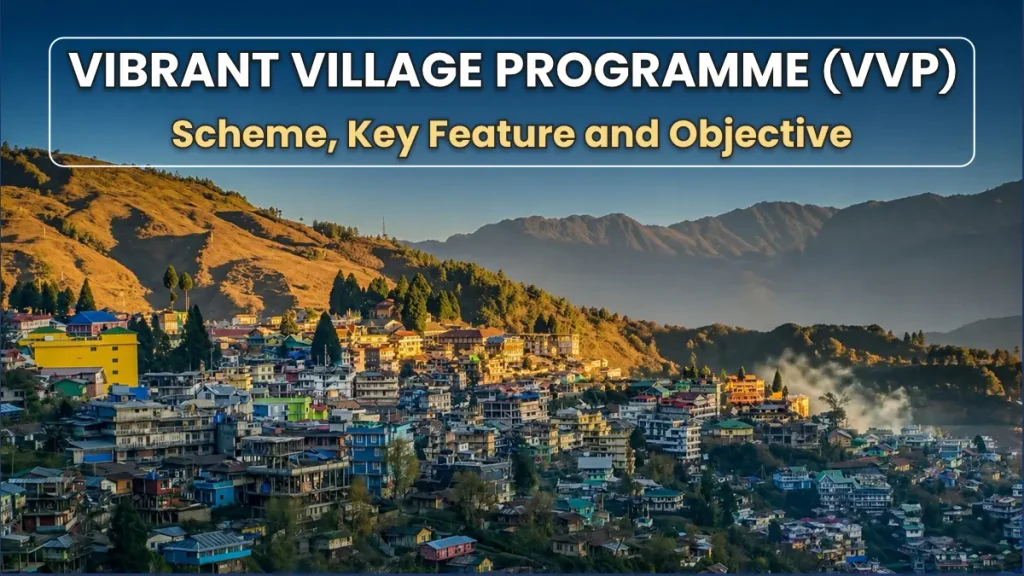
Vibrant Villages Programme (VVP)

Vibrant Villages Programme (VVP) is a flagship initiative of the Ministry of Home Affairs (MHA) aimed at the comprehensive development of strategically located villages along India’s international land borders. It seeks to transform border villages from remote outposts into “first villages of India,” improve quality of life, create livelihood opportunities, reverse out-migration, and strengthen national security by treating border residents as the “eyes and ears” of the border-guarding forces.

The programme aligns with the vision of Viksit Bharat@2047 for “Safe, Secured & Vibrant land borders.” It builds upon the earlier Border Area Development Programme (BADP) by focusing intensively on selected strategic villages through a combination of direct interventions and convergence of existing schemes.

Objectives

  • Create better living conditions and adequate livelihood opportunities in border villages.
  • Reduce/out-migration and encourage reverse migration.
  • Strengthen border security and control trans-border crime.
  • Assimilate the border population with the national mainstream.
  • Promote tourism, culture, skill development, entrepreneurship, and local economic activities (agriculture, horticulture, medicinal plants, cooperatives, SHGs, FPOs).
  • Ensure saturation of key infrastructure through convergence.

Two Phases

Vibrant Villages Programme – Phase-wise Comparison

VVP-I
Approval: 15 February 2023
Launch: 10 April 2023 from Kibithoo, Anjaw district, Arunachal Pradesh
Type: Centrally Sponsored Scheme
Outlay: ₹4,800 crore (2022-23 to 2025-26/2026-27), of which ₹2,500 crore is for all-weather road connectivity
Coverage: Northern border (mainly China-facing)
Villages: 662 priority villages
Blocks/Districts: 46 blocks in 19 districts
States/UTs: Arunachal Pradesh, Himachal Pradesh, Sikkim, Uttarakhand, and Ladakh
Village break-up: Arunachal Pradesh – 455, Himachal Pradesh – 75, Sikkim – 46, Uttarakhand – 51, Ladakh – 35
Population covered: About 1.42 lakh

VVP-II
Approval: 2 April 2025
Launch: 20 February 2026 from Nathanpur village, Cachar district, Assam
Type: Central Sector Scheme (100% Centre funding)
Outlay: ₹6,839 crore (till FY 2028-29)
Coverage: Other international land borders (excluding northern border blocks already covered under VVP-I)
Villages: 1,954 strategic villages
Blocks: 334 blocks
States/UTs: Arunachal Pradesh, Assam, Bihar, Gujarat, Jammu & Kashmir (UT), Ladakh (UT), Manipur, Meghalaya, Mizoram, Nagaland, Punjab, Rajasthan, Sikkim, Tripura, Uttarakhand, Uttar Pradesh, and West Bengal

Combined (VVP-I + VVP-II)
Total villages: More than 2,616
Total outlay: ₹11,639 crore

VVP-I State-wise priority villages: Arunachal Pradesh (455), Himachal Pradesh (75), Sikkim (46), Uttarakhand (51), Ladakh (35). Population covered: ~1.42 lakh.

VVP-II excludes northern border blocks already covered under VVP-I to avoid duplication.

Key Focus Areas of Intervention

  1. Livelihood generation (agriculture, horticulture, medicinal plants/herbs, one-block-one-product, tourism).
  2. All-weather road connectivity (largely through PMGSY-IV convergence).
  3. Energization (grid + off-grid solar, micro-hydel).
  4. Village infrastructure (housing, health facilities, multi-purpose centres).
  5. Financial inclusion.
  6. Youth empowerment and skill development.
  7. Cooperatives, SHGs, and FPOs.
  8. Promotion of tourism, culture, and outreach activities.
  9. Education infrastructure (including SMART classes).
  10. Television and telecom connectivity.

The programme also aims for saturation of all villages in identified border blocks in four thematic areas: all-weather road connectivity, telecom connectivity, television connectivity, and electrification.

Interventions are guided by Village Action Plans prepared collaboratively, with border-specific, state-specific, and village-specific components. A High-Powered Committee chaired by the Cabinet Secretary can recommend relaxations in scheme guidelines for unique border challenges.

Implementation Progress (VVP-I, as of mid-2026)

  • MHA has sanctioned ~1,248 projects (outlay ~₹3,020 crore).
  • Additional ~1,655 projects sanctioned through convergence by other Central Ministries/Departments.
  • Funds released to States/UT: ~₹953–960 crore.
  • Projects completed: ~283–316.
  • Roads: 111 projects (₹2,481.93 crore) to connect 134 previously unconnected villages.
  • Connectivity: 528 villages with 4G; 625 with piped drinking water; 621 with electricity (on-grid/off-grid).
  • Renewable energy: 140 off-grid solar projects + 7 micro-hydel projects.
  • Tourism: 327 projects (~₹145 crore).
  • Outreach: Over 8,500–8,800 activities (awareness camps, health/veterinary camps, fairs, skill training, etc.).

Recent reports (November 2026) indicate positive outcomes, including reverse migration in 40 border villages in Arunachal Pradesh, as stated by Home Minister Amit Shah. Local procurement by border forces (e.g., ITBP) is also providing assured markets to villagers.

Relevance for West Bengal

West Bengal is covered under VVP-II. Several villages along the India-Bangladesh and India-Bhutan borders have been selected, including:

Approximate allocation is around ₹3 crore per village in many cases, focusing on roads, digital connectivity, health, education, and livelihoods.

Strategic Significance

  • India shares over 15,000 km of land border with seven countries.
  • Border communities historically served as the first line of defence (e.g., local reports during the 1999 Kargil intrusion).
  • By improving living standards and economic opportunities, VVP aims to maintain a settled, confident population that supports border management and internal security.

Official portal: vvp.mha.gov.in
Nodal Ministry: Ministry of Home Affairs (Department of Border Management)

The programme represents a shift from viewing border villages as the “last villages” to recognising them as the “first villages” of India, integrating development with security objectives.