

Saptarshi Nag
Indian Foreign Policy has gone through various changes with the test of the time. The South Asian giant gained its independence from the British Empire in 1947 after long fought freedom struggle. The time also saw an unimaginable India- Pakistan hostility on the lines of religion as soon as they were divided. The bloody, tiny episodes wrapped in history gives us an understanding of why India has always had a protectionist policy. Pandit Jawaharlal Nehru and the then Indian Foreign Policy makers had already seen plenty of wars and its unsolicited destruction. Jawaharlal Nehru forged a policy that tried to keep India out of any bloc. Despite the two World Wars taking place in just a span of decades, the World was looking at yet another global conflict. This time, two partner countries that came out as victorious from the second World War decided to see each other eye to eye in lieu of ideological differences. US and the West were in one camp while USSR and certain communist countries from Eastern Europe and South America were in the opposite camp. It soon became a West vs East conflict. But the difference here was not many countries from the Global East were interested to pick sides. Similarly, India under the leadership of Jawaharlal Nehru had other visions for a new India that had to look inwards first to better provide to a massive population that had just gotten out from the brunt of colonialism. And playing around a conflict was certainly not that vision but completely opposite of what was to be achieved. India and other newly independent countries from different colonies wanted to have strategic autonomy in their internal and external affairs. They didn’t wish to get dictated regarding their domestic and foreign policies through ideological lenses. Gaining, independence was a crucial achievement for these countries and maintaining it away from external influence was another challenge. Non-Alignment Movement became an answer for these countries in such a critical moment.
Non-Alignment Movement began as a response to the two strategic military blocs (US, USSR) being formed amidst the Cold War in the early 1950’s. The specific term of Non-Alignment Movement was coined by V.K Menon in 1953. However, Non-Alignment Movement is also known to be the brain child of Jawaharlal Nehru. The founding members of the movement were the then Indian Prime Minister Jawaharlal Nehru, President of the Socialist Federal Republic of Yugoslavia Josip Broz Tito, President of Egypt Gamal Abdel Nasser, President of the Republic of Indonesia Sukarno and President of Ghana Kwame Nkrumah. The Bandung Asian-African Conference in 1955 laid the stones for a formal organization. However, the organization named Movement of Non-Aligned Countries was formed in 1960. Its first conference was held in 1961 in Belgrade where 25 countries attended it. The early days of the Indian Foreign Policy were driven by the principles of non-alignment.
Nehruvian Idealism was the driving force behind much of the policy frame work. India walked the path of moral and idealism during its early years. It trusted countries like China very easily without confirming deeper realities which had their own repercussions set in the far future. India acted calmly in the matters of conflict and concerns from the beginning itself. Panchsheel, Five Principles of Peaceful Coexistence also became an important element for Indian Foreign Policy. The five Principles of Panchsheel were – Mutual respect for each other’s territorial integrity and sovereignty, Mutual non-aggression, Mutual noninterference in each other’s internal affairs, Equality and mutual benefit, Peaceful co-existence. However, the border clashes with China came as a shell shock not only to India but to the non-alignment countries. The India China War in 1962 exposed the harsh realities to the Indian Foreign Policy makers. A large part of Eastern Kashmir (Aksai Chin) was annexed by China. India lost the war by an embarrassing margin. This shook the belief of Jawaharlal Nehru and thereafter, India slowly sought its journey towards Strategic Realism. In this period, the Indian Foreign Policy put greater emphasis on National Interest.
India under the leadership of Indira Gandhi further emphasized on national interest. India took tough decisions under the stern central leadership. The major change was evident during the 1971 India Pakistan War. A lot of changes were visible from a Foreign Policy stand point. The Indian leadership was aware of the human rights violations happening in the then East Pakistan Region. However, initially, India’s response was that of a non-interventionist. India was still vocal at the U.N. as it raised the issue multiple times at the global forum. But it was tough not to act as India saw an inflow of millions of refugees from East Pakistan. During the war in East Pakistan, in 1971, which led to the formation of Bangladesh, around 10 million refugees (80 percent of them Hindu) crossed the border into India of which an estimated 35,000 remained in India, mostly in West Bengal.
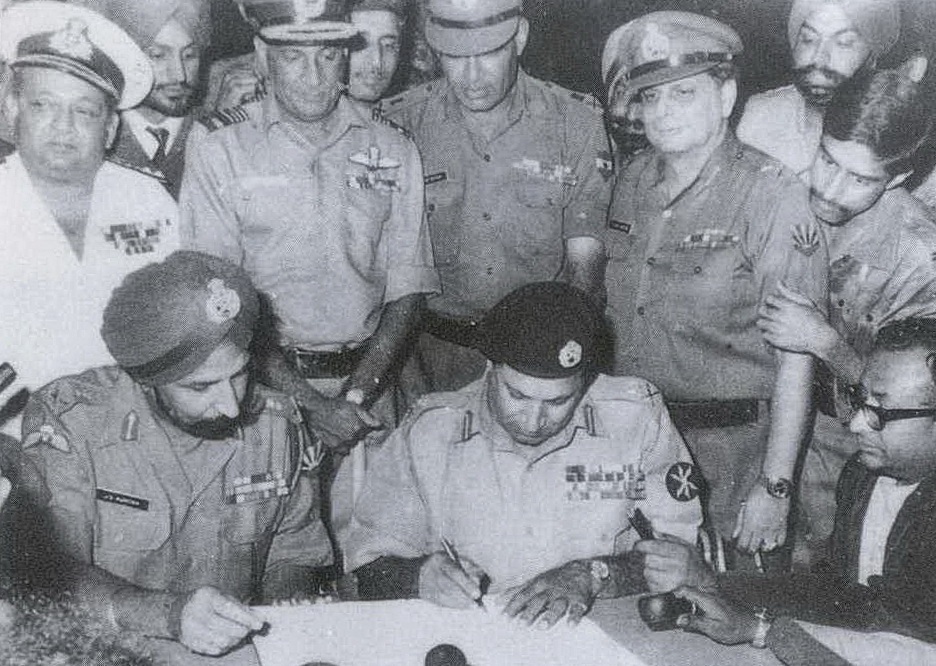
The then Assistant for National Security Affairs Henry Kissinger visited India in July, 1971. He warned Indira Gandhi against any attack on Pakistan. However, just a month later, India did something no one would have expected in the international realm. India and Soviet Union signed a security pact with each other in August, 1971. This was a major moment for Indian Foreign Policy which also showcased India’s move away from its non-alignment strategy. The South Asian giant broke away from its non-alignment strategy and principle in favour of its national interest. It was indeed a major turning point in the history of Indian Foreign Policy. Indira Gandhi outwitted West and Pakistan with this move. Pakistan pre-emptively attacked India on December 3rd. This paved the way for a full-fledged war between India and Pakistan. U.S. tried to bluff India by sending their war ships to Bay of Bengal. However, India’s security pact with the Soviet Union made sure Soviet’s send their warships as well to counter U.S. U. S’s bluff was called out and India won the war against Pakistan on December 16. It was a major Indian Foreign Policy win by external force. India not only diffused a possible three front war scenario but also split half their enemy nation. It was a major moment for the India Soviet partnership as well. The Soviets were more sensitive to India’s causes like that of the Kashmir issue. USSR vetoed UN resolutions on the Kashmir issue in 1957, 1962 and 1971. In total, they vetoed six times in favour of India in the U.N. India’s strategic alliance with Soviet Union in 1971 saw them moving away from Non-Alignment Movement.
However, the Soviet Union was doomed as the Berlin Wall fell in 1989. The Cold War symbol, Berlin Wall was brought down thus uniting West Berlin and East Berlin. Soon after, various Soviet Republics began announcing their independence and Soviet Union’s flag furled for the last time in 1991. This was shocking for India as one of their strategic allies was brought down. India was dependent on Soviet Union for a lot of things out of which military equipments contributed the most. The break-up of the Union therefore disrupted defence production and deliveries to foreign customers. Indian officials spent some time trying to identify the estimated 3500 suppliers scattered around the new republics who manufactured the military equipment that India needed.
India had to reshape it’s Foreign Policy in a new reality of the world that was a unipolar world order. In the absence of Soviet Union, U.S. became the sole superpower in the world. India already had an improvement of relations with the U.S. from 1980’s. India’s economic crisis in 1991 paved the way for the LPG (liberalization, privatization and globalization) reforms. As a result, Indian economy opened up and India moved towards economic pragmatism. They had an inflow of foreign capital especially from the Western countries. This led to globalization of Indian economy. Relations with the West went in the upward trajectory from the 90’s. However, the 1999 Kargil War with Pakistan enhanced opportunities for multi alignment. U.S.A played a role of non-interference as it did not support any country publicly during the war. It also cut off the access of GPS to India to balance the odds and deprive India of any major advantage in the war against Pakistan. The U.S. took a moral high ground when India needed its support. But Sweden provided indirect military support to India through the immediate sale of Bofors artillery guns. Russia and France swiftly delivered spare parts for some of India’s fighter jets while Israel quickly delivered Heron Unmanned Aerial Vehicle, laser-guided bombs. At a time when certain countries delayed military equipment orders during the Kargil War, certain other countries came in support of India by providing quick delivery of military equipment. Israel’s military help during the Kargil War kick started ministerial level meetings between the two nations for the first time in history. On the other side, Russia saw a major power change as Vladimir Putin became the Russian President in 1999. Though the power shift was not immediate but the appointment held a massive change for the coming years.
Another milestone that further pushed India towards the U.S. was the India – U.S. nuclear deal in 2008. The 123 agreements between the two nations paved the way for India to trade with other countries for civil nuclear deals. All this while maintaining their stance of not signing the NPT agreement. Despite, China’s protest against the deal, U.S. worked through its clout to make the deal happen which showcased India’s growing strategic relationship with the West.
However, the 2008 terrorist attack in Mumbai caused a lot of disbalances. India highly advocated for tough sanctions on Pakistan and its proxy terrorists. But the call fell on deaf ears. Multilateral forums and countries could only condemn of what happened. U.S. did not do much to hurt Pakistan for its misadventure across the border. This has been a major issue for India where Pakistan uses its proxy terrorists, trains them and sends them to India to destabilize the country. India has been advocating for a tough action on certain individuals as well as Pakistan as a country but so far not much has been achieved.
Soon, Narendra Modi bagged a massive majority on 16th May 2014. The Prime Minister elect showed early signs of a robust foreign policy as he invited all the SAARC (South Asian Association for Regional Cooperation) leaders for his swearing in ceremony. All the leaders accepted the invitation and attended the event. Surprisingly, the then Pakistan Prime Minister, Nawaz Sharif too accepted the invitation and attended Narendra Modi’s swearing in ceremony. This was a perfect start for Narendra Modi’s Neighbourhood First Policy with all the regional head of states attending his oath taking ceremony. The year 2014 showed what was to come in terms of foreign policy for India under the new leadership. Prime Minister Narendra Modi visited various countries in his first year of power itself. He started off by visiting Bhutan. Narendra Modi then made trips to Brazil, Nepal, Japan, U.S., Myanmar, Australia, Fiji and again Nepal in his first year in power. Narendra Modi attended a SAARC Summit, BRICS Summit and UN General Assembly Session. He also hosted Chinese Premier Xi Jinping in Ahmedabad the same year. Narendra Modi reached out to multiple poles of power to further strengthen India’s role in the global order. It was important for the Prime Minister to start on such a strong note and repair some relationships with other countries. Relationship with the U.S. grew stronger in the initial years of Narendra Modi’s leadership. He also batted for further strengthening ties with Russia giving mixed signals to Washington. Back home, he also sought to give more prominence to the neighbourhood by attending SAARC summits.
However, Pakistan’s constant misadventure nullified India’s efforts vis a vis SAARC. The last functional SAARC summit that happened was back in 2014 in Nepal. The next nation to host the SAARC summit was Pakistan and since then the summit is consistently getting cancelled as India has refused to visit Pakistan until it amends its ways vis a vis India and Kashmir. However, boycotting SAARC gave a lifeline to BIMSTEC. BIMSTEC like SAARC is a regional organization that consists of South Asian Countries. Bay of Bengal Initiative for Multi-Sectoral Technical and Economic Cooperation (BIMSTEC) consists of Bangladesh, Bhutan, India, Nepal, Sri Lanka, Myanmar, Thailand. Though only three summits of BIMSTEC have taken place since 2014, but its prominence has massively increased as a regional multilateral forum for India. India is also a key funder of the projects in BIMSTEC led initiatives. Important game changing projects like Kaladan Multimodal Project (linking India and Myanmar), Asian Trilateral Highway (linking India and Thailand through Myanmar) are already underway. The passage holds the potential to link India and a handful of ASEAN countries. In terms of trade and strategic importance, BIMSTEC is a key multilateral organization in the region.
India, with a population of 1.5 billion people, landmass such big that it holds the position of 7th largest country in the world. India is also the fourth largest economy in the world. However, it has still not gotten its fair share at the United Nations Organization. Narendra Modi and his foreign policy makers have been aggressively advocating for U.N. reforms and permanent U.N. Security Council membership. India has been constantly working with other nations to get as much support as it can muster for its pursuit of a permanent seat in the United Nations Security Council. It has already bagged support from four permanent members of the Security Council – U.S., Russia, U.K., France. Similarly, India garnered votes of many countries to get into the NSG group. But China had a tough stance every time and India was blocked the entry.
The China challenge for India has been ever growing in these few years. The Doklam crisis in 2017 warned India of what was to come. India was tight lipped about China under the leadership of Narendra Modi until 2020 Border clashes with China. The border clashes came as a shock to many but it was long expected in the strategic circles that an aggressive China would definitely make a move against India sooner than later. China is also a factor in India’s multi alignment approach. China’s string of pearls move has led India to counter with another strategy. The term ‘String of Pearls’ was initially published in 2005, in a document titled ‘Energy Futures in Asia’ presented to the United States Secretary of Defence Donald H Rumsfeld by Booz Allen Hamilton. The strategy of the ‘String of Pearls’ revolves around the construction of infrastructure networks in littoral countries from the South China Sea to the Middle East.
India has been working with different countries to counter China’s string of pearls. So far, India is building a deep-sea Port in Sabang, Indonesia. India built a deep-water port in Sittwe in 2016. India has signed agreements to access strategically located Naval facilities in Oman. India has signed an agreement to access Changi Naval Base of Singapore. India has also aligned itself with the QUAD group under its multi alignment approach to counter China in the Indian Ocean. Australia, US, Japan and India currently hold the QUAD membership. Though, the members themselves say it is not a security pact or organization but QUAD could well be the answer to China’s aggression in the Indian Ocean Region. QUAD stands for an open, prosperous and inclusive Indo Pacific region. Currently, India is working with the QUAD members in various fields like Vaccines, Technology, AI etc. However, this does not mean that India is completely aligned with the West like every other country in the QUAD group. India is also a part of BRICS, SCO group which seeks for a change in the global order that also challenges the authority of the U.S. and the West in the current global order. BRICS has been a major voice for the developing countries. SCO, too has helped India let her voice be heard in the global arena of geopolitics. India still gets an invitation for nearly every G7 summit including the latest one in Canada. This shows that both West and (Russia, China led groups) see India as a responsible and important player in the global order. India’s presence in QUAD, SCO, BRICS groups shows its multilateral approach in today’s world order. When it comes to bilateral engagements, India has maintained warm relations with every major country barring a few with which it has strategic concerns like Turkey, Canada (Relation with Canada may see a change in the coming future though) China.
The Indian Foreign Policy has been under tremendous pressure in the course of the Russian-Ukraine war. India has been wooed by both Russia and Ukraine with West to take a particular side that suits their own interests. However, India rather took a stance which supports its interests in the domestic and international realm. As a result of that, India has come under massive criticism from the Western circles be it media or even the citizens. Everyone has an opinion on India’s moral encompass. The West cannot entirely be trusted entirely either, that is why a multi-lateral approach is the best way forward. However, during these testing times, India has to walk on a tight rope to sustain on a path of national interest. Under the China challenge, the present government has not been able to make much progress. Even the Russia Ukraine conflict can be taken as an example where there is much more room for improvement vis a vis India’s overall approach.
With Western alliances weakening, particularly in the wake of Donald Trump’s return to power, India’s diplomatic agility becomes even more critical. Trump’s unpredictable stance on NATO and his reluctance to engage in European security challenges suggest a weakening of traditional Western cohesion. Meanwhile, Russia’s resurgence and China’s expansionist policies in the Indo-Pacific further complicate global alignments.
India has always played a long game in diplomacy, avoiding permanent entanglements. This strategic flexibility allows it to engage with both the West and its historical allies without being constrained by ideological divisions. It also underscores India’s role as a stabilising force in an increasingly multipolar world.
The war in Ukraine, instability in the Middle East, and Trump’s political resurgence have shaken the foundations of transatlantic unity. Trump’s transactional approach to global leadership—undermining NATO, questioning America’s commitment to Europe, and advocating isolationist policies—contradicts the post-World War II liberal order. His disdain for Europe, his willingness to engage with autocrats like Vladimir Putin, and his unpredictable foreign policy have left traditional allies scrambling for new strategies.
In this fractured landscape, India’s balancing act becomes even more significant. While the US and its allies push for a more rigid ideological alignment, India continues to assert its independence. Its response to the Russia-Ukraine war—prioritising energy security over Western pressure—demonstrates its commitment to national interest over ideological conformity. Similarly, India’s role in the Indo-Pacific, countering China’s assertiveness through QUAD, while maintaining economic engagement with Beijing, underscores its strategic dexterity.
India’s multi-alignment is not just about hedging bets; it is about positioning itself as a stabilising force. This approach is evident in its engagement with West Asia, where it maintains strong ties with Israel, the Gulf nations, and Iran, ensuring both economic security and diplomatic influence.
As the US retreats into unpredictability and Europe struggles with its strategic identity, India emerges as a key global player. Its leadership in the Global South, advocacy for climate justice, and role in emerging economic corridors like the India-Middle East-Europe Corridor (IMEC) signal its growing influence. India’s foreign policy trajectory will continue to emphasise strategic autonomy while deepening ties with key players. The Atmanirbhar Bharat initiative focuses on self-reliance in defence and technology, reinforcing India’s ability to act independently. As PM Narendra Modi stated: “A strong and self-reliant India will contribute to a stable and prosperous world.”
Ultimately, India’s global role is no longer that of a passive observer but an active shaper of international governance. As Kautilya (Chanakya) advised in Arthashastra: “A wise king neither rushes into alliances nor rejects them outright but chooses them based on national interest.” India’s evolving strategy exemplifies this timeless principle, positioning it as a pivotal player in global geopolitics. And in such a scenario, multi-alignment policy is not an option for India, it is a mandatory agenda for becoming a global superpower and for using its own leverage in the ever-changing geopolitical dynamism in the New Global Order.
Sources- BRICS Portal, PIB, MoEA( GOI), The Indian Express, EPW, IJFMR, SAARC Secretariat.

We are very fortunate Sir, to be able to read this master piece.
Masterly composition sir. Feeling greatly indebted to you.
thank you