Uniform Civil Code (UCC) refers to the proposal for a common set of laws governing personal matters—marriage, divorce, succession, inheritance, adoption, and related family rights—applicable to all citizens of India irrespective of religion. It is a Directive Principle under Article 44 of the Constitution, which states that the State shall endeavour to secure a Uniform Civil Code throughout the territory of India. Personal laws currently vary by community (Hindu, Muslim, Christian, Parsi, etc.), while some secular laws (such as the Special Marriage Act) already exist.
Constitutional and Historical Context
Article 44 is non-justiciable (not enforceable in courts).
Marriage, divorce, inheritance and succession fall under the Concurrent List (Entry 5), so both Parliament and State legislatures can legislate.
Goa has long followed a civil code rooted in the Portuguese Civil Code of 1867 (continued after liberation), often cited as an existing model, though it contains some community-specific exceptions.
The 21st Law Commission (2018) concluded that a full UCC was “neither necessary nor desirable at this stage.” It recommended reforming discriminatory provisions within each personal law for gender equality rather than imposing uniformity across communities. It received over 75,000 responses.
Current Status (as of November 2026)
India does not yet have a nationwide Uniform Civil Code. Progress has been driven primarily at the state level:
Uttarakhand: Fully in force since 27 January 2025. First post-Independence state to implement a comprehensive UCC. Covers marriage, divorce, succession, inheritance and live-in relationships. Exempts Scheduled Tribes. Amended in 2026 for procedural improvements.
Gujarat: Enacted (passed March 2026; President’s assent September 2026; published in gazette October 2026). Comes into force on a date notified by the state government after rules are framed. Exempts Scheduled Tribes and certain protected customary groups.
Assam: Enacted (passed May 2026; President’s assent September 2026). First North-Eastern state to enact UCC. Similar scope and exemptions for Scheduled Tribes.
Madhya Pradesh: Bill passed (approved unanimously in a special Cabinet meeting in August 2026); further steps pending.
Other states (Maharashtra, Chhattisgarh, Rajasthan, etc.) have set up drafting committees.
Union Law Minister Arjun Ram Meghwal has stated that the government is committed to implementing UCC across the country, citing its constitutional basis. Home Minister Amit Shah has expressed confidence that it will be implemented in all 21 BJP/NDA-ruled states before the 2029 general elections. There is no central UCC bill currently under active consideration in Parliament; the focus has shifted to state-level models, with Uttarakhand’s law often treated as a template.
Implementation Data from Uttarakhand (First Year)
Over 5 lakh applications received by early 2026 (around 4.74–4.8 lakh approved).
Marriage registrations form the bulk (roughly 4.2 lakh applications).
Live-in relationship registrations have been relatively low.
Nearly all marriage registrations are now processed online, with certificates typically issued in about five days on average.
Amendments in 2026 strengthened penalties for fraud/coercion, replaced certain procedural terms, aligned references with the new criminal codes (BNS/BNSS), and eased some appeal and data-sharing rules related to privacy concerns.
Key Features of Recent State UCC Laws
Common elements across Uttarakhand, Gujarat and Assam codes include:
Mandatory registration of marriages and live-in relationships.
Prohibition of polygamy/bigamy.
Uniform rules on succession and inheritance (spouses, children and parents generally recognised as primary heirs).
Recognition of rights of children from live-in relationships in some provisions.
Exemptions for Scheduled Tribes (whose customary laws are protected under the Constitution, including Articles 371A/G and the Sixth Schedule).
Arguments For and Against
Potential Advantages
Greater gender equality by removing discriminatory provisions across personal laws.
Simplification and reduced litigation in family matters.
Promotion of national integration and equality before the law.
Aligns with the constitutional directive in Article 44.
Main Concerns
Possible impact on religious freedom and minority rights (Articles 25–26).
Risk of imposing majority norms on diverse communities.
Practical difficulties in reconciling tribal and customary practices.
Privacy issues raised by mandatory live-in relationship registration (especially in the Uttarakhand model).
The 21st Law Commission’s view that reforming existing personal laws for equality within communities may be preferable to a single code at this stage.
Summary
The Uniform Civil Code remains a Directive Principle rather than a completed nationwide law. While there is no central legislation in force, several BJP-ruled states have enacted or are advancing state-level codes, with Uttarakhand being the only one fully operational as of November 2026. Implementation has focused on marriage registration, succession and live-in relationships, with Scheduled Tribes generally exempted. Political commitment at the Centre and in NDA-ruled states points toward further expansion by 2029, but nationwide uniformity would still require either a central law or coordinated state action, and continues to generate debate on gender justice, federalism, diversity and individual rights.
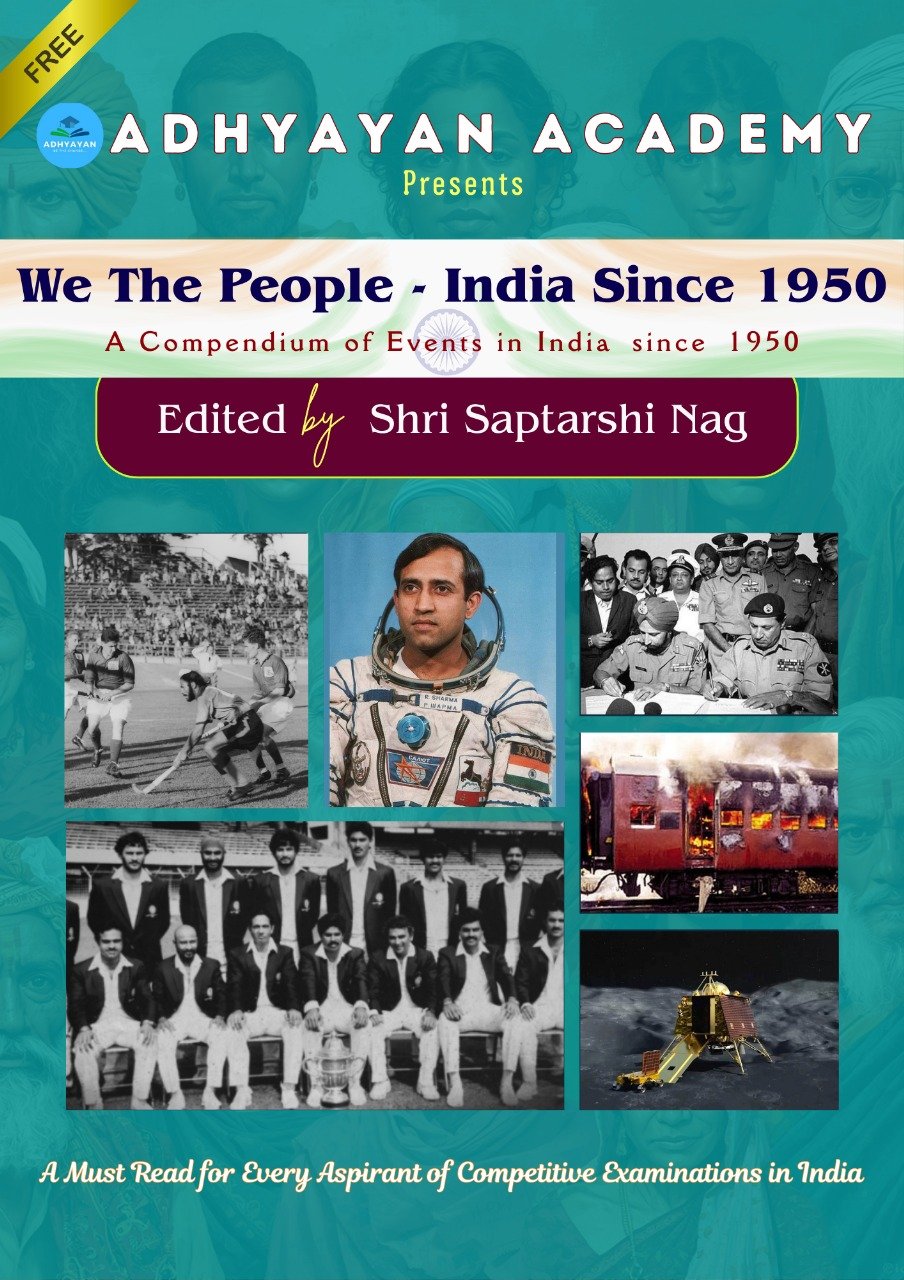
Finally the next work is seeing the daylight. Although it is not a creative work like the previous one ’28 Days of Thinking Differently’, this book is going to help aspirants allover the country for any sort of examination conducted in India. Had many sleepless nights working on it but considering the social impact it will produce, I have decided to keep it free of cost. At the end of the day, sharing knoweldge is the goal an educated man should strive for. So, get it free of cost by becoming a member of the Telegram Channel of Adhyayan Academy for Competitive Examinations, the institute started by my wife after she quit her WBCS job. Even if you are not an aspirant, this is going to help you to hone your knowledge on India. If you are a quiz master, this may prove to be a gem for you. If you are a student, gift the free book to your friend. If you are a father, share this with your daughter or son. If you are in love, share this with your partner and show that you care. If you are a journalist, use this as your reference manual. I bet, once you finish you will surely be a General Knowledge Expert. Releasing on 22nd August. Stay tuned. The link of the Telegram Channel https://lnkd.in/gqtFSzJu
India marks a significant milestone as the Atal Mission for Rejuvenation and Urban Transformation (AMRUT) completes 10 years since its launch on June 25, 2015. Introduced as a transformative initiative to improve the quality of life in urban areas, AMRUT has focused on delivering basic infrastructure and services—especially water supply, sewerage, urban mobility, and green spaces—to citizens across 500 cities and towns and almost 60% of the total urban population of India.
Rajasthan was the first state in the country to submit State Annual Action Plan under (AMRUT). The scheme is dependent with public–private partnership (PPP) model. If required, various other schemes like Swachh Bharat Mission, Housing for All 2022, along with the local state schemes like that related to water supply and sewerage and other infrastructure related schemes can be linked to AMRUT.
Nodal Ministry: Ministry of Housing and Urban Affairs
Scheme Type: Centrally sponsored scheme, funds shared among States and UTs based on urban population and number of towns.
Mission
The purpose of Atal Mission for Rejuvenation and Urban Transformation (AMRUT) is to
ensure that every household has access to a tap with assured supply of water and a sewerage connection
(ii) increase the amenity value of cities by developing greenery and well-maintained open spaces (e.g. parks)
(iii) reduce pollution by switching to public transport or constructing facilities for non-motorized transport (e.g. Walking and cycling).
Implementation
SAAP (State Annual Action Plans) is a consolidated plan of all the city level SLIPs (Service Level Improvement Plan) of all proposed AMRUT cities in the respective states. A formulation on City level SLIP is done based on diligent estimation of ambiguities in the availability of infrastructure like water supply, sewerage network, draining system, transportation facilities, available digital and internet facilities, industrial facilities etc. 135litres per capita per day is another factor in the process including water supply and sewerage connections to all urban households
AMRUT 2.0 was launched on 1 October 2021 for a period of 05 years. Its objectives are universal coverage of water supply from 500 cities to about 4,900 statutory towns in the country and coverage of sewerage/septage management in 500 cities covered in the first phase of the AMRUT scheme.
AMRUT 2.0 aims to promote the circular economy of water through the development of a City Water Balance Plan (CWBP) by recycling/reuse of treated sewage, rejuvenation of water bodies and water conservation.
Important Initiatives so far:
‘AMRUT Mitra’ involved 10,000+ women Self-Help Group (SHG) members.1,762 projects worth ₹147 crore approved. It involves women Self Help Groups (SHGs) in water demand management, water quality testing, water infrastructure operations, and other water sectoral projects. So far, 1762 projects worth ₹140 crore have been approved under this initiative
Drink from Tap (DFT) through 381 projects worth ₹23,490 crore sanctioned, likely to benefit 8 lakh households.3,630 contractors/officials trained.
3,032 water bodies approved for rejuvenation, covering 1.09 lakh acre area.
Capacities of States augmented by training over 90,000 contractors, plant operators, plumbers, women, youth, officials etc.
Challenges:
A NITI Aayog report indicates that around 21 major cities will deplete their groundwater, leaving 40% of India’s population without access to drinking water by 2030.
Nearly 31% of urban Indian households lack piped water while 67.3% are not connected to a piped sewerage system.
Pollution of water bodies: For example, large water bodies like Bellandur Lake (Bengaluru) have become heavily polluted due to industrial effluents and untreated sewage flowing into them.
Unplanned concretization prevents water from percolating into the soil and recharging the water table.
In Bengaluru, the number of lakes has decreased from 262 in 1961 to about 81 currently.
Conclusion
As AMRUT completes a decade, it marks a significant shift in India’s urban development approach, focused on inclusive planning, efficient service delivery, and sustainable growth. By strengthening local bodies and improving core services like water, sanitation, and green spaces, the Mission has laid a strong foundation for future-ready, liveable cities across the country.
Those willing to be a part of my biggest academic project ‘Eklavya Descriptive Bengali English Course’ 2025-26 are requested to send a WhatsApp to 6295350330, the official number of Adhyayan Academy. Before they send their WhatsApp, they are also requested to go through the article below
Q- Write a newspaper report on increasing bike menace in your locality
Ans- The Menace of Rash Biking Haunts the Citizens
Staff Reporter
ABC, July28: The menace of rash bike driving continues to evade the baton of law even though stringent rules are in place. Recently, an innocent footpath dweller lost his life due to such unhindered speed of a two-wheeler in the wee hours of night. This takes the tally of such unfortunate deaths in this year within this locality alone to seven which includes one woman, two children and two bikers as well. Driving bikes without helmets is a common sight these days for the people of this town. Uncontrolled speed, unbearable popping sound from the silencer pipes, drunken driving- all these are adding to the woes of the citizens.
Despite several complaints to the local police, no formal action has yet been taken, letting the culprits roam Scot- free.
” I have lost my son due to this horror and I am still waiting for justice”, Namita Devi started weeping as she was telling us about that horrific accident that took away the life of her only son.
” We are leaving no stones unturned to combat this menace. Several measures are being taken already. Spot fines, installation of CCTV cameras at several places, surveillance by drones are to name a few”, claimed the Superintendent of Police of the district.
But who will be answerable for those deaths? The town still looks for a clue.
To learn how to write such reports or answers on any other topics or to get my guidance for English/Bengali/ Economics or overall Guidance for WBCS or any other exams,please call or whatsapp @ 6295350330. This is the official number of Adhyayan Academy. My much awaited descriptive English /Bengali Course for 1 year is starting from 1st September. Admission is going on for my Clerkship Main/ WBSSC Group C Course. Mock Test Course for PSC Miscellaneous Main has also started.
For regular updates, follow us @ FB, YouTube or Telegram with following links
A risk associated with insurance, and linked to asymmetric information. People who are worried about their health will be more inclined to pay for health insurance than those who are fighting fit. One way to avoid the problem is to make insurance compulsory for all, as happens with car ownership.
Alpha
That part of an investment return that is due to the skill of the fund manager. This can be very hard to measure.
Amortisation
The gradual reduction in the value of an asset (or a debt) over time. A debt (such as a mortgage) is amortised via regular repayments. Companies use amortisation to steadily reduce the value of intangible assets on their balance-sheets.
Antitrust
Term used to describe laws or regulations designed to stop firms from exploiting their monopoly positions in markets at the expense of consumers or rival businesses.
Asset stripping
The practice of buying a company and rapidly selling off the component parts with the aim of making a profit. This often leads to great disruption in the business and a loss of jobs.
Austerity
A term used to describe efforts to reduce the share of public spending in GDP, particularly in the 2010s. When the economy is already weak, Keynesian economists view austerity programmes as a mistake, because they reduce demand. But free-market economists worry that, without austerity, the government’s role in the economy inexorably expands over time.
Authoritarian capitalism
Usually applied especially to China and Russia and to certain extent in India these days, this describes economies in which big business co-exists with an authoritarian government. Businesses are allowed to make money but if they dare to criticise the government, or appear too independent, they may face criminal or financial sanctions.
Backwardation
A term used in the commodity market for when the price for delivering a product today (the spot price) is higher than for delivery in future. Normally, the future price is higher, a situation known as contango. Backwardation is normally the sign of a supply shortage, causing traders to compete to get the product immediately.
Bank run
In a crisis, bank depositors may start to doubt they will get their money back. So, they may demand to withdraw it. Since banks have lent out this money, it is impossible for them to repay all depositors instantly. The bank may fail. To avoid this, most countries have schemes of deposit insurance.
Basis point
One hundredth of a percentage point. The term is often used to describe interest rate changes. A quarter-percentage-point rise or fall in rates is described as 25 basis points. Example, when the Repo rate is changed 0.25%, it is said to have changed 25 basis points.
Beta
This ratio measures the sensitivity of an individual asset’s price to that of the overall market. A stock that tends to go up even more rapidly than the market when it is rising, and drop more precipitously when it is falling, is described as “high beta”; one that moves less violently than the market is “low beta”.
Bill of exchange
A short-term financial instrument, originally used to finance international trade. The buyer of goods would give the seller a signed bill, equal to the value of the purchase, which the seller could then cash with a banker. In modern finance, bills are a catch-all term for short-term debt such as Treasury bills and commercial bills.
Bretton Woods
Location in New Hampshire of a conference in 1944 which decided the post-war economic order. It led to the establishment of the International Monetary Fund and the World Bank. And it agreed on a currency system that linked all currencies at fixed exchange rates to the dollar, which was convertible into gold at $35 an ounce.
Business cluster
When companies in an industrial sector gather in a specific area, such as technology companies in Silicon Valley. When a cluster forms, companies will find it easier to attract high-skilled staff, workers have a wider choice of employers, innovations can circulate more quickly and start-up companies may find it easier to get finance.
Capital flight
What happens when investors try to avoid high taxes, or the prospect of currency devaluation, by sending their money abroad. Governments try to prevent such flight by imposing capital controls but they need to act quickly. Investors will anticipate the introduction of capital controls by indulging in capital flight.
Cartel
Agreement where a group of producers collaborate to fix the price, or restrict the supply, of a good or service. Perhaps the best-known example is the Organisation of the Petroleum Exporting Countries, or OPEC. Cartels among companies are often outlawed by government antitrust regulations because they restrict competition.
Coase theorem
A concept, developed by Ronald Coase that deals with externalities. Coase thinks of the problem in terms of conflicting property rights such as the right of a factory to operate noisy machinery and the right of its neighbours to enjoy peace and quiet. If property rights are clearly delineated then, in the absence of transaction costs, bargaining should lead to an efficient outcome, such as the factory compensating its neighbours for the noise. Coase’s work on externalities, along with that on the theory of the firm, won him a Nobel prize in 1991.
Collateral
An item pledged as security against a loan. An obvious example is a house or flat, which homeowners used as collateral when taking out a mortgage. In financial markets, safe securities such as Treasury bonds are often used as collateral by traders and investors.
Commodity cycle
A pattern of rising and falling commodity prices and production. Rising commodity prices cause consumers to cut back their use and producers to expand output. In the ensuing glut, prices fall and output falls until commodities are so cheap that their use rises again.
Comparative advantage
This idea has been called one of the most profound insights in economics. If country A can make cars more cheaply than country B, and B can produce shirts more cheaply than A, it clearly makes sense to trade. Each has an absolute advantage in one area. But what if A is more efficient at producing everything than B? It still makes sense for them to trade, with B producing the goods where it is more competitive; if for example it is 90% as efficient as A in making shirts, and only 60% in car manufacturing, then it should specialise in making shirts and trade them for cars. Both countries will gain.
Conglomerate
A large company that has diversified across a range of countries and business areas, normally through making acquisitions. Eg. Reliance
Consumer confidence
A measure, taken from a survey, of the public’s attitude towards the economic outlook. If people are worried about their jobs, or political unrest, or a pandemic, they will be less likely to spend money.
Contango
When the futures price of a commodity is higher than the spot price.
Crawling peg
An exchange-rate system in which a currency is tied to another, but can fluctuate within a range, or band, depending on certain conditions.
Creative destruction
A concept, developed by Joseph Schumpeter, to explain economic innovation. Old inefficient companies must go out of business to release capital and workers so they can be used in new, more innovative ways.
Credit default swap
A derivative contract between two parties in which one insures the other against the default of a bond or loan. One of the products at the heart of the 2007-09 financial crisis.
Crowdingout
The notion that actions by the state might restrict the options of the private sector. It usually applies to credit. If the government borrows a lot, and pushes up interest rates, then investors may not have enough capital to supply the investment needs of businesses.
Dependency ratio
The proportion of the population that is not of working age, compared with that which could work, if it chose to. Conventionally, dependants are defined as those aged up to 14 or over 65. Sometimes the figures are separated into youth dependency and old-age dependency. The higher the ratio, the greater the tax burden that is likely to fall on the working population; this is a problem for many developed economies, given the numbers now surviving into old age.
Deposit insurance
A scheme whereby a government agrees to compensate depositors if a bank goes bust. This can help prevent bank runs, when depositors panic.
Deregulation
It is a staple of conservative thought that there are too many regulations which hold back economic growth. So, every few years, governments announce a policy of deregulation to cut back the red tape. It turns out, however, that public opinion often demands that governments act to ban things that are bad, or that are disliked. And so more regulations are introduced.
Disintermediation
Cutting out the middleman, or connecting customers directly with producers. In theory, this should reduce costs. In practice, middlemen emerge in a new form; high-street travel agents may have declined in importance but many people use online versions such as Expedia or makemytrip.com.
Dumping
Selling something for less than the cost of producing it. This practice may be adopted by a dominant supplier in an industry in the hope of driving competitors out of business. More commonly, countries argue that producers in other nations are “dumping” goods and gaining market share; this can be used as an excuse to adopt protectionist measures such as tariffs.
To be continued…
To get Saptarshi Sir’s guidance for PSC Miscellaneous Mains/ Clerkship Main/ English/Economy or for overall WBCS or other exam preparation, call or WhatsApp us @6295350330. Classes for PSC Miscellaneous Main and Clerkship Main have already started. WBCS New batch is also going on. You can also download our app for online guidance using the link
The Khajuraho temples are a group of Hindu and Jain temples in Madhya Pradesh, India, built between 950 and 1050 AD by the Chandela dynasty. These temples showcase the Nagara style of architecture,
Bodh Gaya is located almost 96 kilometrese away from Patna, Bihar and is one of the UNESCO World Heritage sites in India. It’s an important religious centre for the Buddhists as this was the place where Mahatma Buddha attained enlightenment. The holy Bodhi Tree is the site where Siddhartha gained Enlightenment and became Gautam Buddha. The famous Mahabodhi Temple was established in the reign of Ashoka the Great in about approximately 250 BCE.
The Statue of Liberty was designed and built in France. It was a gift from the people of France to the United States to commemorate the centennial of American independence. The statue was designed by French sculptor Frédéric Auguste Bartholdi and its metal framework was built by French engineer Gustave Eiffel, who also designed the Eiffel Tower in Paris. The statue was then disassembled and shipped to the United States, where it was reassembled on Liberty Island in New York Harbor and dedicated on October 28, 1886.
The Buddhist Monuments located at Sanchi in Madhya Pradesh are a World Heritage Site in India and they are the oldest stone structures in India. Originally commissioned by emperor Ashoka in 3rd century BCE, the Sanchi Stupa is located 46 kilometer north-east of Bhopal.
The Jantar Mantar is an astronomical observatory built in 18th century Rajasthan. It is an astronomical observatory which was built by the Rajput King Sawai Jai Singh of Rajasthan in 1738 CE
The Burj Khalifa, the tallest building in the world, is located in Dubai, United Arab Emirates (UAE).
Hampi is a UNESCO World Heritage site located in the Northern part of Karnataka. It lies within the ruins of the ancient, prosperous kingdom of Vijayanagar
The nickname of the clock tower in London is “Big Ben.”
The Elephanta caves are located on an island in the Arabian City, not very far from the city of Mumbai.
The Ellora Caves are an important UNESCO World Heritage site and an archaeological site, ranging 29 kilometers Northwest of the city of Aurangabad, Maharashtra. The Ellora Caves are well known for their Indian-rock cut architecture. The presence of Hindu, Buddhist and Jain temples and sculptures portray the tolerance which was extended towards different faiths and beliefs in Ancient Indian History.
Rumtek Monastery is located in which Indian state?
Ans- Sikkim
Hemis monastery in Leh, Ladakh.
Tawang monastery- Arunachal Pradesh
Angkor Wat, the largest religious monument in the world, was built in the early 12th century by King Suryavarman II as a Hindu temple dedicated to Vishnu. It’s located in present-day Cambodia, within the city of Angkor, which served as the capital of the Khmer Empire from the 9th to the 15th centuries. Initially a Hindu temple, it was later transformed into a Buddhist temple.
Bahai temple is in New Delhi
Dilwara temple in Mount Abu, Rajasthan- Jain temple.
In which place Shringeri Math is situated, which established by Shankaracharya?
Ans- Rameshwaram.
In which state’s Sabarimala pilgrimage, the pilgrims have taken the oath of cleanliness?
(a) Karnataka
(b) Kerala
(c) Telangana
(d) Tamil Nadu
Ans: (b) Kerala
The residence of the Prime Minister of which country is called ‘Temple Trees’?
(a) Nepal
(b) Myanmar
(c) Sri Lanka
(d) Bangladesh
Ans: (c) Sri Lanka
The Char Dham Highway project connects the four holy places of Yamunotri, Gangotri, Kedarnath, and Badrinath. In which Indian state are all these religious places located?
(a) Uttarakhand
(b) Himachal Pradesh
(c) Arunachal Pradesh
(d) Sikkim
Ans: (a) Uttarakhand
The largest temple complex in India is the Sri Ranganathaswamy Temple located in Srirangam, Tamil Nadu
Tawang monastery is the largest monastery in India. is also known as Galden Namgyal Lhatse.
The world’s largest mosque is Masjid al-Haram, located in Mecca, Saudi Arabia. It is also known as the Great Mosque of Mecca and encloses the Kaaba.
The largest mosque in India is the Taj-ul-Masajid, located in Bhopal, Madhya Pradesh. It has a capacity for around 175,000 worshippers.
The Seven Wonders of the World are a group of places around the globe that are considered to be of great importance. These are: The Colosseum in Italy, Petra in Jordan, Chichén Itzá in Mexico, Christ the Redeemer in Brazil, Machu Picchu in Peru, Taj Mahal in India and The Great Wall of China.
The tallest statue in the world is the Statue of Unity, located in Gujarat, India. It depicts Sardar Vallabhbhai Patel, a prominent figure in India’s independence movement, and stands at a height of 182 meters (597 feet).
The highest monastery in the world is generally accepted to be Rongbuk Monastery, located in Tibet.
The highest temple in India is Tungnath Temple, located in Uttarakhand, at an altitude of 12,073 feet (3,680 meters)
The five temples that make up the Panch Kedar are: Kedarnath, Tungnath, Rudranath, Madhyamaheshwar, and Kalpeshwar. These temples are dedicated to Lord Shiva and are located in the Garhwal region of Uttarakhand, India. Shiva temples.
Adi Shankaracharya established four mathas to propagate his teachings and maintain the continuity of Sanatana Dharma. These are:
Sringeri Sharada Peetham: Located in Sringeri, Karnataka.
Jyotir Math: Located in Joshimath, Uttarakhand.
Dwarka Sharada Peetham: Located in Dwarka, Gujarat.
Govardhan Math: Located in Puri, Odisha.
World Architecture Day- 6 Oct
Tulsi Manas Mandir is located at Varanasi, UP.
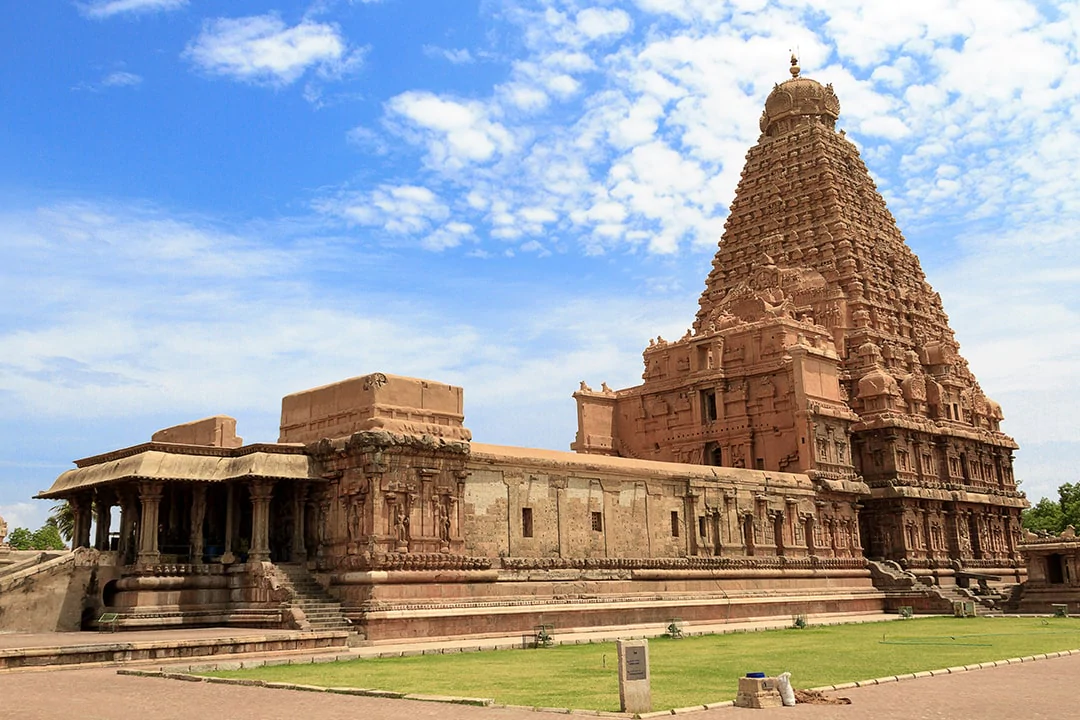
Brihadeshwara temple or Raja Rajeswara temple is located at Thanjavur, Tamil Nadu. It was built by Raj Raja Chola I.
Sun Temple at Konark, Odissa is also known as Black Pagoda. Built by Narasimhadeva 1.
Ellora temple was built during the Rashtrakuta dynasty.
The Charminar at Hyderabad was built by Mohd. Kuli Qutub Shah in 1591 to commemorate the end of plague in the city.
Kailash temple is located at Ellora, Maharashtra.
Moti Masjid was built by Aurangzeb.
Le Corbusier designed the planned city of Chandigarh.
Bimal Patel is the architect of India’s new Parliament building.
Golconda fort is in Hyderabad, Telengana. It was bult by Sultan Quli Qutub ul Mulk.
The Vesara style of temple architecture mainly evolved, practised, and developed by the influence of the Chalukyas of Kalyani.
Jagannath Temple (Puri) is believed to be constructed in the 12th century by King Anatavarman Chodaganga Deva of the Eastern Ganga Dynasty.
Known as the “Architect of the Poor”, Laurie Baker was responsible for the revolutionised mass housing concept in Kerala.
G Wittet designed the Gateway of India in Mumbai, borrowing several elements of Mughal style
The Victoria terminus station in Mumbai is an example of Victorian Gothic revival architecture in India, deriving themes from Indian traditional architecture. It was designed by FW Stevens.
There are 44 World Heritage Sites in India, 6th most in the world. Out of these, 36 are cultural, seven are natural, and one, Khangchendzonga National Park, is of mixed type, listed for both cultural and natural properties. India has the sixth-most sites worldwide. The first sites to be listed were the Ajanta Caves, Ellora Caves, Agra Fort, and Taj Mahal, all of which were inscribed in the 1983 session of the World Heritage Committee. The most recent site listed is the Maratha Military Landscapes of India, in 2025.
Italy has the most UNESCO World Heritage Sites with a total of 60. It is followed by China with 59 sites, and then Germany with 54
Uttar Pradesh is the Indian state with the most international airports. As of 2025, it has five international airports: Chaudhary Charan Singh International Airport in Lucknow, Lal Bahadur Shastri International Airport in Varanasi, Kushinagar International Airport, Maharishi Valmiki International Airport in Ayodhya, and Noida International Airport in Jewar.
Maharashtra is the Indian state with the highest number of UNESCO World Heritage Sites, boasting a total of 5 sites. These include the Ajanta Caves, Ellora Caves, Elephanta Caves, Chhatrapati Shivaji Maharaj Terminus, and the Western Ghats (a natural site).
Tamil Nadu is the Indian state with the most temples. It’s often referred to as the “land of temples” due to the sheer number of Hindu temples found there, estimated to be over 400,000.
The oldest church in India is believed to be the St. Thomas Syro-Malabar Church in Palayur, Kerala, which is said to have been established in 52 AD by St. Thomas the Apostle.
To get Saptarshi Sir’s guidance for PSC Miscellaneous Mains/ Clerkship Main/ English/Economy or for overall WBCS or other exam preparation, call or WhatsApp us @6295350330. Classes for PSC Miscellaneous Main and Clerkship Main have already started. WBCS New batch is also going on. You can also download our app for online guidance using the link
Which state is home to the largest freshwater lake in India?
Ans- Wular lake in J&K
2. Largest freshwater lake in the world?
Ans- Lake Baikal, Russia
3. Which lake is the largest by surface area in the world?
a) Lake Superior
b) Caspian Sea
c) Lake Victoria
d) Lake Michigan
Ans. (b)
4. Deepest lake – Lake Baikal
5. Which lake was formed by a meteorite impact?
Ans- Lonar (Maharashtra) Crater Lake
6. Which lake is known as the “Queen of Lakes” in Kerala?
Ans- Sasthamkotta Lake
7. Where is Lake Titicaca, the highest navigable lake globally, situated?
Ans- Bolivia and Peru
8. Which lake in Manipur, India, is distinguished by its floating islands of vegetation?
Ans- The most unique thing about Loktak Lake is the floating phumdi. Phumdis are the organic masses composed of vegetation, soil, and decaying matter. Some of these floating islands are big enough to support houses and shops. Keibul Lamjao National Park is the only floating national park in the world.
10. Important lakes and their states
Name State/UT
Pangong Ladakh
Gurdongmar Sikkim (Highest Lake of India)
Vembanad Kerala
Chilka Odissa
Pulicat Andhra Pradesh
Jor Pokhri/ Sukhia Pokhri Darjeeling, WB
Nagarjun Sagar Telengana
Shivaji Sagar Lake Maharashtra
Kolleru Andhra Pradesh
Chandra Taal Himachal Pradesh
Umiyam Meghalaya
Hussain Sagar Andhra Pradesh
Dal Lake Srinagar (J &K)
Bhimtaal Uttarakhand
Nainitaal Uttarakhand
Kanwar( Largest ox bow lake) Bihar
Dhankar Himachal Pradesh
Chamera Himachal Pradesh
11. Chilika Lake in Odisha is the largest saline water lake in India.
12. The Caspian Sea, often referred to as a sea, is technically classified as a lake because it has no outlet to the ocean.
13. Rajasthan has the largest number of salt lakes in India. Rajasthan is the arid state of India with average yearly rainfall appx 58-60 cm. There are large number lakes mostly artificial as well as Natural Lakes.
14. Gobind Sagar lake is the largest man-made lake situated in Bilaspur district of Himachal Pradesh. After Gobind Sagar Dhebar lake in Rajasthan is largest artificial lake.
16. Pong dam also known as Maharana Pratap Sagar is the highest earth fill dam constructed across the river Beas. It is located in Kangra district of Himachal Pradesh.
17. The ‘Chilka lake region’ lies in between the deltas of Mahanadi and Godavari. Chilika Lake is a brackish water lagoon.
19. Rasik Bill is in Cooch Behar district.
20. The ‘Chilka lake region’ lies in between the deltas of Mahanadi and Godavari. Chilika Lake is a brackish water lagoon
21. Lake Tanganyika is an African Great Lake. It is the world’s second-largest freshwater lake by volume and the second deepest, in both cases after Lake Baikal in Siberia. It is the world’s longest freshwater lake.
22. Nokdara lake is in Kalimpong district.
23. The world’s highest lake, if size is not a criterion, may be the crater lake of Ojos del Salado, at 6,390 metres. It is in Andes.
24. Lake Vostok is in Antarctica.
25. Sukna lake in Chandigarh.
26. Tso Moriri lake is in Ladakh.
27. Ashtamudi lake is in Kerala.
28. Tsongmu lake in Sikkim.
29. Located on the border of the United States and Canada are the Great Lakes of North America. They include 5 lakes: Michigan, Huran, Erie, Ontario, and Superior which together contain around 21% of the world’s freshwater supply.
30. Finland has the nickname “Land of the Thousand Lakes” as there are over 187,000 lakes in the country.
31. The study of inland water bodies and ecosystems is called Limnology.
32. The lowest lake in the world is the Dead Sea, on the edge of Israel and Jordan. The surface level is 418 m below sea level.
33. In 1981, Chilika Lake became the first Indian wetland of international importance.
34. Udaipur is known as India’s “City of Lakes.
35. Deepest lake in India Loktak Lake
36. Highest lake in India- Tsho Lamu lake, Sikkim
37. The longest lake in India is Vembanad Lake. It is also the largest lake in the state of Kerala. Vembanad Lake stretches for approximately 96.5 kilometers (60 miles) and has a maximum width of 14 kilometers.
38. Khechipedi lake in Sikkim
39. Nakki lake is at Mount Abu, Rajasthan
40. Kanwar lake is Asia’s largest oxbow lake, located in Begusarai district, Bihar.
41. Roop Kund lake at Uttarakhand is also known as Skeleton Lake/Mystery Lake because of numerous skeletons found at its bottom.
42. Black Sea is not a lake since Bosporus and Dardanelles Straits connect it to the Mediterranean Sea. Many big rivers fall into the Black Sea, making the salinity of its surface water half that of the ocean: 17‰.
43. Caspian Sea and Dead Sea are lakes. The surface and shores of the Dead Sea are 423 metres below sea level, making it Earth’s lowest elevation on land.
44. The Largest Lakes (surface area) by Continent
Australia – Lake Eyre (Salt Lake)
Africa – Lake Victoria, also the third-largest freshwater lake on Earth. It is one of the Great Lakes of Africa.
Antarctica – Lake Vostok (subglacial)
Asia – Lake Baikal (if the Caspian Sea is considered a lake, it is the largest in Eurasia, but is divided between the two geographic continents)
Europe – Lake Ladoga, followed by Lake Onega, both located in northwestern Russia.
North America – Lake Superior.
South America – Lake Titicaca, which is also the highest navigable body of water on Earth at 3,812 metres above sea level. The much larger Lake Maracaibo is a contiguous body of water with the sea, so it is ignored. ,
To get Saptarshi Sir’s guidance for PSC Miscellaneous Mains/ Clerkship Main/ English/Economy or for overall WBCS or other exam preparation, call or WhatsApp us @6295350330. Classes for PSC Miscellaneous Main and Clerkship Main have already started. WBCS New batch is also going on. You can also download our app for online guidance using the link
This article consists of the following contents which are extremely important for any competitive examination for both objective and descriptive questions.
History of space research in India
Major milestones of India’s space technology
Indian Regional Navigation Satellite System
Rakesh Sharma
Gaganayan Mission
Chandrayaan Mission with special emphasis on Chandrayaan 3
Axiom 4 and Shubhanshu Shukla
The space research activities were initiated in India during the early 1960’s, when applications using satellites were in experimental stages even in the United States. With the live transmission of Tokyo Olympic Games across the Pacific by the American Satellite ‘Syncom-3’ demonstrating the power of communication satellites, Dr. Vikram Sarabhai, the founding father of Indian space programme, quickly recognized the benefits of space technologies for India.
As a first step, the Department of Atomic Energy formed the INCOSPAR (Indian National Committee for Space Research) under the leadership of Dr. Sarabhai and Dr. Ramanathan in 1962. The Indian Space Research Organisation (ISRO) was later formed on August 15, 1969. The prime objective of ISRO is to develop space technology and its application to various national needs. It is one of the six largest space agencies in the world. The Department of Space (DOS) and the Space Commission were set up in 1972 and ISRO was brought under DOS on June 1, 1972.
Since inception, the Indian space programme has been orchestrated well and had three distinct elements such as, satellites for communication and remote sensing, the space transportation system and application programmes. Two major operational systems have been established – the Indian National Satellite (INSAT) for telecommunication, television broadcasting, and meteorological services and the Indian Remote Sensing Satellite (IRS) for monitoring and management of natural resources and Disaster Management Support.
Major milestones in Indian Space Programme
Indian Space Programme began at Thumba Equatorial Rocket Launching Station (TERLS) located at Thumba near Thiruvanathapuram. Thumba was selected for being rocket launching station because geomagnetic equator of the earth passes over Thumba. The geomagnetic equator of the earth passes over Thumba.
On November 21, 1963, the first sounding rocket was launched from TERLS. The first rocket, a Nike-Apache was procured from the US. A sounding rocket is a rocket, which is intended for assessing the physical parameters of the upper atmosphere.
The Satellite Telecommunication Earth Station was set up at Ahmedabad on January 1, 1967.
India’s first indigenous sounding rocket, RH-75, was launched on November 20, 1967.
Aryabhata – First Indian Satellite was launched on April 19, 1975. It was launched from the former Soviet Union. It provided India with the basis of learning satellite technology and designing.
During 1975-76, ISRO along with NASA developed means of using space communications system for TV broadcasting. This resulted in the creation of the project Satellite Instructional Television Experiment (SITE). It was a one-year program covering Indian villages and districts. The main purpose of SITE was to experiment usage of satellite broadcasting to educate the masses. SITE, hailed as ‘the largest sociological experiment in the world’ benefited around 200,000 people, covering 2400 villages of six states and transmitted development-oriented programmes using the American Technology Satellite (ATS-6).
During January 1, 1977 — January 1, 1979, Satellite Telecommunication Experiments Project (STEP), a joint project of ISRO-and Post and Telegraphs Department (P&T) using the Franco-German Symphonie satellite was taken up. Conceived as a sequel to SITE which focused on Television, STEP was for telecommunication experiments.
Bhaskara-I – an experimental satellite for earth observations was launched on June 7, 1979.
First Experimental launch of SLV-3 with Rohini Technology Payload on board (August 10, 1979). Satellite could not be placed in orbit. Satellite Launch Vehicle-3 (SLV-3) is the first launch vehicle of India.
Ariane Passenger Payload Experiment (APPLE), an experimental geo-stationary communication satellite was successfully launched on June 19, 1981. It became the forerunner for future communication satellite system.
Indian National Satellite system (INSAT)-1A was launched on April 10, 1982. This system was for the communication, broadcasting and meteorology.
On April 2, 1984, the first Indo-Soviet manned space mission was launched. Wing Commander Rakesh Sharma (born 13 January 1949) became the first Indian citizen to go into space. He flew aboard in the Soviet rocket Soyuz T-11, as part of a three member Soviet-Indian crew as part of the Soviet Interkosmos programme.
Sharma retired as a wing commander and later joined Hindustan Aeronautics Limited (HAL) in 1987, serving as the chief test pilot in the HAL Nashik Division until 1992, before moving on to Bangalore to work as HAL’s chief test pilot. Sharma retired from flying in 2001
The first operational Indian Remote Sensing Satellite, IRS-1A was launched on March 17, 1988.
On March 24, 1987, the first developmental launch of Augmented Satellite Launch Vehicle (ASLV) that supported a larger payload than the SLV-3 and was meant to be low-cost happened.
Second developmental launch of Polar Satellite Launch Vehicle (PSLV) with IRS-P2, on board took place on October 15, 1994. Satellite successfully placed in Polar Sun synchronous Orbit. PSLV went on to become a favoured carrier for satellites of various countries due to its reliability and cost efficiency, promoting unprecedented international collaboration.
The first developmental launch of Geosynchronous Satellite Launch Vehicle (GSLV)-D1 with GSAT-1 on board took off from Sriharikota on April 18, 2001. It was developed keeping in mind the heavier and more demanding Geosynchronous communication satellites.
INSAT-4CR weighing 2130 kg and launched by GSLV-F04 on September 2, 2007 is the heaviest satellite launched from India.
PSLV-C11 successfully launches CHANDRAYAAN-1 from Sriharikota on October 22, 2008. Chandrayaan-1 is a scientific investigation – by spacecraft – of the Moon. The name Chandrayaan means “Chandra- Moon, Yaan-vehicle”, –in Indian languages (Sanskrit and Hindi) , – the lunar spacecraft. Chandrayaan-1 is the first Indian planetary science and exploration mission. Chandrayaan-1 was operational for 312 days till August 28, 2009.
November 5, 2013 – PSLV – C25 successfully launches Mars Orbiter Mission (Mangalyaan) Spacecraft from Sriharikota.
India’s communication satellite, GSAT-17 was inducted into the INSAT/GSAT system on June 29, 2017 from Kourou, French Guiana by Ariane-5 VA-238.
India’s Polar Satellite Launch Vehicle, in its forty-third flight (PSLV-C41) in XL configuration launched IRNSS-1I Satellite. The ‘XL’ configuration of PSLV is used for the twentieth time. The IRNSS-1I is the eighth satellite to join the NavIC navigation satellite constellation and was launched on April 12, 2018.
India’s next generation high throughput communication satellite, GSAT-11 was successfully launched on December 05, 2018 from Kourou launch base, French Guiana by Ariane-5 VA-246. Weighing about 5854 kg, GSAT-11 is the heaviest satellite built by ISRO.
Gaganyaan Programme – Two unmanned & one manned flight has been planned. Estimates for Phase-I expenditure- Rs 9023 Crores. Gaganyaan Programme will establish a broader framework for collaboration between ISRO, academia, industry, national agencies and other scientific organizations. The Gaganyaan Mission will be led by V. R. Lalithambika, the former Director of the Directorate of the Human Spaceflight Programme with ISRO Chairman S Somnath and S. Unnikrishnan Nair, Director of Vikram Sarabhai Space Centre. The Hindustan Aeronautics Limited (HAL)-manufactured crew module underwent its first uncrewed experimental flight on 18 December 2014. On 27 February 2024, Prime Minister Narendra Modi revealed the identities of the first four Indian astronauts (Gaganyatris): Gp Capt Prasanth Balakrishnan Nair, Gp Capt Ajit Krishnan, Gp Capt Angad Pratap and Gp Capt (then Wg Cdr) Shubhanshu Shukla. Axiom‑4 represents a milestone for the Indian Human Spaceflight Programme, integrating with ISRO’s Gaganyaan initiative. While Gaganyaan remains India’s independent crewed program, Ax‑4 provides the first opportunity for an Indian astronaut—Shubhanshu Shukla—to fly on a commercial mission to the ISS.
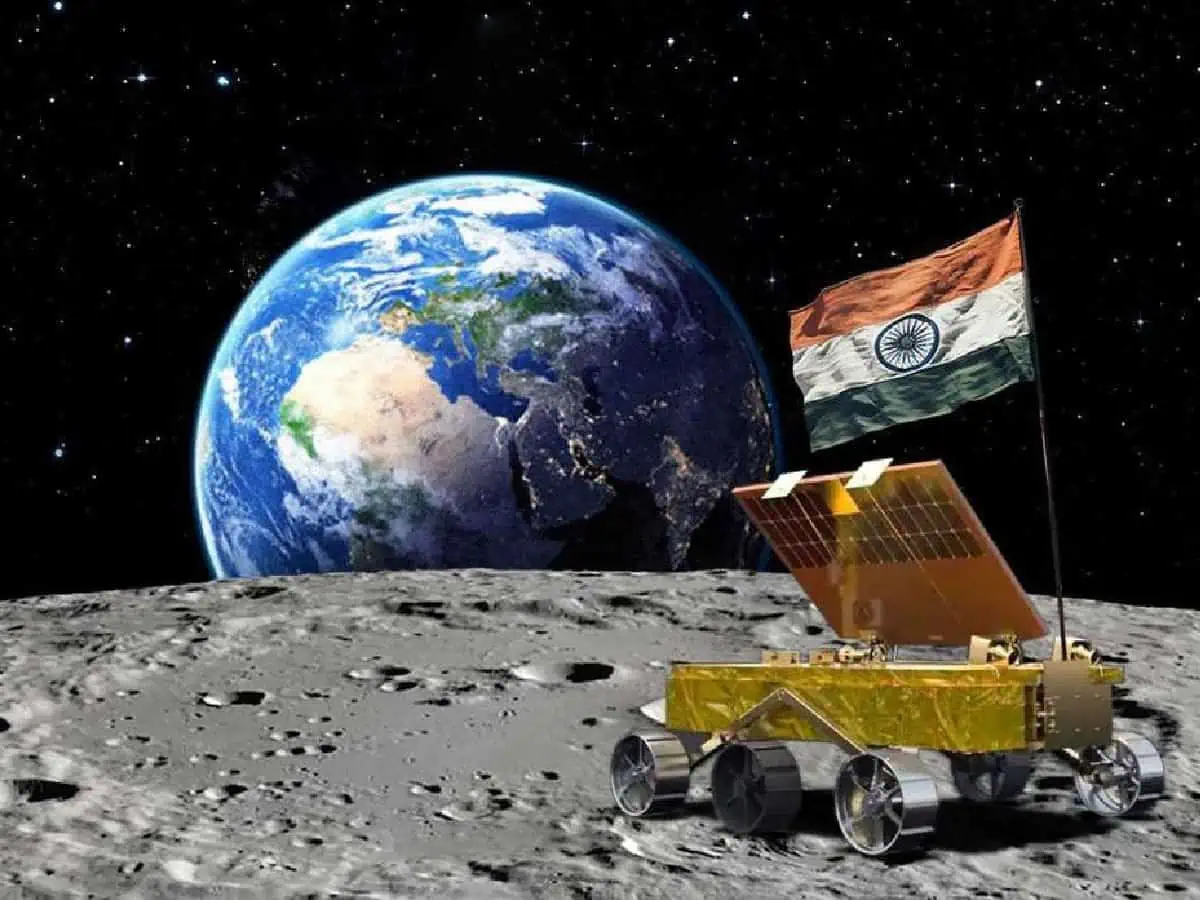
Geosynchronous Satellite Launch Vehicle, GSLV MkIII-M1 rocket, carrying Chandrayaan-2 spacecraft was launched from the Satish Dhawan Space Centre, Sriharikota in Andhra Pradesh on July 22, 2019. Chandrayaan-2 is India’s second mission to the moon. It comprises a fully indigenous Orbiter, Lander (Vikram) and Rover (Pragyan). The Rover Pragyan is housed inside Vikram lander. Chandrayaan-2 has several science payloads to facilitate a more detailed understanding of the origin and evolution of the Moon. To know more about Chandrayan 2, click here.
ISRO undertakes PSLV-C53/DS-EO mission on June 30, 2022. PSLV-C53 is the second dedicated commercial mission of New Space India Limited (NSIL).
Indian Regional Navigation Satellite System (IRNSS): NavIC
IRNSS is an independent regional navigation satellite system being developed by India. It is designed to provide accurate position information service to users in India as well as the region extending up to 1500 km from its boundary, which is its primary service area. An Extended Service Area lies between primary service area and area enclosed by the rectangle from Latitude 30 deg South to 50 deg North, Longitude 30 deg East to 130 deg East.
IRNSS will provide two types of services, namely, Standard Positioning Service (SPS) which is provided to all the users and Restricted Service (RS), which is an encrypted service provided only to the authorised users. The IRNSS System is expected to provide a position accuracy of better than 20 m in the primary service area.
Chandrayaan-3 was a lunar mission by ISRO focused on demonstrating safe landing and roving capabilities on the Moon. It was a follow-up mission to Chandrayaan-2 to demonstrate end-to-end capability in safe landing and roving on the lunar surface. It consisted of a Lander (Vikram), a Rover (Pragyan), and a Propulsion module. The mission successfully landed on the lunar south pole on August 23, 2023, making India the first country to achieve this feat. On July 14, 2023, Chandrayaan- 3 took off from the Satish Dhawan Space Centre in Sriharikota. The spacecraft seamlessly entered lunar orbit on August 5, 2023. The historic moment unfolded when the lander made a successful touchdown near the Lunar south pole on Aug 23, 2023.The mission’s objectives included conducting in-situ scientific experiments on the lunar surface, such as analysing the elemental composition and thermal properties.
Major Findings:
Lunar Surface Temperature Surprise: Chandra’s Surface Thermophysical Experiment (ChaSTE) measured temperatures reaching 70 degrees Celsius, surprising scientists who expected temperatures between 20 to 30 degrees Celsius.
Lunar Surface Elements Confirmed: The Laser-Induced Breakdown Spectroscopy instrument onboard ‘Pragyan’ rover confirmed the presence of Sulphur on the lunar surface near the south pole. Elements such as Aluminium, Calcium, Iron, Chromium, Titanium, Manganese, Silicon, and Oxygen were also detected.
Leadership in Space Technology:
It joins the elite group of nations—Russia, the US, and China—with demonstrated lunar soft-landing capability
India’s indigenous cryogenic engines and efforts to declutter the orbit showcase its leadership in space technology.
Positioning India as a global hub in the New Space economy
Built on a shoestring budget of just Rs 715 Crore, it is a landmark in India’s quest for the space.
Increasing interest in space tourism may lead to private space parks.
Convergence with smart space robots can create in-orbit manufacturing hubs, fostering economic activities
Over 500 space-tech startups, MSMEs, and industries fuel the New Space movement in India.
Shubhanshu Shukla is a group captain and test pilot with the Indian Air Force (IAF) and gaganyatri (astronaut) with the Indian Space Research Organisation (ISRO). As of July 2025, he is serving as the mission pilot for Axiom Mission 4, a privately organised mission to the International Space Station (ISS). Shukla is the first ISRO astronaut to visit the ISS and the second Indian to travel to space, following Rakesh Sharma’s mission in 1984.
Axiom Mission 4 (Ax‑4) was a private crewed spaceflight to the International Space Station (ISS) operated by Axiom Space in partnership with SpaceX and NASA. The mission launched atop a SpaceX Falcon 9 Block 5 rocket, which placed the Crew Dragon Grace spacecraft into low Earth orbit. This was the maiden flight of Grace (C213), the fifth and final Crew Dragon capsule to be built. The four-person crew included commander Peggy Whitson, an Axiom Space employee and former NASA astronaut; pilot Shubhanshu Shukla of the Indian Space Research Organisation (ISRO); and mission specialists Sławosz Uznański-Wiśniewski, a European Space Agency (ESA) project astronaut from Poland, and Tibor Kapu, representing the Hungarian Space Office. The mission marked the first government-sponsored human spaceflight in over 40 years, and only the second overall, for India, Hungary, and Poland. Each of these countries previously flew one astronaut as part of the Soviet Union’s Interkosmos program. While those earlier missions docked with Salyut 6 or Salyut 7, Ax-4 was the first government-sponsored mission from any of the three nations to reach the ISS.
LUPEX: Lunar Polar Exploration Mission- a collaborative effort between ISRO and JAXA(Japan), is poised to explore the Moon’s polar regions.
Shukrayaan 1: It is a planned mission to send an orbiter to Venus, the second planet from the Sun. It is expected to study Venus’s geological and volcanic activity, emissions on the ground, wind speed, cloud cover, and other planetary characteristics.
To get Saptarshi Sir’s guidance for PSC Miscellaneous Mains/ Clerkship Main/ English/Economy or for overall WBCS or other exam preparation, call or WhatsApp us @6295350330. Classes for PSC Miscellaneous Main and Clerkship Main have already started. WBCS New batch is also going on. You can also download our app for online guidance using the link
Alzheimer’s disease is a progressive form of dementia, resulting in severe loss of memory and cognitive ability and abnormalities in behavioral pattern. Three cardinal factors can be associated with the onset of Alzheimer’s- Age, Genetics and Family history. During the course of the disease, excessive amount of the chemical substance glutamate is released which in turn causes excessive brain cell damage and degeneration. There is no cure for the disease although the rate of damage can be slowed down by proper medication. Mostly people over 65 years of age are the victims of this incurable disease.
Dementia or memory loss is rather a symptom that can be due to a plethora of reasons and Alzheimer’s is one of those. It can also be due to Parkinson’s, traumatic injury etc. In every case, there is degeneration of the nerves resulting in incoordination of activities.
Key Characteristics of Alzheimer’s Disease:
Memory Loss: The most common early symptom is difficulty remembering recent events.
Cognitive Decline: Alzheimer’s affects thinking, reasoning, and judgment, impacting language, attention, and other cognitive functions.
Behavioral Changes: Individuals may experience changes in personality, mood, and behavior.
Progression: The disease progresses through stages, from mild cognitive impairment to moderate and severe dementia.
Researchers have primarily identified one gene Apolipoprotein E (APOE) for the onset of Alzheimer’s in older people. The disease is irreversible and leads to severe conditions like loss of speech and basic motor functions. However, in many cases, it is nonidentifiable at the early stages. Present-day city lifestyle often contributes to the onset of this nervous disorder. Therefore a healthy lifestyle is often suggested to avoid chances of Alzheimer’s.
There is no particular diagnostic technique to pinpoint this disease. Doctors mostly rely on the symptoms to diagnose the disease. However, CT scan (Computed tomography scan), PET scan (Positron emission tomography scan) or MRI (Magnetic resonance imaging) are often conducted to diagnose the condition of the brain resulting from the Alzheimer’s.
There is no proper medication to cure this disease. However, associated symptoms like depression, hallucination, agitation, aggression etc can be treated by antidepressants, antipsychotics, tranquilizers etc. Doctors often use drugs like donepezil or memantine to treat Alzheimer’s. Memantine is known to reduce the release of glutamate and thereby lessens brain degeneration.
Alzheimer’s has no cure, but two treatments — donanemab (Kisunla™) and lecanemab (Leqembi®) — demonstrate that removing beta-amyloid, one of the hallmarks of Alzheimer’s disease, from the brain reduces cognitive and functional decline in people living with early Alzheimer’s. Other treatments can temporarily slow the worsening of dementia symptoms and improve quality of life for those with living Alzheimer’s and their caregivers. Today, there is a worldwide effort underway to find better ways to treat the disease, delay its onset and prevent it from developing.
There are over 55 million people worldwide living with dementia, and Alzheimer’s disease is the most common form, accounting for 60-70% of those cases. Therefore, the number of Alzheimer’s patients globally is estimated to be between 33 million and 38.5 million. Alzheimer’s disease is a growing concern in India, with an estimated 5.3 million people currently living with dementia, the most common cause of which is Alzheimer’s. The prevalence of Alzheimer’s and other dementias in India is around 7.4% among adults aged 60 and older. This number is projected to significantly increase, potentially doubling by 2030 and tripling by 2050, posing a major challenge to the healthcare system.
Alzheimer’s patients are to be treated with utmost care, empathy and love. No medication but proper care, disciplined lifestyle, socialization, active participation in cognitive exercises can reduce the damages caused by this disease. Care and love are often seen to produce magical effects on patients. So next time you meet a person suffering from Alzheimer’s, don’t forget to give him a hug and show that you care.
Operation Barga was a land reform movement, throughout rural West Bengal for recording the names of sharecroppers (bargadars) while avoiding the time-consuming method of recording through the settlement machinery. It bestowed on the bargadars, the legal protection against eviction by the landlords (jotedars), and entitled them to the due share of the produce. Operation Barga was launched in 1978 and concluded by the mid-1980s. Introduced in 1978, and given legal backing in 1979 and 1980, Operation Barga became a popular but controversial measure for land reforms. The ultimate aim of these land reforms was to facilitate the conversion of the state’s bargadars into landowners, in line with the Directive Principles of State Policy of the Indian Constitution. To date, Op Barga has recorded the names of approximately 1.5 million bargadars. The initiative has been studied and admired as a model for land reform in other regions, emphasizing the importance of recognizing and protecting the rights of marginalized farmers.
The operation was divided into the following five distinct steps:
Identification of the priority pockets with large concentration of bargadars.
Camping by the Government Officials at the priority pockets.
Meeting between the bargadars and the government officials.
The collective participation of the villagers in the reconnaissance and field verification to establish the claims of sharecroppers.
Issue of temporary certificates called ‘parchas’ to confirm sharecroppers as evidence of their rights enabling them to obtain bank credit.
To begin with, group meetings between Officials and Bargadars were organized during “settlement camps” (also called “Reorientation camps”), where the bargadars could discuss their grievances. The first such camp was held at Halusai in Polba taluk in Hooghly district from 18 to 20 May 1978. An empirical analysis of the impact of Operation Barga on agricultural production, productivity, employment, income including its distribution and on the qualitative improvement in the utilization of barga land was conducted during the period 1986–88 in the three districts of Birbhum, Burdwan and Jalpaiguri in West Bengal.
Operation Barga was successful in enumerating the Bargadars. Over the period 1977–90, the fraction of registered sharecroppers rose from 23 to 65%. During the same period of time in West Bengal, there was expansion in public and private irrigation and there was technological change as well. These reforms, along with the guaranteed crop share and bargadar’s increased stake in the land led to an increase in agricultural output. By the end of 1982 about 1.2 million sharecroppers were recorded, out of the total estimated number of about 2.0-3.5 million.
By the end of June 1994 around 1460,000 bargadars had been recorded over an area of over 451,800 hectares. The most remarkable achievement of the programme, as reported in the 1986-88 study, was that it enhanced social status of the bargadars and security of tenancy.
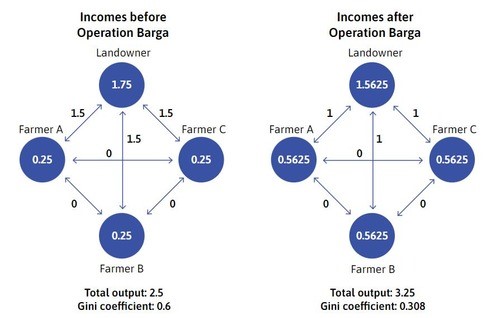
West Bengal enjoyed a subsequent dramatic increase in farm output per unit of land, as well as farming incomes. By comparing the output of farms before and after the implementation of Operation Barga, economists concluded that both improved work motivation and investment occurred. One study suggested that Operation Barga was responsible for around 28% of the regional growth in agricultural productivity from 1979 to 1993. The empowerment of the bargadars also had positive spillover effects, as local governments became more responsive to the needs of poor farmers.
The above image shows how Operation Barga reduced Gini coefficient in WB
Operation Barga (and West Bengal’s land reforms in general) have been criticized for their small scope and inability to solve all the major problems. This criticism has been mainly due to policies not accounting for the high population-to-landmass ratio in Bengal (the highest in the country), the small and highly segregated land holding patterns and failure of the Government to develop agri-industrial markets for farm produce. These failures, critics contend, have distributed poverty rather than creating prosperity.