MSP and Crop Insurance in India

Minimum Support Price (MSP) is a form of market intervention by the Government of India to insure agricultural producers against any sharp fall in farm prices. The minimum support prices are announced by the Government of India at the beginning of the sowing season for certain crops on the basis of the recommendations of the Commission for Agricultural Costs and Prices (CACP). MSP is price fixed by Government of India to protect the producer – farmers – against excessive fall in price during bumper production years. The minimum support prices are a guarantee price for their produce from the Government. The major objectives are to support the farmers from distress sales and to procure food grains for public distribution. In case the market price for the commodity falls below the announced minimum price due to bumper production and glut in the market, government agencies purchase the entire quantity offered by the farmers at the announced minimum price. This concept was introduced in 1966-67 during the Green Revolution as part of agricultural reforms, MSP serves as a safety measure taken by the union government to protect farmers from financial losses and maintain food security. Government fixes minimum support prices (MSPs) for 22 mandated agricultural crops.

Cost of Production: The primary factor includes expenses on seeds, fertilizers, irrigation, and labour. Farmers are assured a minimum margin of 50% over the production cost.

Demand and Supply: The government analyses market trends and consumer demand to determine appropriate pricing.

Market Price Trends: Domestic and international price comparisons ensure that the MSP remains competitive.

Inter-Crop Price Parity: A balanced pricing structure across different crops encourages diversified farming.

Terms of Trade: The government assesses the relationship between agricultural and non-agricultural sectors to maintain fair trade conditions.

Concerns

Limited Coverage: According to the Shanta Kumar Committee’s 2015 report, only 6% of farmers benefit from the MSP. Mainly those in regions with access to procurement infrastructure, such as Punjab and Haryana, while a large number of farmers in other states are left out.

Skewed Crop Focus: The MSP system is focused primarily on a few crops, especially rice and wheat, leading to a lack of incentive for farmers to grow other crops, which affects crop diversification and can contribute to overproduction of these staple crops.

Overburdening Procurement System: The MSP often leads to large-scale government procurement, especially of rice and wheat, causing storage challenges and wastage, and straining the Food Corporation of India’s (FCI) resources.

Environmental Impact: The focus on certain water-intensive crops like rice (supported by MSP) leads to environmental concerns such as groundwater depletion, particularly in regions like Punjab.

Dependence on Middlemen: In some cases, even when MSP is declared, farmers face difficulties in accessing procurement agencies directly, leading to dependence on middlemen who may exploit them by offering lower prices.

Initiatives for Crop Insurance

Crop insurance schemes in India aim to protect farmers from financial losses due to crop failure or damage caused by natural disasters, pests, and diseases. These schemes play a vital role in stabilizing farmers’ incomes and ensuring the sustainability of agriculture.

Key Objectives of Crop Insurance:

Financial Protection: Mitigate losses from crop failure.

Stability in Farm Income: Enable farmers to recover from adverse events and reinvest in agriculture.

Credit Accessibility: Assures banks of repayment, encouraging credit to the agricultural sector.

Encouragement of Modern Practices: Reduce risks associated with adopting new farming techniques.

Though the Government of India has initiated efforts for providing crop insurance to farmers since independence, a major boost was given in the form of the Comprehensive Crop Insurance Scheme (CCIS) in 1985 during the Seventh Five Year Plan period, which covered the risk in the cultivation of major crops against natural calamities and pests and diseases

The National Agricultural Insurance Scheme (NAIS) which is also known as the Rashtriya Krishi Bima Yojana replaced CCIS in 1999–2000. NAIS operates in all States and Union Territories of India. Insurance coverage and financial support to farmers would be given in the event of failure of any of the notified crops as a result of natural calamities, pests and diseases.

NAIS is implemented by the Agriculture Insurance Company of India Ltd (AIC) and the scheme helps the farmers to adopt new and innovative farming practices and scientific modern technology. It is promoted by General Insurance Corporation of India, National Bank of Agriculture and Rural Development (NABARD), United India Insurance Company Limited, National Insurance Company Limited, Oriental Insurance Company Limited and The New India Assurance Company Limited and it is directly controlled by the Ministry of Finance, Government of India.

In India, Pradhan Mantri Fasal Bima Yojana was also launched by the government in 2016 for agricultural insurance in the country. It was set up in line with the One Nation-One Scheme theme.

Pradhan Mantri Fasal Bima Yojana (PMFBY)

Objective: To provide financial support to farmers in case of crop loss due to natural calamities.

Key Features:

Premium rates for farmers:

Kharif crops: 2% of the sum insured.

Rabi crops: 1.5% of the sum insured.

Commercial and horticultural crops: 5% of the sum insured.

The remaining premium is subsidized by the Central and State Governments.

Coverage for pre-sowing to post-harvest losses, including localized calamities (e.g., hailstorms).

Technology Use: Remote sensing, drones, and GPS for faster claim assessment and transparency.

Economy Encyclopaedia – Part 1

Adverse selection

A risk associated with insurance, and linked to asymmetric information. People who are worried about their health will be more inclined to pay for health insurance than those who are fighting fit. One way to avoid the problem is to make insurance compulsory for all, as happens with car ownership.

Alpha

That part of an investment return that is due to the skill of the fund manager. This can be very hard to measure.

Amortisation

The gradual reduction in the value of an asset (or a debt) over time. A debt (such as a mortgage) is amortised via regular repayments. Companies use amortisation to steadily reduce the value of intangible assets on their balance-sheets.

Antitrust

Term used to describe laws or regulations designed to stop firms from exploiting their monopoly positions in markets at the expense of consumers or rival businesses.

Asset stripping

The practice of buying a company and rapidly selling off the component parts with the aim of making a profit. This often leads to great disruption in the business and a loss of jobs.

Austerity

A term used to describe efforts to reduce the share of public spending in GDP, particularly in the 2010s. When the economy is already weak, Keynesian economists view austerity programmes as a mistake, because they reduce demand. But free-market economists worry that, without austerity, the government’s role in the economy inexorably expands over time.

Authoritarian capitalism

Usually applied especially to China and Russia and to certain extent in India these days, this describes economies in which big business co-exists with an authoritarian government. Businesses are allowed to make money but if they dare to criticise the government, or appear too independent, they may face criminal or financial sanctions.

Backwardation

A term used in the commodity market for when the price for delivering a product today (the spot price) is higher than for delivery in future. Normally, the future price is higher, a situation known as contango. Backwardation is normally the sign of a supply shortage, causing traders to compete to get the product immediately.

Bank run

In a crisis, bank depositors may start to doubt they will get their money back. So, they may demand to withdraw it. Since banks have lent out this money, it is impossible for them to repay all depositors instantly. The bank may fail. To avoid this, most countries have schemes of deposit insurance.

Basis point

One hundredth of a percentage point. The term is often used to describe interest rate changes. A quarter-percentage-point rise or fall in rates is described as 25 basis points. Example, when the Repo rate is changed 0.25%, it is said to have changed 25 basis points.

Beta

This ratio measures the sensitivity of an individual asset’s price to that of the overall market. A stock that tends to go up even more rapidly than the market when it is rising, and drop more precipitously when it is falling, is described as “high beta”; one that moves less violently than the market is “low beta”.

Bill of exchange

A short-term financial instrument, originally used to finance international trade. The buyer of goods would give the seller a signed bill, equal to the value of the purchase, which the seller could then cash with a banker. In modern finance, bills are a catch-all term for short-term debt such as Treasury bills and commercial bills.

Bretton Woods

Location in New Hampshire of a conference in 1944 which decided the post-war economic order. It led to the establishment of the International Monetary Fund and the World Bank. And it agreed on a currency system that linked all currencies at fixed exchange rates to the dollar, which was convertible into gold at $35 an ounce.

Business cluster

When companies in an industrial sector gather in a specific area, such as technology companies in Silicon Valley. When a cluster forms, companies will find it easier to attract high-skilled staff, workers have a wider choice of employers, innovations can circulate more quickly and start-up companies may find it easier to get finance.

Capital flight

What happens when investors try to avoid high taxes, or the prospect of currency devaluation, by sending their money abroad. Governments try to prevent such flight by imposing capital controls but they need to act quickly. Investors will anticipate the introduction of capital controls by indulging in capital flight.

Cartel

Agreement where a group of producers collaborate to fix the price, or restrict the supply, of a good or service. Perhaps the best-known example is the Organisation of the Petroleum Exporting Countries, or OPEC. Cartels among companies are often outlawed by government antitrust regulations because they restrict competition.

Coase theorem

A concept, developed by Ronald Coase that deals with externalities. Coase thinks of the problem in terms of conflicting property rights such as the right of a factory to operate noisy machinery and the right of its neighbours to enjoy peace and quiet. If property rights are clearly delineated then, in the absence of transaction costs, bargaining should lead to an efficient outcome, such as the factory compensating its neighbours for the noise. Coase’s work on externalities, along with that on the theory of the firm, won him a Nobel prize in 1991.

Collateral

An item pledged as security against a loan. An obvious example is a house or flat, which homeowners used as collateral when taking out a mortgage. In financial markets, safe securities such as Treasury bonds are often used as collateral by traders and investors.

Commodity cycle

A pattern of rising and falling commodity prices and production. Rising commodity prices cause consumers to cut back their use and producers to expand output. In the ensuing glut, prices fall and output falls until commodities are so cheap that their use rises again.

Comparative advantage

This idea has been called one of the most profound insights in economics. If country A can make cars more cheaply than country B, and B can produce shirts more cheaply than A, it clearly makes sense to trade. Each has an absolute advantage in one area. But what if A is more efficient at producing everything than B? It still makes sense for them to trade, with B producing the goods where it is more competitive; if for example it is 90% as efficient as A in making shirts, and only 60% in car manufacturing, then it should specialise in making shirts and trade them for cars. Both countries will gain.

Conglomerate

A large company that has diversified across a range of countries and business areas, normally through making acquisitions. Eg. Reliance

Consumer confidence

A measure, taken from a survey, of the public’s attitude towards the economic outlook. If people are worried about their jobs, or political unrest, or a pandemic, they will be less likely to spend money.

Contango

When the futures price of a commodity is higher than the spot price.

Crawling peg

An exchange-rate system in which a currency is tied to another, but can fluctuate within a range, or band, depending on certain conditions.

Creative destruction

A concept, developed by Joseph Schumpeter, to explain economic innovation. Old inefficient companies must go out of business to release capital and workers so they can be used in new, more innovative ways.

Credit default swap

A derivative contract between two parties in which one insures the other against the default of a bond or loan. One of the products at the heart of the 2007-09 financial crisis.

Crowding out

The notion that actions by the state might restrict the options of the private sector. It usually applies to credit. If the government borrows a lot, and pushes up interest rates, then investors may not have enough capital to supply the investment needs of businesses.

Dependency ratio

The proportion of the population that is not of working age, compared with that which could work, if it chose to. Conventionally, dependants are defined as those aged up to 14 or over 65. Sometimes the figures are separated into youth dependency and old-age dependency. The higher the ratio, the greater the tax burden that is likely to fall on the working population; this is a problem for many developed economies, given the numbers now surviving into old age.

Deposit insurance

A scheme whereby a government agrees to compensate depositors if a bank goes bust. This can help prevent bank runs, when depositors panic.

Deregulation

It is a staple of conservative thought that there are too many regulations which hold back economic growth. So, every few years, governments announce a policy of deregulation to cut back the red tape. It turns out, however, that public opinion often demands that governments act to ban things that are bad, or that are disliked. And so more regulations are introduced.

Disintermediation

Cutting out the middleman, or connecting customers directly with producers. In theory, this should reduce costs. In practice, middlemen emerge in a new form; high-street travel agents may have declined in importance but many people use online versions such as Expedia or makemytrip.com.

Dumping

Selling something for less than the cost of producing it. This practice may be adopted by a dominant supplier in an industry in the hope of driving competitors out of business. More commonly, countries argue that producers in other nations are “dumping” goods and gaining market share; this can be used as an excuse to adopt protectionist measures such as tariffs.

To be continued…

To get Saptarshi Sir’s guidance for PSC Miscellaneous Mains/ Clerkship Main/ English/Economy or for overall WBCS or other exam preparation, call or WhatsApp us @6295350330. Classes for PSC Miscellaneous Main and Clerkship Main have already started. WBCS New batch is also going on. You can also download our app for online guidance using the link

https://play.google.com/store/apps/details?id=co.penny.oecgd&pcampaignid=web_share

For free notes, daily quizzes, word games and many other surprises, please join our Telegram Group using the link below

https://t.me/theadhyayanacademy

‘Operation Barga’ in West Bengal

Operation Barga was a land reform movement, throughout rural West Bengal for recording the names of sharecroppers (bargadars) while avoiding the time-consuming method of recording through the settlement machinery. It bestowed on the bargadars, the legal protection against eviction by the landlords (jotedars), and entitled them to the due share of the produce. Operation Barga was launched in 1978 and concluded by the mid-1980s. Introduced in 1978, and given legal backing in 1979 and 1980, Operation Barga became a popular but controversial measure for land reforms. The ultimate aim of these land reforms was to facilitate the conversion of the state’s bargadars into landowners, in line with the Directive Principles of State Policy of the Indian Constitution. To date, Op Barga has recorded the names of approximately 1.5 million bargadars. The initiative has been studied and admired as a model for land reform in other regions, emphasizing the importance of recognizing and protecting the rights of marginalized farmers. 

The operation was divided into the following five distinct steps:

Identification of the priority pockets with large concentration of bargadars.

Camping by the Government Officials at the priority pockets.

Meeting between the bargadars and the government officials.

The collective participation of the villagers in the reconnaissance and field verification to establish the claims of sharecroppers.

Issue of temporary certificates called ‘parchas’ to confirm sharecroppers as evidence of their rights enabling them to obtain bank credit.

To begin with, group meetings between Officials and Bargadars were organized during “settlement camps” (also called “Reorientation camps”), where the bargadars could discuss their grievances. The first such camp was held at Halusai in Polba taluk in Hooghly district from 18 to 20 May 1978. An empirical analysis of the impact of Operation Barga on agricultural production, productivity, employment, income including its distribution and on the qualitative improvement in the utilization of barga land was conducted during the period 1986–88 in the three districts of Birbhum, Burdwan and Jalpaiguri in West Bengal.

Operation Barga was successful in enumerating the Bargadars. Over the period 1977–90, the fraction of registered sharecroppers rose from 23 to 65%. During the same period of time in West Bengal, there was expansion in public and private irrigation and there was technological change as well. These reforms, along with the guaranteed crop share and bargadar’s increased stake in the land led to an increase in agricultural output. By the end of 1982 about 1.2 million sharecroppers were recorded, out of the total estimated number of about 2.0-3.5 million.

By the end of June 1994 around 1460,000 bargadars had been recorded over an area of over 451,800 hectares. The most remarkable achievement of the programme, as reported in the 1986-88 study, was that it enhanced social status of the bargadars and security of tenancy.

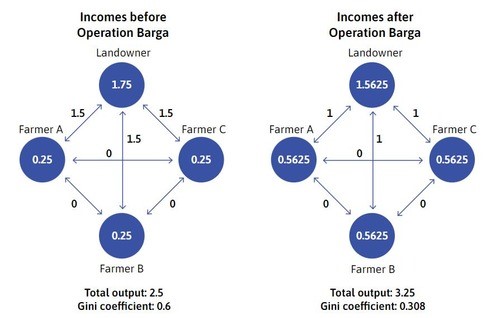
West Bengal enjoyed a subsequent dramatic increase in farm output per unit of land, as well as farming incomes. By comparing the output of farms before and after the implementation of Operation Barga, economists concluded that both improved work motivation and investment occurred. One study suggested that Operation Barga was responsible for around 28% of the regional growth in agricultural productivity from 1979 to 1993. The empowerment of the bargadars also had positive spillover effects, as local governments became more responsive to the needs of poor farmers.

The above image shows how Operation Barga reduced Gini coefficient in WB

Operation Barga (and West Bengal’s land reforms in general) have been criticized for their small scope and inability to solve all the major problems. This criticism has been mainly due to policies not accounting for the high population-to-landmass ratio in Bengal (the highest in the country), the small and highly segregated land holding patterns and failure of the Government to develop agri-industrial markets for farm produce. These failures, critics contend, have distributed poverty rather than creating prosperity.