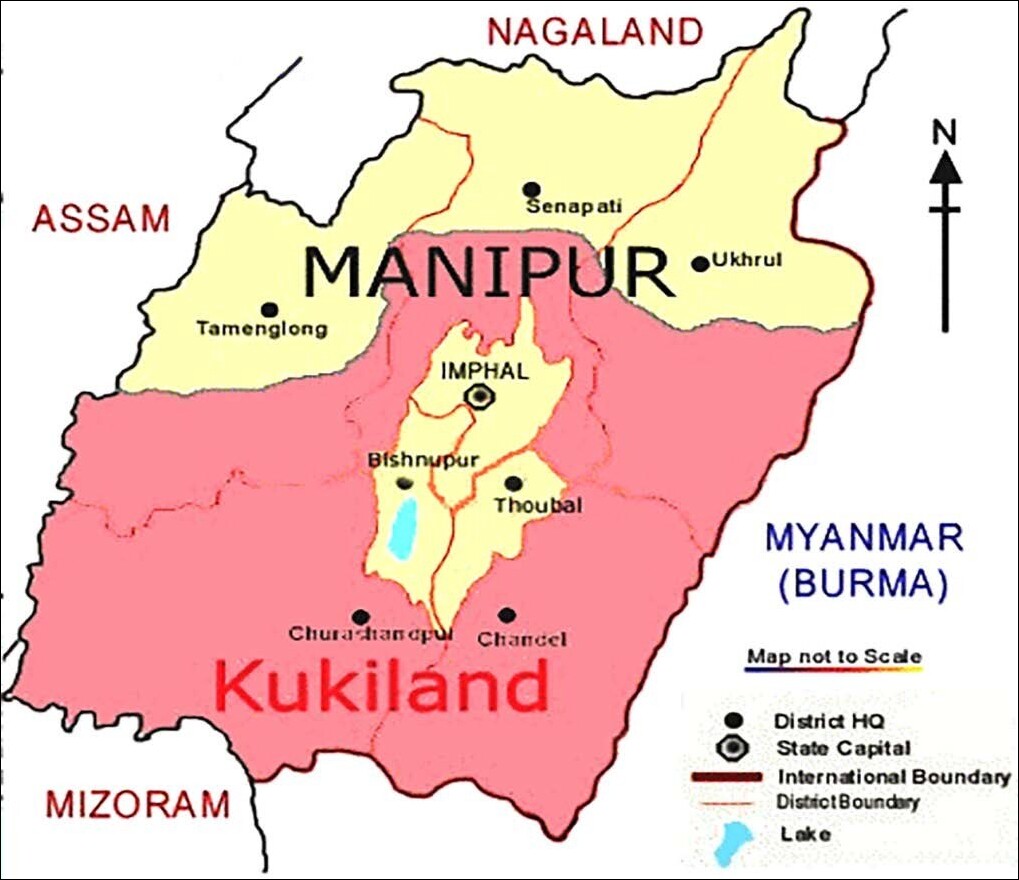
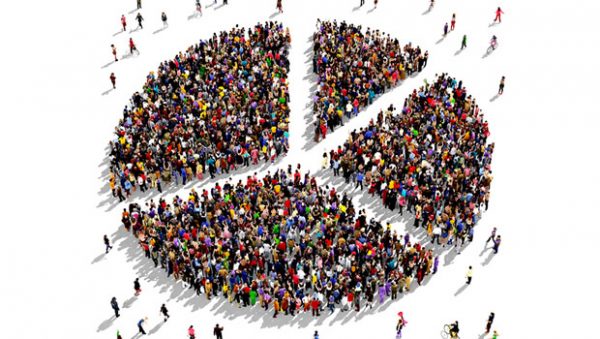
Demography– Manipur is a state in northeast India, bordering Myanmar to its east and south. The Imphal Valley constitutes about 10% of the geographical area of the state with 57% of the population predominantly Meitei, who are majority Hindus, with minorities of Muslims and native Sanamahism followers. The surrounding hills constitute 90% of the geographical area of the state with 43% of the population belonging to 34 tribal groups broadly categorised as Nagas and Kukis (25% and 15% roughly), who follow Christianity.
The Nagas dominate the northern districts while the Kukis are predominant in the south. The tribal people have the Scheduled Tribe (ST) status, whereas the Meitei have been accorded Other Backward Class (OBC) status, with some classified as Scheduled Castes (SC) in certain areas.
Historical Perspective– Historical ethnic conflicts and tensions between Kukis (Hill tribe) and Meiteis in Manipur have contributed to the unrest, as both communities compete for political representation, resources, and cultural recognition.
Most of the Meiteis live in the Imphal valley while the tribals live in the hill districts. The Meiteis are more educated and also better represented in business and politics of the state than Kukis and Nagas.
Meitei dominate the political establishment in Manipur with 40 out of the 60 Assembly constituencies.
People from the hill areas claim that despite hill districts of Manipur comprising 89% of the geographical area, there were only 20 MLAs from these areas in the Manipur Assembly.
Meiteis are limited to only around 10% of the land in the state, as the rest of the state is classified as tribal areas.
They live in the small patch of plain area in the state, the Imphal Valley, while the Kuki(tribals) reside in the protected Hill Areas, exclusively reserved for them.
Being classified as non-tribals, Meitei people can’t buy land in over 90% of the state.
While the tribals can buy land in Imphal Valley, thereby further reducing the land availability.
The Hill Areas in Manipur comprising 90% of the total land in Manipur are declared by the government under the provisions of Article 371C of the Constitution.
The Beginning– In 2020, as the Centre began the first delimitation process in the state since 1973, the Meitei community alleged that the Census figures used in the exercise did not accurately reflect the population break-up. Meitei leaders have alleged that there has been a sudden mushrooming of villages in Churachandpur district.
The then Chief Minister N Biren Singh repeatedly echoed and fed these fears — pointing to the presence of Myanmarese in Churachandpur, and linking them to the cultivation of poppy, and repeatedly making references to “foreigners” and “outsiders” and “Drug traffickers”.
Since 2012, there has been a constant demand led by the Scheduled Tribes Demand Committee of Manipur (STDCM) for granting the Scheduled Tribe (ST) status to the Meitei community.
The Meitei Tribe Union had filed a petition before the Manipur High Court and had argued that the Meitei community was once recognised as a “tribe” before the merger of the princely state of Manipur with the Union of India in 1949 and that it lost its identity as a tribe after the merger.
On 20 April 2023, a judge of the Manipur High Court directed the state government to “consider the request of the Meitei community to be included in the Scheduled Tribes (ST) list”.
The Kukis feared that the ST status would allow the Meiteis purchase land in the prohibited hilly areas.
The Eruption– The tribal groups called for a total shutdown on 28 April 2023 in protest of the state government actions.
Violence erupted on May 3, 2023, after tribal communities protested a Manipur High Court order granting the Meitei community certain benefits, including land ownership in protected areas and quotas in government jobs.
Incidents of sexual violence have garnered both national and international attention, bringing to light the harrowing reality faced by women in Manipur.
Meitei mobs have repeatedly targeted women as a means of control of the rival faction, including burning homes and subjecting them to assaults, and even forcing women to strip under threats of violence or shooting them in the face, causing disfigurement.
The Meitei groups have also attacked people from their own community who have spoken out against them.
In a shocking charge, the CBI has alleged that personnel from the Manipur Police allegedly drove the two women to a mob of around 1,000 people, which stripped and paraded them before they were gang-raped, in an incident that shook the nation.
The 26-second clip showed two Kuki tribal women paraded naked by a mob of men who were groping their genitals and assaulting them.
In August 2023, India’s Supreme Court expressed concerns over what it termed the “absolute breakdown of law and order” in Manipur.
The authorities have also failed to protect members of the Meitei community. In November 2024, about 35 armed Kuki militants attacked the camp of the Central Reserve Police Force, paramilitary police, and the adjacent police station in Jiribam district, allegedly looking for “Meitei people.” They abducted and killed three women and three children including an 8-month-old infant from the Meitei community, and burned to death two older Meitei men.
As of December 2024, the 42 special investigation teams created by the Supreme Court had filed charges in only 6 percent of the 3,023 registered cases, including murders, 9 cases of sexual crimes against women, and 2,888 cases of looting, arson, and other property crimes.
Regional Implications and Challenges
In the absence of any hint of immediate peace, the prolonged conflict, nearing a civil war, is causing a significant and irreversible shift in how the people of Manipur perceive each other and New Delhi. Decades of effort to build trust between the different groups since the ethnic clashes of the 1990s, and confidence-building measures with New Delhi after the rise of insurgent groups in the 1950s, were shattered overnight on May 3, 2023.
Tragically, in the post-May 3, 2023 period the harmony between the Meiteis and Kukis has been disturbed by an ever-increasing divide owing to the persistent violence. No one feels safe in areas dominated by the rival ethnic community, resulting in large-scale migration to safer areas, including Assam and Mizoram. Schools and educational institutions remained closed, and with the internet shutdown, online classes were unavailable. Under such circumstances, youths are being compelled to take up arms. The tourism industry has also suffered, with patients from Myanmar stopping medical visits. Retail inflation at 9.7 percent in September 2023 has led to economic insecurity, and unprovoked attacks on farmers and road blockages have caused food security concerns.
Additionally, the conflict has affected mental health, with rising post-traumatic stress disorder (PTSD) cases since the violence began. The government’s inability to address the violence and daily insecurities has fostered a sense of alienation and distrust towards New Delhi. Insurgent groups are gaining popularity as protectors, with dormant groups reactivating and many returning from their bases in unstable Myanmar. If unchecked, these developments can accelerate the radicalization of youth, which is detrimental to India’s national security.
Geopolitically, Manipur holds strategic importance as it shares a border with Myanmar and serves as a gateway to Southeast Asia for India. Also, Manipur is crucial for India’s Act East Policy (AEP), which aims to develop cultural links, trade, tourism, and connectivity with Southeast Asia. The trilateral highway project linking India, Myanmar, and Thailand starts from Moreh in Manipur and ends at Mae Sot in Thailand. Therefore, stability of the region is crucial for India’s foreign policy. With China’s growing power and influence in the conflict-ridden Myanmar, instability in Manipur can benefit China. Additionally, the conflict has also tarnished India’s global image, with organizations and states like Human Rights Watch, the European Union, the United Nations, Genocide Watch, and the United States expressing serious concerns.
Unrest persists– Two years after ethnic violence erupted between Meitei and Kukis and the resignation of the CM Singh and President’s Rule being imposed, violent clashes are still common in the state. So far, more than 260 people have lost their lives in the clashes, around 2000 people have been injured and over 70,000 people have been displaced.
Steps needed to restore peace– It is important to identify the victims and rehabilitate them and those in rehabilitation camps, with the help of the Govt and the civil society.
The government should foster the participation of the civil society of the region in the decision-making process to instil a sense of ownership and belonging. A huge quantity of weapons and ammunition are still being held by the warring communities in the conflict-driven state of Manipur.
The entire civil society needs to be disarmed on priority.
The Mizoram Accord of 1986 between the Government of India and the Mizo National Front (MNF) serves as an example of successful engagement with all stakeholders.
The repeal of AFSPA, Armed Forces Special Powers Act 1958, is necessary to improve the human rights situation in the region.
The government should ensure that the legal system is fair and transparent to prevent the misuse of power by security forces.
The authorities should ensure that people have the right to return when conditions are in place for a safe and voluntary process carried out in accordance with the United Nations Guiding Principles on Internal Displacement, with full and meaningful participation of all affected communities, including the equal participation of women.
To get Saptarshi Sir’s guidance for PSC Miscellaneous Mains/ Clerkship Main/ English/Economy or for overall WBCS or other exam preparation, call or WhatsApp us @6295350330. Classes for PSC Miscellaneous Main and Clerkship Main have already started. WBCS New batch is also going on. You can also download our app for online guidance using the link
This article consists of the following contents which are extremely important for any competitive examination for both objective and descriptive questions.
History of space research in India
Major milestones of India’s space technology
Indian Regional Navigation Satellite System
Rakesh Sharma
Gaganayan Mission
Chandrayaan Mission with special emphasis on Chandrayaan 3
Axiom 4 and Shubhanshu Shukla
The space research activities were initiated in India during the early 1960’s, when applications using satellites were in experimental stages even in the United States. With the live transmission of Tokyo Olympic Games across the Pacific by the American Satellite ‘Syncom-3’ demonstrating the power of communication satellites, Dr. Vikram Sarabhai, the founding father of Indian space programme, quickly recognized the benefits of space technologies for India.
As a first step, the Department of Atomic Energy formed the INCOSPAR (Indian National Committee for Space Research) under the leadership of Dr. Sarabhai and Dr. Ramanathan in 1962. The Indian Space Research Organisation (ISRO) was later formed on August 15, 1969. The prime objective of ISRO is to develop space technology and its application to various national needs. It is one of the six largest space agencies in the world. The Department of Space (DOS) and the Space Commission were set up in 1972 and ISRO was brought under DOS on June 1, 1972.
Since inception, the Indian space programme has been orchestrated well and had three distinct elements such as, satellites for communication and remote sensing, the space transportation system and application programmes. Two major operational systems have been established – the Indian National Satellite (INSAT) for telecommunication, television broadcasting, and meteorological services and the Indian Remote Sensing Satellite (IRS) for monitoring and management of natural resources and Disaster Management Support.
Major milestones in Indian Space Programme
Indian Space Programme began at Thumba Equatorial Rocket Launching Station (TERLS) located at Thumba near Thiruvanathapuram. Thumba was selected for being rocket launching station because geomagnetic equator of the earth passes over Thumba. The geomagnetic equator of the earth passes over Thumba.
On November 21, 1963, the first sounding rocket was launched from TERLS. The first rocket, a Nike-Apache was procured from the US. A sounding rocket is a rocket, which is intended for assessing the physical parameters of the upper atmosphere.
The Satellite Telecommunication Earth Station was set up at Ahmedabad on January 1, 1967.
India’s first indigenous sounding rocket, RH-75, was launched on November 20, 1967.
Aryabhata – First Indian Satellite was launched on April 19, 1975. It was launched from the former Soviet Union. It provided India with the basis of learning satellite technology and designing.
During 1975-76, ISRO along with NASA developed means of using space communications system for TV broadcasting. This resulted in the creation of the project Satellite Instructional Television Experiment (SITE). It was a one-year program covering Indian villages and districts. The main purpose of SITE was to experiment usage of satellite broadcasting to educate the masses. SITE, hailed as ‘the largest sociological experiment in the world’ benefited around 200,000 people, covering 2400 villages of six states and transmitted development-oriented programmes using the American Technology Satellite (ATS-6).
During January 1, 1977 — January 1, 1979, Satellite Telecommunication Experiments Project (STEP), a joint project of ISRO-and Post and Telegraphs Department (P&T) using the Franco-German Symphonie satellite was taken up. Conceived as a sequel to SITE which focused on Television, STEP was for telecommunication experiments.
Bhaskara-I – an experimental satellite for earth observations was launched on June 7, 1979.
First Experimental launch of SLV-3 with Rohini Technology Payload on board (August 10, 1979). Satellite could not be placed in orbit. Satellite Launch Vehicle-3 (SLV-3) is the first launch vehicle of India.
Ariane Passenger Payload Experiment (APPLE), an experimental geo-stationary communication satellite was successfully launched on June 19, 1981. It became the forerunner for future communication satellite system.
Indian National Satellite system (INSAT)-1A was launched on April 10, 1982. This system was for the communication, broadcasting and meteorology.
On April 2, 1984, the first Indo-Soviet manned space mission was launched. Wing Commander Rakesh Sharma (born 13 January 1949) became the first Indian citizen to go into space. He flew aboard in the Soviet rocket Soyuz T-11, as part of a three member Soviet-Indian crew as part of the Soviet Interkosmos programme.
Sharma retired as a wing commander and later joined Hindustan Aeronautics Limited (HAL) in 1987, serving as the chief test pilot in the HAL Nashik Division until 1992, before moving on to Bangalore to work as HAL’s chief test pilot. Sharma retired from flying in 2001
The first operational Indian Remote Sensing Satellite, IRS-1A was launched on March 17, 1988.
On March 24, 1987, the first developmental launch of Augmented Satellite Launch Vehicle (ASLV) that supported a larger payload than the SLV-3 and was meant to be low-cost happened.
Second developmental launch of Polar Satellite Launch Vehicle (PSLV) with IRS-P2, on board took place on October 15, 1994. Satellite successfully placed in Polar Sun synchronous Orbit. PSLV went on to become a favoured carrier for satellites of various countries due to its reliability and cost efficiency, promoting unprecedented international collaboration.
The first developmental launch of Geosynchronous Satellite Launch Vehicle (GSLV)-D1 with GSAT-1 on board took off from Sriharikota on April 18, 2001. It was developed keeping in mind the heavier and more demanding Geosynchronous communication satellites.
INSAT-4CR weighing 2130 kg and launched by GSLV-F04 on September 2, 2007 is the heaviest satellite launched from India.
PSLV-C11 successfully launches CHANDRAYAAN-1 from Sriharikota on October 22, 2008. Chandrayaan-1 is a scientific investigation – by spacecraft – of the Moon. The name Chandrayaan means “Chandra- Moon, Yaan-vehicle”, –in Indian languages (Sanskrit and Hindi) , – the lunar spacecraft. Chandrayaan-1 is the first Indian planetary science and exploration mission. Chandrayaan-1 was operational for 312 days till August 28, 2009.
November 5, 2013 – PSLV – C25 successfully launches Mars Orbiter Mission (Mangalyaan) Spacecraft from Sriharikota.
India’s communication satellite, GSAT-17 was inducted into the INSAT/GSAT system on June 29, 2017 from Kourou, French Guiana by Ariane-5 VA-238.
India’s Polar Satellite Launch Vehicle, in its forty-third flight (PSLV-C41) in XL configuration launched IRNSS-1I Satellite. The ‘XL’ configuration of PSLV is used for the twentieth time. The IRNSS-1I is the eighth satellite to join the NavIC navigation satellite constellation and was launched on April 12, 2018.
India’s next generation high throughput communication satellite, GSAT-11 was successfully launched on December 05, 2018 from Kourou launch base, French Guiana by Ariane-5 VA-246. Weighing about 5854 kg, GSAT-11 is the heaviest satellite built by ISRO.
Gaganyaan Programme – Two unmanned & one manned flight has been planned. Estimates for Phase-I expenditure- Rs 9023 Crores. Gaganyaan Programme will establish a broader framework for collaboration between ISRO, academia, industry, national agencies and other scientific organizations. The Gaganyaan Mission will be led by V. R. Lalithambika, the former Director of the Directorate of the Human Spaceflight Programme with ISRO Chairman S Somnath and S. Unnikrishnan Nair, Director of Vikram Sarabhai Space Centre. The Hindustan Aeronautics Limited (HAL)-manufactured crew module underwent its first uncrewed experimental flight on 18 December 2014. On 27 February 2024, Prime Minister Narendra Modi revealed the identities of the first four Indian astronauts (Gaganyatris): Gp Capt Prasanth Balakrishnan Nair, Gp Capt Ajit Krishnan, Gp Capt Angad Pratap and Gp Capt (then Wg Cdr) Shubhanshu Shukla. Axiom‑4 represents a milestone for the Indian Human Spaceflight Programme, integrating with ISRO’s Gaganyaan initiative. While Gaganyaan remains India’s independent crewed program, Ax‑4 provides the first opportunity for an Indian astronaut—Shubhanshu Shukla—to fly on a commercial mission to the ISS.
Geosynchronous Satellite Launch Vehicle, GSLV MkIII-M1 rocket, carrying Chandrayaan-2 spacecraft was launched from the Satish Dhawan Space Centre, Sriharikota in Andhra Pradesh on July 22, 2019. Chandrayaan-2 is India’s second mission to the moon. It comprises a fully indigenous Orbiter, Lander (Vikram) and Rover (Pragyan). The Rover Pragyan is housed inside Vikram lander. Chandrayaan-2 has several science payloads to facilitate a more detailed understanding of the origin and evolution of the Moon. To know more about Chandrayan 2, click here.
ISRO undertakes PSLV-C53/DS-EO mission on June 30, 2022. PSLV-C53 is the second dedicated commercial mission of New Space India Limited (NSIL).
Indian Regional Navigation Satellite System (IRNSS): NavIC
IRNSS is an independent regional navigation satellite system being developed by India. It is designed to provide accurate position information service to users in India as well as the region extending up to 1500 km from its boundary, which is its primary service area. An Extended Service Area lies between primary service area and area enclosed by the rectangle from Latitude 30 deg South to 50 deg North, Longitude 30 deg East to 130 deg East.
IRNSS will provide two types of services, namely, Standard Positioning Service (SPS) which is provided to all the users and Restricted Service (RS), which is an encrypted service provided only to the authorised users. The IRNSS System is expected to provide a position accuracy of better than 20 m in the primary service area.
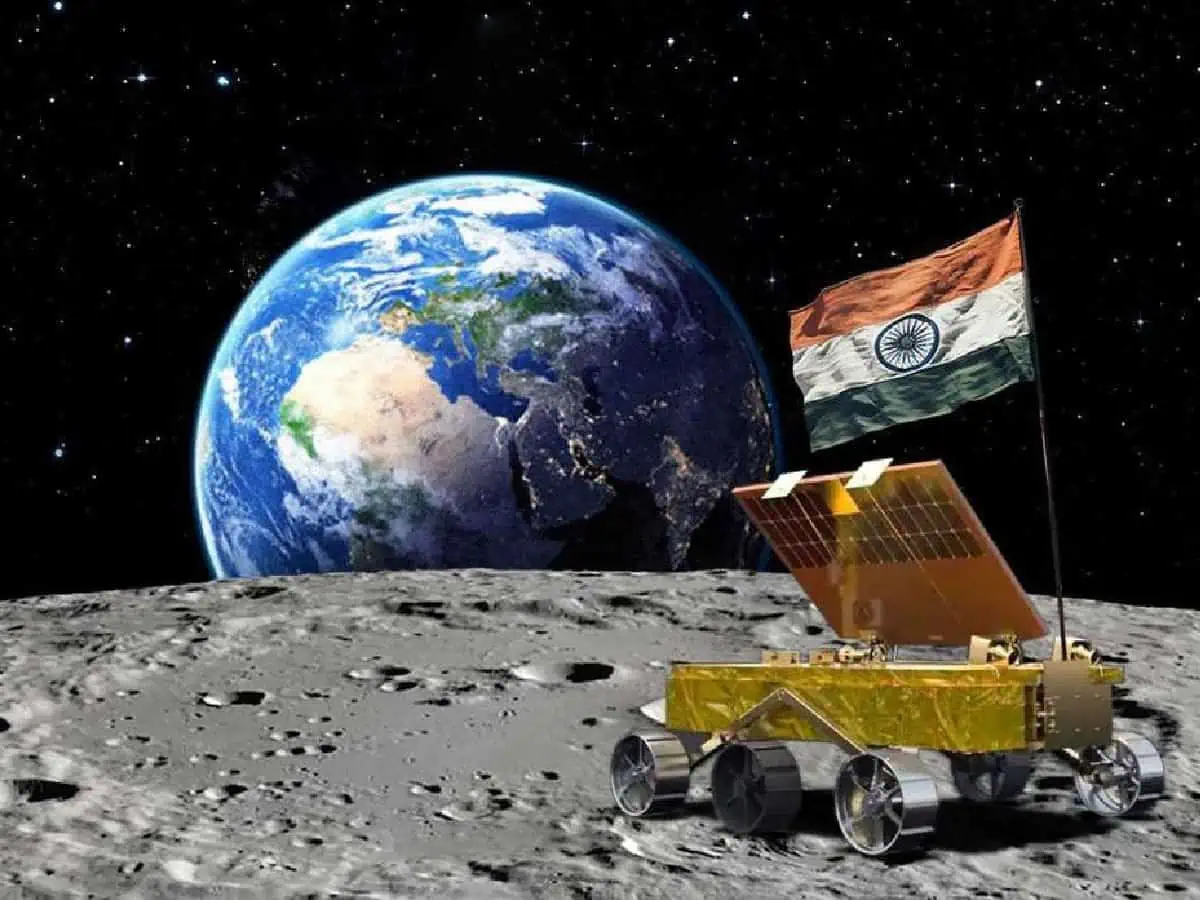
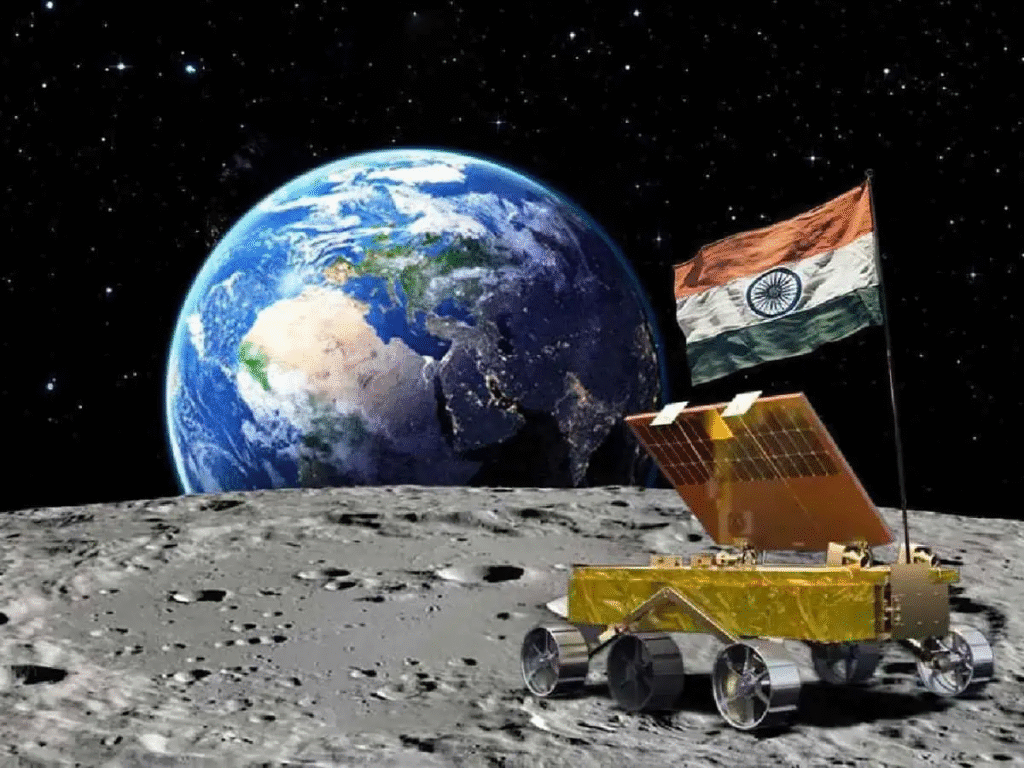
Chandrayaan-3 was a lunar mission by ISRO focused on demonstrating safe landing and roving capabilities on the Moon. It was a follow-up mission to Chandrayaan-2 to demonstrate end-to-end capability in safe landing and roving on the lunar surface. It consisted of a Lander (Vikram), a Rover (Pragyan), and a Propulsion module. The mission successfully landed on the lunar south pole on August 23, 2023, making India the first country to achieve this feat. On July 14, 2023, Chandrayaan- 3 took off from the Satish Dhawan Space Centre in Sriharikota. The spacecraft seamlessly entered lunar orbit on August 5, 2023. The historic moment unfolded when the lander made a successful touchdown near the Lunar south pole on Aug 23, 2023.The mission’s objectives included conducting in-situ scientific experiments on the lunar surface, such as analysing the elemental composition and thermal properties.
Major Findings:
Lunar Surface Temperature Surprise: Chandra’s Surface Thermophysical Experiment (ChaSTE) measured temperatures reaching 70 degrees Celsius, surprising scientists who expected temperatures between 20 to 30 degrees Celsius.
Lunar Surface Elements Confirmed: The Laser-Induced Breakdown Spectroscopy instrument onboard ‘Pragyan’ rover confirmed the presence of Sulphur on the lunar surface near the south pole. Elements such as Aluminium, Calcium, Iron, Chromium, Titanium, Manganese, Silicon, and Oxygen were also detected.
Leadership in Space Technology:
It joins the elite group of nations—Russia, the US, and China—with demonstrated lunar soft-landing capability
India’s indigenous cryogenic engines and efforts to declutter the orbit showcase its leadership in space technology.
Positioning India as a global hub in the New Space economy
Built on a shoestring budget of just Rs 715 Crore, it is a landmark in India’s quest for the space.
Increasing interest in space tourism may lead to private space parks.
Convergence with smart space robots can create in-orbit manufacturing hubs, fostering economic activities
Over 500 space-tech startups, MSMEs, and industries fuel the New Space movement in India.
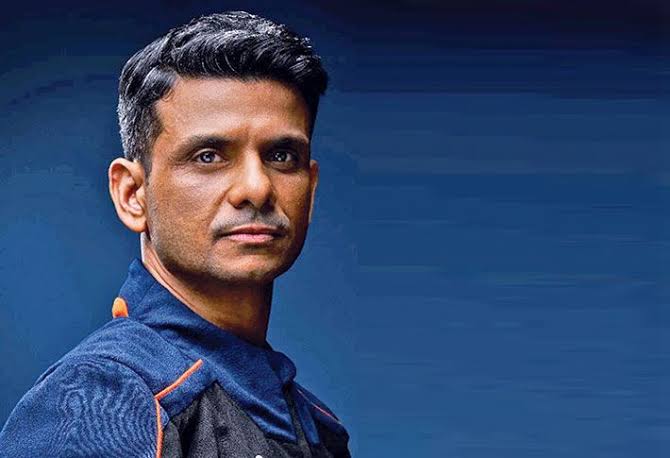
Shubhanshu Shukla is a group captain and test pilot with the Indian Air Force (IAF) and gaganyatri (astronaut) with the Indian Space Research Organisation (ISRO). As of July 2025, he is serving as the mission pilot for Axiom Mission 4, a privately organised mission to the International Space Station (ISS). Shukla is the first ISRO astronaut to visit the ISS and the second Indian to travel to space, following Rakesh Sharma’s mission in 1984.
Axiom Mission 4 (Ax‑4) was a private crewed spaceflight to the International Space Station (ISS) operated by Axiom Space in partnership with SpaceX and NASA. The mission launched atop a SpaceX Falcon 9 Block 5 rocket, which placed the Crew Dragon Grace spacecraft into low Earth orbit. This was the maiden flight of Grace (C213), the fifth and final Crew Dragon capsule to be built. The four-person crew included commander Peggy Whitson, an Axiom Space employee and former NASA astronaut; pilot Shubhanshu Shukla of the Indian Space Research Organisation (ISRO); and mission specialists Sławosz Uznański-Wiśniewski, a European Space Agency (ESA) project astronaut from Poland, and Tibor Kapu, representing the Hungarian Space Office. The mission marked the first government-sponsored human spaceflight in over 40 years, and only the second overall, for India, Hungary, and Poland. Each of these countries previously flew one astronaut as part of the Soviet Union’s Interkosmos program. While those earlier missions docked with Salyut 6 or Salyut 7, Ax-4 was the first government-sponsored mission from any of the three nations to reach the ISS.
LUPEX: Lunar Polar Exploration Mission- a collaborative effort between ISRO and JAXA(Japan), is poised to explore the Moon’s polar regions.
Shukrayaan 1: It is a planned mission to send an orbiter to Venus, the second planet from the Sun. It is expected to study Venus’s geological and volcanic activity, emissions on the ground, wind speed, cloud cover, and other planetary characteristics.
To get Saptarshi Sir’s guidance for PSC Miscellaneous Mains/ Clerkship Main/ English/Economy or for overall WBCS or other exam preparation, call or WhatsApp us @6295350330. Classes for PSC Miscellaneous Main and Clerkship Main have already started. WBCS New batch is also going on. You can also download our app for online guidance using the link
Surface to Surface Missile- Agni, Prithvi, Brahmos
Short Range SAM (Surface to Air)- Trishul (Precision issues led to the import of Barak Missiles from Israel.)
Medium Range SAM-Akash (3 variants)
Long Range SAM- Barak 8
Medium Range Ballistic Missile- Agni I
Intermediate Range Ballistic Missile- Agni II to Agni V
ICBM or Inter Continental Ballistic Missile- Agni V
Short Range Ballistic Missile- Prithvi I and II, Dhanush
Medium Range Ballistic Missile- Shaurya, Prahaar
Supersonic Cruise Missile- Brahmos I
Hypersonic Cruise Missile- Brahmos II
Subsonic Cruise Missile- Nirbhay
Submarine Launched Ballistic Missile- Sagarika K5
Anti-Tank Guided Missile- Nag, Amogha, Helina
The Indian Armed Forces uses various types of ballistic and cruise missiles. In India, the Defence Research and Development Organisation is the major body that is involved in the research and development of missiles. Public sector units (Bharat Dynamics Ltd-BDL, Bharat Electronics Ltd-BEL) and some of the private organizations (Tata Advanced Systems, Larsen & Toubro, and Kalyani Rafael Advanced Systems ) are involved in the manufacture of the missiles, often in collaboration with foreign manufacturers. India is one of seven countries in the world with intercontinental ballistic missiles (ICBMs) and one of four countries with anti-ballistic missile systems. Since 2016, India has been a member of Missile Technology Control Regime (MTCR).
Ballistic Missile Defence System
Aimed at intercepting aerial threat from ballistic missiles that have ranges up to 5000km at altitudes both outside (exo) and inside (endo) the atmosphere
1st layer: Endo
The single stage solid rocket-propelled Advanced Air Defence (AAD) low-altitude interceptor missile. (Ashwin) The AAD interceptor missile is primarily designed to intercept enemy missiles in the endo-atmosphere at altitudes of 20-40 kilometres.
2nd layer: Exo
Prithvi Air Defence Vehicle known as Pradyumna Ballistic Missile Interceptor is designed to destroy missiles with ranges 300-2000 km at exo-atmosphere (about 80km altitude).
First successful interception in 2006
For higher altitudes up to 150 km, Agni-V-based ballistic interceptors would be used. (because of 5000km range)
Multi-Layered Air Defence System: S-400
Alternatives: THAAD and Patriot
India has signed a deal with Russia to acquire S-400 TRIUMF multi-layered air defence system.
S-400 is known as Russia’s most advanced long-range surface-to-air missile defence system.
S-400 layered defence system can intercept all types of aerial targets including aircraft, unmanned aerial vehicles (UAV), and ballistic and cruise missiles up to the range of 400km, at an altitude of up to 30km
Capable of firing three types of missiles to create a layered defence.
USA is offering THAAD and Patriot as alternative to S-400 to India.
Barak-8 Long and Medium Range SAM (Surface to Air Missile)
Medium-range surface-to-air missile system being developed jointly by India and Isreal.
It will have an interception range of 70-100 km.
Part of naval air defence system to be used aboard INS Vikrant (under construction)
Maximum speed of Mach 2.
Notable Deployment: In Ladakh against China
Akash Medium-Range Surface to Air Missile System
India has 2 regiments of the indigenous Akash systems which are capable of multi-target engagement.
It can strike targets up to a range of 25km and altitude of 18,000m.
The Akash has been developed by the Defence Research and Development Organisation (DRDO) and manufactured by Bharat Dynamics Limited (BDL) and Bharat Electronics Limited (BEL). It has become the backbone of India’s air defence system.
The Akash is a medium-range surface-to-air missile system designed to protect vital areas from aerial attacks. It can strike targets at distances of up to 45 kilometres and altitudes between 4 and 25 kilometres.
India is developing a multi-layered air defence system for its cities besides air defence system for tactical battle areas.
1st layer: 2-tier Ballistic Missile Defence System
2nd Layer: S-400 layered defence system
3rd Layer: Barak-8 long and medium range SAM
4th Layer: Akash medium-range surface to air missile system
5th Layer: NASAMS-2
NASAMS-2
India is acquiring NASAMS-2 from US.
NASAMS 2 will form the inner-most layer of Delhi Area Air Defence Plan that has been conceived of.
It will be deployed to protect vital assets and people in the National Capital region of Delhi including President’s house, Parliament etc.
It renders quick-reaction 3-dimensional protection at low altitudes of 5 km to various types of aerial threats ranging from drones to ballistic missiles.
Hypersonic Missiles
Travels at Mach 5 or higher (more than one mile per second)
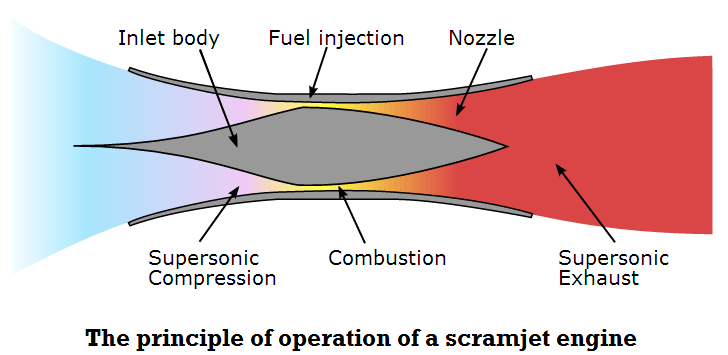
They typically consist of a Supersonic Combustion Ramjet or Scramjet propulsion system to enable such high speeds.
Scramjet engine collects oxygen from the atmosphere as it is travelling and mixes the oxygen with its hydrogen fuel, creating the combustion needed for hypersonic travel.
India is developing a Hypersonic Technology Demonstrator Vehicle (HSTDV)
It is an unmanned scramjet (allowing supersonic combustion) demonstration vehicle that can cruise to a speed of Mach 6 (or six times the speed of sound) and rise up to an altitude of 32 km in 20 seconds. It has been developed by DRDO.
There are 2 types of Hypersonic Weapon Delivery Systems
Hypersonic Cruise Missiles (HCM)
Hypersonic Glide Vehicle (HGV)
They are a mix of the speed of a ballistic missile and manoeuvring capabilities of a cruise missile
While cruise missiles achieve speeds of 550 mile per hour, the hypersonic missiles aircrafts can reach speeds more than 3500 miles per hour.
Capable of penetrating any antimissile defence system currently available that are designed to intercept cruise and ballistic missiles.
Specifically designed for increased survivability against modern ballistic missile defence systems.
Project Kusha is a major indigenous air defence initiative led by India’s Defence Research and Development Organisation (DRDO). Its primary goal is to develop a long-range, multi-layered surface-to-air missile (SAM) system capable of countering advanced aerial threats, including hypersonic weapons traveling at speeds up to Mach 7 (about 8,645 km/h).
Unmanned Aerial Vehicle
An Unmanned Aerial Vehicle, commonly known as a drone, is an aircraft without any human pilot, crew, or passengers on board.
Panchi
The wheeled variant of the Unmanned Aerial Vehicle (UAV) Nishant, can take off and land on tiny airstrips.
It has all of the surveillance capabilities of the UAV Nishant plus greater endurance because it does not need to carry the airbags and parachute system that the UAV Nishant does.
Nishant UAV
Inducted into the Army is a multi-mission UAV with Day/Night operational capability.
Intended for battlefield surveillance, tracking and localization of targets, and artillery firing correction.
Operated by an easy-to-use Ground Control Station + image processing system to examine UAV-sent images.
Anti-satellite weapons (ASAT)
India successfully tested its ASAT missile in March 2019.
A live satellite in low Earth orbit was destroyed by the ASAT missile (283-kilometer).
According to the DRDO, the missile can fire down objects traveling at a speed of 10 km per second from an altitude of 1200 km.
Pinaka Missile System
Pinaka is an indigenous multi-barrel rocket launch system developed for the Indian Army by the Defence Research and Development Organization (DRDO).
Its weapon system includes a cutting-edge guidance package, as well as an advanced navigation and control system.
The Pinaka Mark-II Rocket is converted into a missile by integrating with the navigation, control, and guidance system, which improves accuracy and range.
The Indian Regional Navigation Satellite System assists the missile’s navigation system (IRNSS).
It is an artillery missile system capable of striking enemy land with pinpoint accuracy up to a range of 75 kilometers.
The weapon system’s first version, known as Mark I, had a range of 40 kilometers.
The upgraded version of Pinaka Mark II has an extended range of 70 to 80 km.
Mission Shakti
Mission Shakti was launched to build highly effective anti-satellite weaponry (ASAT). It is a collaboration between the Defence Research and Development Organization (DRDO) and the Indian Space Research Organization (ISRO) (ISRO).
ASAT (anti-satellite) system is a missile-based system used to attack moving satellites.
The primary objective of Mission Shakti was to demonstrate India’s capability to safeguard its space assets by developing the technology to shoot down satellites in orbit. The successful test showcased India’s anti-satellite missile technology.
The successful test made India the fourth country in the world, after the United States, Russia, and China, to possess the capability to shoot down satellites in space.
The test raised discussions and concerns about the militarization of space and the need for international norms and agreements regarding space activities.
Fact File
India’s first indigenously developed missile was Prithvi, a short-range ballistic missile. It was developed under the Integrated Guided Missile Development Program (IGMDP) and first tested in 1988. Prithvi is a surface-to-surface missile with a range of 150 km
Dr. APJ Abdul Kalam spent four decades as a scientist and science administrator, mainly at the Defence Research and Development Organisation (DRDO) and Indian Space Research Organisation (ISRO) and was intimately involved in India’s civilian space programme and military missile development efforts. He was known as the “Missile Man of India” for his work on the development of ballistic missile and launch vehicle technology. He also played a pivotal organisational, technical, and political role in Pokhran-II nuclear tests in 1998, India’s second such test after the first test in 1974.
Operation Trident (India vs Pak 1971) saw the first use of anti-ship missiles in South east Asia region.
Nag anti-tank missile is the only missile in the world to have full fibre glass body.
The Brahmos are named after the rivers Brahmaputra and Moskva.
To get Saptarshi Sir’s guidance for PSC Miscellaneous Mains/ Clerkship Main/ English/Economy or for overall WBCS or other exam preparation, call or WhatsApp us @6295350330. Classes for PSC Miscellaneous Main and Clerkship Main have already started. WBCS New batch is also going on. You can also download our app for online guidance using the link
Question- Write a report on a symposium recently held in your college on environment awareness in about 200 words.
Answer
‘A Day for Nature’- A Symposium with Purpose
Place DEF, July 22: Amidst much funfair the XYZ college at DEF recently organized a symposium titled ‘A Day for Nature’ to raise awareness about the ecosystem we live in. The list of eminent guests included Mr. X, the chairperson of the local municipality, Ms. Y, a renowned environment activist, Mr Z whose NGO recently came in news for novel initiatives to protect the environment.
The symposium was started off by lighting the sacred lamp by the principal of the college along with the dignitaries present. This was followed by a welcome speech by the President of the Governing body of the college. Following that the keynote speakers delivered their valuable speeches on a plethora of subjects like global warming, climate change, afforestation, water crisis, green house gases etc. Student representatives also participated in group discussions, debates and a quiz on environment.
It was resolved that a plantation programme will be carried out at the locality and its vicinity by the college along with the civil society. A team of Green Volunteers will be formed to address any emergency issue concerning nature or to mitigate any damage caused thereby. An awareness rally was also planned. Finally, the eventful symposium concluded with vote of thanks by the General Secretary of the Students’ Union.
Notes for the students
1) Place ‘M’ signifies any place like Howrah, Kolkata, Jalpaiguri.
2) Do not write direct names or places. Instead, use A,B,C,X,Y,Z.
3) Do not forget to add a heading
4) Add a dateline as done in the above report.
5) Avoid using flowery language and bombastic words.
6) Help the examiner to visualize what actually happened.
7) DO NOT USE UNNECESSARY WORDS OR SENTENCES.
8) Keep it simple.
To get Saptarshi Sir’s guidance for English/Economy or for overall WBCS/ PSC Miscellaneous Main or other exam preparation, call or WhatsApp us @6295350330. Classes for PSC Miscellaneous Main have already started. WBCS New batch is also going on. You can also download our app for online guidance using the link
Please note that this is one of the most important topics for any examination like UPSC CSE, WBCS, PSC Clerkship, SSC CGL, Miscellaneous or others. Read and memorize every date very carefully.
Date Day
1st January Global Peace Day
6th January World War Orphans Day
9th January Pravasi Bharatiya Divas NRI Day
10th January- World Hindi Day
12th January National Youth Day (Birth Day of Swami Vivekanand)
15th January Army Day of India ((Field Marshall K.M. Cariappa took over the
command of Army on this day in 1949 from the British)
24th January National Girl Child Day of India
25th January India Tourism Day, National Voters Day
28th January Data protection day
30th January Martyr’s Day, World Leprosy Eradication Day
2nd February World Wetlands Day
4th February World Cancer Day
20th February World Day of Social Justice
21st February International Mother Language Day
27 February World Sustainable Energy Day
28 February National Science Day
3rd March World Wildlife Day
8 March International Women’s Day
15 March World Consumer Rights Day
21 March World Forestry Day
22 March World Water Day
23rd March World Meteorological Day
24 March World Tuberculosis (TB) Day
27 March World Theatre Day
2 April World Autism Awareness Day
7 April World Health Day
21 April National Civil Service Day
22 April World Earth Day
24 April National Panchayati Day
1st May International Labour Day
3rd May Press Freedom Day
8th May World Red Cross Day
21st May Anti-terrorism day
24th May Commonwealth Day
31st May Anti-Tobacco Day
5th June World Environment Day
12th June World Day Against Child Labour
14th June World Blood Donor Day
20th June World Refugee Day
21st June International Yoga Day, World Music Day
27th June World Diabetes Day
1st July National Doctor’s Day
11th July World Population Day
26th July Kargil Vijay Diwas
29th July International Tiger Day
6th August Hiroshima Day
9th August Quit India Day and Nagasaki Day
12th August International Youth Day
29th August National Sports Day
5th September Teachers’ Day (Dr. Radhakrishnan’s birthday)
8th September World Literacy Day
15th September Engineer’s Day in India
16th September World Ozone Day
27th September World Tourism Day
2nd October Mahatma Gandhi’s birthday, International Day of Non-violence
5th October World Teacher’s Day
11th October International Girl Child Day
16th October World Food Day
24th October UN Day
31st October Rastriya Ekta Diwas (in memory of Sardar Patel), National Integration Day (In memory of Indira Gandhi)
5th November World Radiography Day
29th November International Day of Solidarity with Palestinian People
1st December World Aids Day
2nd December World Computer literacy day, International Day of Abolition of slavery
3rd December International Day of People with disabilities
10th December Human Right Day
23rd December Kisan Divas (Farmer’s Day)
29th December International Bio-diversity day
For getting my personal guidance for PSC Miscellaneous Mains/ WBCS , pls call or whatsapp now- 6295350330
The United Nations is an international organization founded in 1945 after the Second World War by 51 countries committed to maintaining international peace and security, developing friendly relations among nations and promoting social progress, better living standards and human rights.
Despite the problems encountered by the League of Nations in arbitrating conflict and ensuring international peace and security prior to World War II, the major Allied powers agreed during the war to establish a new global organization to help manage international affairs. This agreement was first articulated when U.S. President Franklin D. Roosevelt and British Prime Minister Winston Churchill signed the Atlantic Charter in August 1941. The name United Nations was originally used to denote the countries allied against Germany, Italy, and Japan. On January 1, 1942, 26 countries signed the Declaration by United Nations, which set forth the war aims of the Allied powers.
As the Second World War raged, the leaders of the United Kingdom, China, the United States and the Soviet Union, under intense pressure from the press and public, discussed the details of a post-war organization. In 1944 representatives meeting at Dumbarton Oaks in Washington, DC, prepared a blueprint for an international organization. Towards the end of the war representatives of 50 countries gathered in San Francisco between April and June 1945 to hammer out the final text that would lay the foundations of international cooperation. This was the Charter of the United Nations, signed on 26 June by 50 countries. Poland, the 51st country, was not able to send a representative to the San Francisco conference but is considered an original member.
Purposes of the United Nations
Due to its unique international character, and the powers vested in its founding Charter, the Organization can take action on a wide range of issues, and provide a forum for its Member States to express their views.
The UN has 4 main purposes
To keep peace throughout the world;
To develop friendly relations among nations;
To help nations work together to improve the lives of poor people, to conquer hunger, disease and illiteracy, and to encourage respect for each other’s rights and freedoms;
To be a centre for harmonizing the actions of nations to achieve these goals.
Structure and Organization of the United Nations The Charter established six principal organs of the United Nations: the General Assembly, the Security Council, the Economic and Social Council, the Trusteeship Council, the International Court of Justice, and the Secretariat. The United Nations family, however, is much larger, encompassing 15 agencies and several programmes and bodies
General Assembly
The General Assembly is the main deliberative organ of the UN and is composed of representatives of all Member States. The work of the United Nations year-round derives largely from the mandates given by the General Assembly. Comprising all Member States of the United Nations, it provides a unique forum for multilateral discussion of the full spectrum of international issues covered by the Charter. The General Assembly is the main deliberative, policymaking and representative organ of the UN. All 193 Member States of the UN are represented in the General Assembly, making it the only UN body with universal representation. Each year, in September, the full UN membership meets in the General Assembly Hall in New York for the annual General Assembly session, and general debate, which many heads of state attend and address. Decisions on important questions, such as those on peace and security, admission of new members and budgetary matters, require a two-thirds majority of the General Assembly. Decisions on other questions are by simple majority. The General Assembly, each year, elects a GA President to serve a one-year term of office.
Security Council
The Security Council has primary responsibility, under the UN Charter, for the maintenance of international peace and security. The Council is composed of five permanent members – China, France, Russian Federation, the United Kingdom and the United States – and ten non-permanent members. The non-permanent members are elected by the General Assembly for two-year terms. Each Council member has one vote. Decisions on procedural matters are made by an affirmative vote of at least nine of the 15 members. Decisions on substantive matters require nine votes, including the concurring votes of all five permanent members. This rule is often referred to as the “veto” power. A reform of the Security Council, including its membership, is under consideration.
Since its first meeting, the Security Council has taken permanent residence at the United Nations Headquarters in New York City.
Economic and Social Council
The Economic and Social Council (ECOSOC) is the principal organ to coordinate the economic, social and related work of the United Nations and the specialized agencies and institutions. Voting in the Council is by simple majority; each member has one vote. The United Nations Economic and Social Council (ECOSOC) is headquartered in New York City
International Court of Justice
The International Court of Justice, located at the Hague in the Netherlands, is the principal judicial organ of the United Nations. It settles legal disputes between States and gives advisory opinions to the UN and its specialized agencies. Its Statute is an integral part of the United Nations Charter.
Trusteeship Council
The Trusteeship Council was established in 1945 by the UN Charter to provide international supervision for 11 Trust Territories placed under the administration of 7 Member States, and ensure that adequate steps were taken to prepare the Territories for self-government and independence. By 1994, all Trust Territories had attained self-government or independence. Its work completed, the Council has amended its rules of procedure to meet as and where occasion may require.
Secretariat
The Secretariat – an international staff working in duty stations around the world – carries out the diverse day-to-day work of the Organization. It services the other principal organs of the United Nations and administers the programmes and policies laid down by them.
At its head is the Secretary-General, who is appointed by the General Assembly on the recommendation of the Security Council for a five-year, renewable term. The Secretary-General is a symbol of United Nations ideals and a spokesman for the interests of the world’s peoples, in particular the poor and vulnerable among them.
The duties carried out by the Secretariat are as varied as the problems dealt with by the United Nations. These range from administering peacekeeping operations to mediating international disputes, from surveying economic and social trends and problems to preparing studies on human rights and sustainable development. Secretariat staff also inform the world’s communications media about the work of the United Nations; organize international conferences on issues of worldwide concern; and interpret speeches and translate documents into the Organization’s official languages.
As international civil servants, staff members and the Secretary-General answer to the United Nations alone for their activities, and take an oath not to seek or receive instructions from any Government or outside authority. Under the Charter, each Member State undertakes to respect the exclusively international character of the responsibilities of the Secretary-General and the staff and to refrain from seeking to influence them improperly in the discharge of their duties.
The United Nations, while headquartered in New York, maintains a significant presence in Addis Ababa, Bangkok, Beirut, Geneva, Nairobi, Santiago and Vienna, and has offices all over the world. Currently, the United Nations has 193 Member States.
How does a country become a Member of the United Nations?
Membership in the United Nations, in accordance with the Charter, “is open to all peace-loving States that accept the obligations contained in the United Nations Charter and, in the judgment of the Organization, are able to carry out these obligations”. The recognition of a new State or Government is an act that only other States and Governments may grant or withhold. It generally implies readiness to assume diplomatic relations. The United Nations is neither a State nor a Government, and therefore does not possess any authority to recognize either a State or a Government. As an organization of independent States, it may admit a new State to its membership or accept the credentials of the representatives of a new Government.
States are admitted to membership in the United Nations by decision of the General Assembly upon the recommendation of the Security Council. The procedure is briefly as follows:
The State submits an application to the Secretary-General and a letter formally stating that it accepts the obligations under the Charter.
The Security Council considers the application. Any recommendation for admission must receive the affirmative votes of 9 of the 15 members of the Council, provided that none of its five permanent members have voted against the application.
If the Council recommends admission, the recommendation is presented to the General Assembly for consideration. A two-thirds majority vote is necessary in the Assembly for admission of a new State.
Membership becomes effective the date the resolution for admission is adopted.
Funding
The UN budget for 2024 was $3.59 billion, not including additional resources donated by members, such as peacekeeping forces. Including specialized agencies of the UN, the UN System Chief Executives Board for Coordination reports total expenses of $67.4 billion in 2022 for 43 United Nations entities.
The UN is financed from assessed and voluntary contributions from its member states. The General Assembly approves the regular budget and determines the assessment for each member. This is broadly based on the relative capacity of each nation to pay, as measured by its gross national income (or GNI), with adjustments for external debt and low per capita income.
The Assembly has established the principle that the UN should not be unduly dependent on any one member to finance its operations. Thus, there is a “ceiling” rate, setting the maximum amount that any member can be assessed for the regular budget. In December 2000, the Assembly revised the scale of assessments in response to pressure from the United States. As part of that revision, the regular budget ceiling was reduced from 25% to 22%. For the least developed countries (or LDCs), a ceiling rate of 0.01% is applied. In addition to the ceiling rates, the minimum amount assessed to any member nation (or “floor” rate) is set at 0.001% of the UN budget ($31,000 for the two-year budget 2021–2022).
A large share of the UN’s expenditure addresses its core mission of peace and security, and this budget is assessed separately from the main organizational budget. The peacekeeping budget for the 2021–2022 fiscal year is $6.38 billion, supporting 66,839 personnel deployed in 12 missions worldwide. UN peace operations are funded by assessments, using a formula derived from the regular funding scale that includes a weighted surcharge for the five permanent Security Council members, who must approve all peacekeeping operations. This surcharge serves to offset discounted peacekeeping assessment rates for less developed countries. The largest contributors to the UN peacekeeping budget for 2023–2024 are: the United States (26.94%), China (18.68%), Japan (8.03%), Germany (6.11%), the United Kingdom (5.35%), France (5.28%), Italy (3.18%), Canada (2.62%), South Korea (2.57%) and Russia (2.28%).
Special UN programmes not included in the regular budget, such as UNICEF and the World Food Programme, are financed by voluntary contributions from member governments, corporations, and private individuals.
Awards
A number of agencies and individuals associated with the UN have won the Nobel Peace Prize in recognition of their works. Two secretaries-general, Dag Hammarskjöld and Kofi Annan, were each awarded the prize; as were Ralph Bunche, a UN negotiator, René Cassin, a contributor to the Universal Declaration of Human Rights, and the American Secretary of State Cordell Hull for his role in the organization’s founding. Lester B. Pearson, the Canadian Secretary of State for External Affairs, was awarded the prize in 1957 for his role in organizing the UN’s first peacekeeping force to resolve the Suez Crisis.
UNICEF won the prize in 1965, the International Labour Organization in 1969, the UN Peacekeeping Forces in 1988, the International Atomic Energy Agency (which reports to the UN) in 2005, and the UN-supported Organisation for the Prohibition of Chemical Weapons in 2013. The UN High Commissioner for Refugees was awarded the prize in 1954 and 1981, becoming one of only two recipients to win the prize twice. The UN as a whole was awarded the prize in 2001, sharing it with Annan. In 2007, the IPCC received the prize “for their efforts to build up and disseminate greater knowledge about man-made climate change, and to lay the foundations for the measures that are needed to counteract such change.
UN Programs
UNDP
Headquarters: New York City, USA
The United Nations Development Programme (UNDP) works in nearly 170 countries and territories, helping to eradicate poverty, reduce inequalities and build resilience so countries can sustain progress. As the UN’s development agency, UNDP plays a critical role in helping countries achieve the Sustainable Development Goals.
UNEP
Headquarters: Nairobi, Kenya
The United Nations Environment Programme (UNEP) established in 1972, is the voice for the environment within the United Nations system. UNEP acts as a catalyst, advocate, educator and facilitator to promote the wise use and sustainable development of the global environment.
UNFPA
Headquarters: New York City, USA
The United Nations Population Fund (UNFPA) is the lead UN agency for delivering a world where every pregnancy is wanted, every birth is safe, and every young person’s potential is fulfilled.
UN-HABITAT
Headquarters: Nairobi, Kenya
The mission of the United Nations Human Settlements Programme (UN-HABITAT) is to promote socially and environmentally sustainable human settlements development and the achievement of adequate shelter for all.
UNICEF
Headquarters: New York City, USA
The United Nations Children’s Fund (UNICEF) works in 190 countries and territories to save children’s lives, to defend their rights, and to help them fulfil their potential, from early childhood through adolescence.
WFP
Headquarters: Rome, Italy
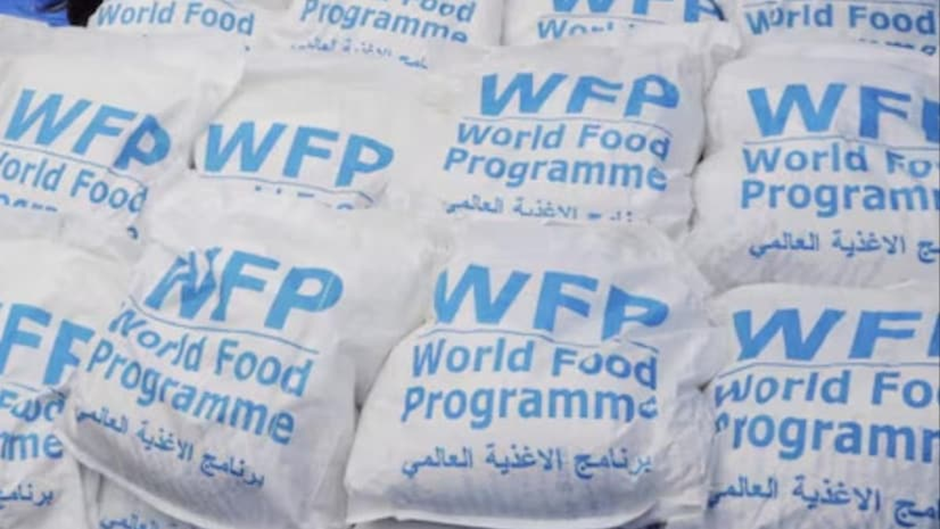
The World Food Programme aims to eradicate hunger and malnutrition. The world’s largest humanitarian agency, WFP helps almost 100 million people in approximately 88 countries with assistance every year through food or cash distributions and more. The World Food Programme was awarded the Nobel Peace Prize in 2020.
UN Specialized Agencies
The UN specialized agencies are autonomous international organizations working with the United Nations. All were brought into relationship with the UN through negotiated agreements. Some existed before the First World War. Some were associated with the League of Nations. Others were created almost simultaneously with the UN or later.
FAO
Headquarters: Rome, Italy
The Food and Agriculture Organization leads international efforts to fight hunger. It is both a forum for negotiating agreements between developing and developed countries and a source of technical knowledge and information to aid development.
ICAO
Headquarters: Montreal, Canada
The International Civil Aviation Organization develops standards for global air transport and assists its 192 Member States in sharing the world’s skies to their socio-economic benefit.
IFAD
Headquarters: Rome, Italy
The International Fund for Agricultural Development, since it was created in 1977, has focused exclusively on rural poverty reduction, working with poor rural populations in developing countries to eliminate poverty, hunger and malnutrition; raise their productivity and incomes; and improve the quality of their lives.
ILO
Headquarters: Geneva, Switzerland
The International Labour Organization promotes international labour rights by formulating international standards on the freedom to associate, collective bargaining, the abolition of forced labour, and equality of opportunity and treatment.
IMF
Headquarters: Washington, DC, USA
The International Monetary Fund fosters economic growth and employment by providing temporary financial assistance to countries to help ease balance of payments adjustment and technical assistance. The IMF currently has $28 billion in outstanding loans to 74 nations.
IMO
Headquarters: London, United Kingdom
The International Maritime Organization has created a comprehensive shipping regulatory framework, addressing safety and environmental concerns, legal matters, technical cooperation, security, and efficiency.
ITU
Headquarters: Geneva, Switzerland
The International Telecommunication Union is the United Nations specialized agency for information and communication technologies. It is committed to connecting all the world’s people – wherever they live and whatever their means. Through our work, we protect and support everyone’s fundamental right to communication.
UNESCO
Headquarters: Paris, France
The United Nations Educational, Scientific and Cultural Organization focuses on everything from teacher training to helping improve education worldwide to protecting important historical and cultural sites around the world.
UNIDO
Headquarters: Vienna, Austria
The United Nations Industrial Development Organization is the specialized agency of the United Nations that promotes industrial development for poverty reduction, inclusive globalization and environmental sustainability.
UN Tourism
Headquarters: Madrid, Spain
The World Tourism Organization is the United Nations agency responsible for the promotion of responsible, sustainable and universally accessible tourism.
UPU
Headquarters: Bern, Switzerland
The Universal Postal Union is the primary forum for cooperation between postal sector players. It helps to ensure a truly universal network of up-to-date products and services.
WHO
Headquarters: Geneva, Switzerland
The World Health Organization is the directing and coordinating authority on international health within the United Nations system. The objective of WHO is the attainment by all peoples of the highest possible level of health. Health, as defined in the WHO Constitution, is a state of complete physical, mental and social well-being and not merely the absence of disease or infirmity.
WIPO
Headquarters: Geneva, Switzerland
The World Intellectual Property Organization protects intellectual property throughout the world through 23 international treaties.
WMO
Headquarters: Geneva, Switzerland
The World Meteorological Organization facilitates the free international exchange of meteorological data and information and the furtherance of its use in aviation, shipping, security, and agriculture, among other things.
World Bank
Headquarters: Washington, DC, USA
The World Bank focuses on poverty reduction and the improvement of living standards worldwide by providing low-interest loans, interest-free credit, and grants to developing countries for education, health, infrastructure, and communications, among other things. The World Bank works in over 100 countries.
International Bank for Reconstruction and Development (IBRD)
International Centre for Settlement of Investment Disputes (ICSID)*
International Development Association (IDA)
International Finance Corporation (IFC)
Multilateral Investment Guarantee Agency (MIGA)*
* International Centre for Settlement of Investment Disputes (ICSID) and Multilateral Investment Guarantee Agency (MIGA) are not specialized agencies in accordance with Articles 57 and 63 of the Charter, but are part of the World Bank Group.
Other Entities and Bodies
UNAIDS
Headquarters: Geneva, Switzerland
The Joint United Nations Programme on HIV/AIDS (UNAIDS) leads and inspires the world to achieve its shared vision of zero new HIV infections, zero discrimination and zero AIDS-related deaths. UNAIDS unites the efforts of 11 UN organizations—UNHCR, UNICEF, WFP, UNDP, UNFPA, UNODC, UN Women, ILO, UNESCO, WHO and the World Bank—and works closely with global and national partners towards ending the AIDS epidemic by 2030 as part of the Sustainable Development Goals.
UNHCR
Headquarters: Geneva, Switzerland
The United Nations High Commissioner for Refugees – UNHCR protects refugees worldwide and facilitates their return home or resettlement.
UNIDIR
Headquarters: Geneva, Switzerland
The United Nations Institute for Disarmament Research is a voluntarily funded autonomous institute within the United Nations. An impartial actor, the Institute generates ideas and promotes action on disarmament and security. UNIDIR brings together states, international organizations, civil society, the private sector and academia to work together—internationally, regionally and locally—to build and implement creative solutions that will benefit all states and peoples.
UNITAR
Headquarters: Geneva, Switzerland
An autonomous UN body established in 1963, the United Nations Institute for Training and Research is a training arm of the United Nations System, and has the mandate to enhance the effectiveness of the UN through diplomatic training, and to increase the impact of national actions through public awareness-raising, education and training of public policy officials.
UNOPS
Headquarters: Copenhagen, Denmark
The mission of the United Nations Office for Project Services is to help people build better lives and help countries achieve peace and sustainable development. UNOPS helps the UN, governments and other partners to manage projects, and deliver sustainable infrastructure and procurement in an efficient way.
CTBTO
Headquarters: Vienna, Austria
The Preparatory Commission for the Comprehensive Nuclear-Test-Ban Treaty Organization promotes the Comprehensive Nuclear-Test-Ban Treaty (which is not yet in force) and the build-up of the verification regime so that it is operational when the Treaty enters into force.
IAEA
Headquarters: Vienna, Austria
The International Atomic Energy Agency, is the world’s centre for cooperation in the nuclear field. The Agency works with its Member States and multiple partners worldwide to promote the safe, secure and peaceful use of nuclear technologies.
ICC
Headquarters: The Hague, Netherlands
The International Criminal Court investigates and, where warranted, tries individuals charged with the gravest crimes of concern to the international community: genocide, war crimes, crimes against humanity and the crime of aggression. As a court of last resort, it seeks to complement, not replace, national courts.
IOM
Headquarters: Geneva, Switzerland
The International Organization for Migration works to help ensure the orderly and humane management of migration, to promote international cooperation on migration issues, to assist in the search for practical solutions to migration problems and to provide humanitarian assistance to migrants in need, including refugees and internally displaced people.
OPCW
Headquarters: The Hague, Netherlands
The Organisation for the Prohibition of Chemical Weapons is the implementing body of the Chemical Weapons Convention (CWC), which entered into force in 1997. OPCW Member States work together to achieve a world free of chemical weapons.
UNFCCC
Headquarters: Bonn, Germany
The UNFCCC Secretariat (UN Climate Change) was established in 1992 when countries adopted the United Nations Framework Convention on Climate Change (UNFCCC). With the subsequent adoption of the Kyoto Protocol in 1997 and the Paris Agreement in 2015, Parties to these three agreements have progressively reaffirmed the Secretariat’s role as the United Nations entity tasked with supporting the global response to the threat of climate change.
WTO
Headquarters: Geneva, Switzerland
The World Trade Organization is a forum for governments to negotiate trade agreements, and a place where member governments try to sort out the trade problems, they face with each other.
ITC
Headquarters: Geneva, Switzerland
The International Trade Centre (ITC) is the only development agency that is fully dedicated to supporting the internationalization of small and medium-sized enterprises (SMEs). Established in 1964, the ITC is the joint agency of the World Trade Organization and the United Nations.
The work of the United Nations today
The work of the United Nations reaches every corner of the globe. Although best known for peacekeeping, peacebuilding, conflict prevention and humanitarian assistance, there are many other ways the United Nations and its System (specialized agencies, funds and programmes) affect our lives and make the world a better place. The Organization works on a broad range of fundamental issues, from sustainable development, environment and refugees protection, disaster relief, counter terrorism, disarmament and non-proliferation, to promoting democracy, human rights, gender equality and the advancement of women, governance, economic and social development and international health, clearing landmines, expanding food production, and more, in order to achieve its goals and coordinate efforts for a safer world for this and future generations.
Present Heads
António Guterres (Chair of CEB) Secretary-General of the United Nations
Qu Dongyu, Director-General, FAO
Gilbert F. Houngbo, Director-General, ILO
Audrey Azoulay, Director-General, UNESCO
Juan Carlos Salazar, Secretary-General, ICAO
Ajay Banga, President, World Bank Group
Kristalina Georgieva, Managing Director, IMF
Adhanom Ghebreyesus, Director-General, WHO
Celeste Saulo, Secretary-General, WMO
Arsenio Dominguez, Secretary-General, IMO
Daren Tang, Director-General, WIPO
Gerd Müller, Director-General, UNIDO
Rafael Mariano Grossi, Director-General, IAEA
Ngozi Okonjo-Iweala, Director-General, WTO
Rebeca Grynspan, Secretary-General, UNCTAD
Achim Steiner, Administrator, UNDP
Inger Andersen, Executive Director, UNEP
Filippo Grandi, High Commissioner, UNHCR
Catherine M. Russell, Executive Director, UNICEF
Challenges before the UN today.
The challenges are multifaceted. Climate change has reached an unforeseen peak. Polar ice meltdown, catastrophic storms, inundations, earthquakes have made millions of people homeless. Terrorism has shaken the very root of the whole world. The first year of the new millennium witnessed the horrifying incident of 9/11 attack on America. Even after 25 years, terrorism remains one of the principal concerns of the UN as evident in the statement of the UNSC after the heinous attacks on the civilians on the soil of J&K in India. The UNSC has “condemned in the strongest terms” the terrorist attack in Jammu and Kashmir, stressing that those responsible should be held accountable and the organisers and sponsors of this “reprehensible act of terrorism” should be brought to justice.
Preventing the spread of nuclear weapons and promoting disarmament are critical goals for the UN. The proliferation of nuclear technology and tensions between nuclear-armed states, such as the United States, Russia, and North Korea, present ongoing challenges to international security. Human Rights and Humanitarian Crises
The UN is tasked with promoting and protecting human rights worldwide. Humanitarian crises, such as those in Syria, Myanmar, and Venezuela, pose significant challenges to upholding human rights. Balancing the principles of sovereignty and the responsibility to protect is an ongoing debate within the UN system.
The 21st century has seen a significant increase in forced migration and refugee crises. Large-scale population-forced migration is a global calamity that calls for coordinated action from the international community under the direction of world leaders. A record-breaking number of migrants and refugees are crossing international boundaries to escape war, persecution, poverty, and other severe situations. Large-scale population relocation affects the social, economic, and political landscape in ways that go beyond casualties. The UN High Commissioner for Refugees (UNHCR) works to provide protection and assistance to displaced persons, but issues related to immigration policies, border control, and xenophobia have complicated efforts to address this challenge.
Political Divisions among Member States of the United Nations also remains a major concern for the UN. We have seen how the ongoing war between Russia and Ukraine has caused unimaginable sufferings to millions.
Global health concern is another area the UN has to battle with. We have seen how helpless the world felt during the Covid pandemic.
The need for UN reform is imperative to adapt to the evolving global landscape and to fulfil its mission of promoting international peace, security, and development effectively. This reform should be pursued to enhance the UN’s capacity to address current and future challenges while upholding the principles of equality, justice, and cooperation among nations. The world today is vastly different from what it was in 1945 when the UN was established. New global powers have emerged, and the geopolitical landscape has shifted dramatically. Reforming the UN’s decision-making structures, particularly the Security Council, is essential to reflect these changes and ensure equitable representation among nations. Ensuring that UN resources are allocated efficiently and transparently is essential. Reform should focus on optimising budgetary practices and eliminating waste to ensure that funds are directed toward programs that have a real impact on global development.
To get Saptarshi Sir’s guidance for English/Economy or for overall WBCS/ PSC Miscellaneous Main or other exam preparation, call or WhatsApp us @6295350330. Classes for PSC Miscellaneous Main have already started. WBCS New batch is also going on. You can also download our app for online guidance using the link
The digital age presents a double-edged sword. While urban centres flourish with advanced technology and internet access, rural communities struggle to bridge the digital divide. This lack of access creates a significant barrier to education, healthcare, and economic progress, further widening the social gap. The digital divide is the gap created by unequal access to modern telecommunications technology among different demographic groups and regions. This can include inequalities in access to computers, smartphones, and the internet.
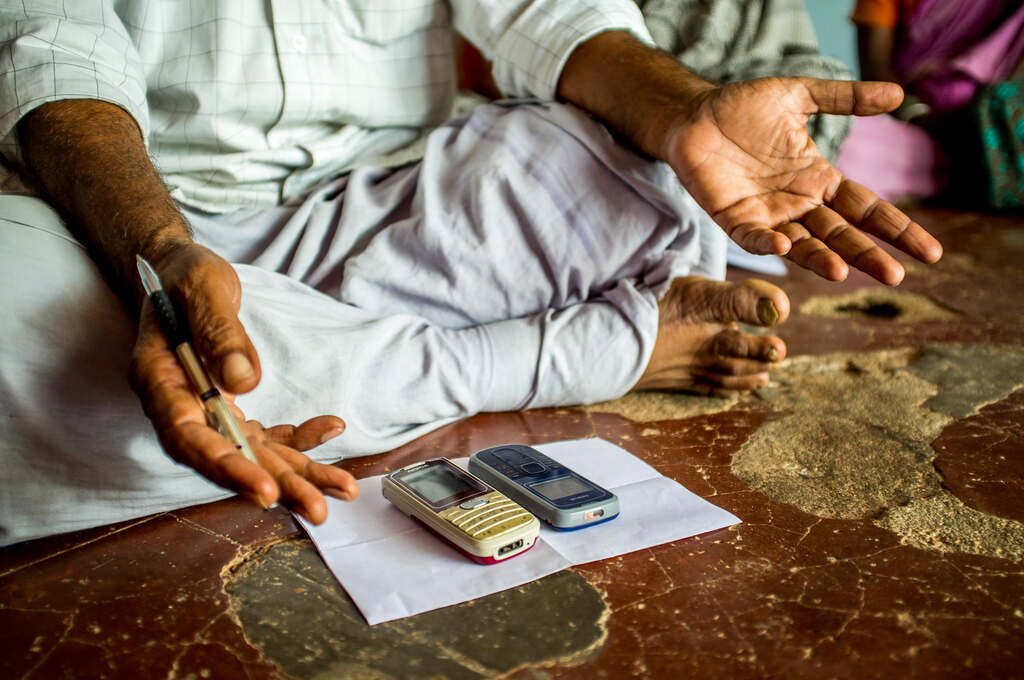
When the term “digital divide” was first used in the late 20th century, it described the gap between those with cell phone access and those without it. The term has since expanded to include the technical and financial ability to use available technology and access the internet. However, the meaning of the “digital divide” is constantly shifting with the development of technology.
In India, this ‘Divide’ is far more prominent than other developing nations. The digital divide in the access and usage of ICTs and the internet has also led to an exclusionary consequence in three sectors of utmost significance: education, health and finance. In a country plagued by high socioeconomic inequality, the digitalisation process cannot be posited as the panacea for the inherent challenges of the physical world. It becomes particularly problematic when half of the population neither has access to gadgets and the internet or the technological know-how to move to a digital environment. In such circumstances, the digitalisation process becomes unequal, favouring the digitally connected while excluding the rest, and in certain cases, exacerbating the already existing inequalities.
India, the largest democracy and the most populous nation in the world having a population of almost 1.4 billion people, out of which approximately 350 million people are uneducated and only a paltry percentage of the people have access to the internet. But surprisingly, despite such demoralizing numbers, India presently serves as one of the worlds’ leading IT hubs. Though superficially, this might seem to be paradoxical, in reality, there is a lot more to it. Digitalization and Information and Communication Technology (ICT) serve as the basis of modern society. The development of ICTs and the rapid pace of digitalization have necessitated multiple social, economic, and environmental changes globally. While on India is happy to go cashless and order daily consumable items by just a click, the other India continues to suffer from the plight of poverty, illiteracy both academic and digital, hunger and alienation from the rest of India.
The reasons behind such divide are not hard to find. While poverty, lack of education, lack of intent, poor infrastructure, lack of electrification, improper connectivity, difficult terrains all contribute to such gap, the implications of this divide are even more concerning. Socio-economic immobility, rising unemployment, denial of access to basic amenities and several government schemes, digital fraud for the newbies, increasing socio-economic and digital inequality, unfulfillment of potential of a substantial share of a population are to name a few. Unfortunately, almost every government schemes are today being implemented through digital platforms. Every beneficiary must be digitally incorporated in the databases to have access to the facilities the Central or the state Governments are providing. However, as the beneficiaries mostly are digitally illiterate especially in the rural areas, they are often misled and cheated by unscrupulous middlemen. While the deserving is left uncared for, the shrewd undeserving lot takes the advantage of digital knowledge. This leads to widespread corruption at the grassroot level.
Addressing the digital divide is crucial to unlock India’s economic potential and promote social equality. Government initiatives like the National Digital Literacy Mission and the Pradhan Mantri Gramin Digital Saksharta Abhiyan have been introduced to increase digital literacy. National Education Policy, 2020 also aims at making “India a global knowledge superpower” by introducing several changes from the school to college level in the Indian education system with special emphasis on digital education. However, there is a need to ramp up efforts to improve digital infrastructure, particularly in rural areas, and ensure physical access to ICT for all sections of society.
Further, underprivileged groups need to be motivated to incorporate technology into their daily lives, and digital skills must be imparted to bridge the gap. Stronger regulation and efforts to reduce the cost of Edtech products can improve access to online education. Initiatives like the NDHM (National Digital Health Mission) should be accompanied by measures to enhance digital infrastructure and promote digital literacy to ensure the effective delivery of healthcare services.
India has grand growth aspirations, but bridging India’s digital divide is crucial for inclusive growth and to harness the full potential of technology. By addressing disparities in internet usage, mobile ownership, and access to digital services, India can create a more equitable society and unlock economic opportunities for all its citizens.
While AI (Artificial Intelligence) is defining the new age, for a substantial part of Indian population, the A and the I should start with Am I digitally literate?
Demographic dividends occur in countries that see declines in both fertility and mortality rates. A country that experiences low birth rates in conjunction with low death rates receives an economic dividend or benefit from the increase in productivity of the working population that ensues. As fewer births are registered, the number of young dependents grows smaller relative to the working population. With fewer people to support and more people in the labour force, an economy’s resources are freed up and invested in other areas to accelerate a country’s economic development and the future prosperity of its populace.
To receive a demographic dividend, a country must go through a demographic transition where it switches from a largely rural agrarian economy with high fertility and mortality rates to an urban industrial society characterized by low fertility and mortality rates. In the initial stages of this transition, fertility rates fall, leading to a labour force that is temporarily growing faster than the population dependent on it. All else being equal, per capita income grows more rapidly during this time too. This economic benefit is the first dividend received by a country that has gone through the demographic transition.
There are four main areas where a country can find demographic dividends:
Savings: During the demographic period, personal savings grow and can be used to stimulate the economy.
Labor supply: More workers are added to the labour force, including more women.
Human capital: With fewer births, parents are able to allocate more resources per child, leading to better educational and health outcomes.
Economic growth: GDP per capita is increased due to a decrease in the dependency ratio.
According to United Nations Population Fund (UNFPA), demographic dividend means, “the economic growth potential that can result from shifts in a population’s age structure, mainly when the share of the working-age population (15 to 64) is larger than the non-working-age share of the population (14 and younger, and 65 and older)”.
Where the world economies are struggling with declining birth rates, tight labour markets and an ageing population, India is standing at the cusp of an unprecedented opportunity—all thanks to its demographic. With the world’s largest youth population1 with the median age of 28.4 years, India is not only strengthening its competitive advantage but also setting trends in consumer and discretionary spending. India will have 1.04 billion working age persons by 2030, highest of any large economy.
So, what is a youth? As defined by the National Youth Policy, the population in the age group of 18-29 years is considered youth. India has over 371.4 million youth, as per 2021 census projections, making up for approximately 27% of the total population.
Imagine a country where half of the population is in its prime working years. Here, innovation meets ambition as the youthful workforce is poised to redefine global growth. That’s India for you.
More than four in 10 people in India are under 25 years old. For investors seeking expansion opportunities, this offers a substantial pool of potential workers across various industries, including technology, manufacturing and services.
A young population can help India’s economic growth and innovation since it represents a larger workforce with the potential for improved productivity and increased consumer demand. India’s demographics offer various advantages for investors, notably among which are:
A trained workforce boosts economic prosperity with the potential to boost economic output, innovation and productivity in the nation.
A rising young population increases demand for products and services, driving economic activity.
A young population that openly embraces technology breakthroughs and invests in digital infrastructure can help India overcome development challenges and become a global technological leader.
Investments in infrastructure, especially in metropolitan and rural areas, are crucial to tapping and promoting the potential for productivity and economic growth among the nation’s youth.
India’s booming IT and BPO services export story is a testament to its ability to capitalise on demographic advantages. It has the largest pool of English-speaking science, technology, engineering and mathematics (STEM) graduates of an estimated two million. Thereby providing a competitive edge over other regions. The nation will have nearly 18 million STEM graduates by 2027, a sign of India’s growing influence in the science and tech sector. According to the All-India Higher Education survey, women constituted 42.6% of total STEM graduates in 2021-22, which makes a compelling argument for inclusive development and gender equality. Although we have a substantial pool of female STEM graduates, it remains underutilised mainly because women either do not join the mainstream workforce or drop out early in this field. This presents an opportunity not only for the government and policymakers but also for investors to foster equitable growth.
“India still has some time to benefit from its demographic dividend for economic growth but is aging faster than many realize,” McKinsey Global Institute said in its report ‘Dependency and depopulation? Confronting the consequences of a new demographic reality’. “Despite very fast progress, India is still a low-income country, so it needs to “get rich before it gets old,” it added.
In absolute numbers, India will have 1.04b working age persons by 2030. Correspondingly, India’s dependency ratio would be the lowest in its history by 2030 at 31.2%. India’s young dependency ratio —the number of children below 15 years of age relative to total population — is expected to overtake the old dependency ratio (ratio of population aged above 65 years relative to total population) by 2056.
India would remain the largest provider of human resources in the world. About 24.3% of the incremental global workforce over the next decade will come from India. This is significant considering the rapidly ageing population in the developed world, creating potential challenges to labour supply in various sectors of the global economy.
The fact that India has a relatively young population with a median age of 28.4 years is equally important. Approximately 26% of the population is below 14 years and ~67% is between the age of 15 to 64 years and 7% above the age of 65. In contrast, the population over 65 years in US is ~17% and Europe is over ~21%.
The potential contribution of the growing population to India’s GDP growth would depend, among other factors, on the rate of growth and size of total population and its contribution to the size of working age population who may be absorbed in productive employment.
This young population not only reinforces India’s competitive advantage in the services and manufacturing sectors, but also unleashes the consumption power of a young population towards discretionary expenditure.
Challenges associated with Demographic Dividend in India
Unemployment is still the biggest monster in India. While we boast of magical economic progress in the past decade or so, have we really been able to allow our younger generation to reap the fruit? It has been shared recently that the central government has been able to produce only around 2 million jobs in the past decade in stark contrast to 20 million jobs promised a decade earlier. As per the India Employment Report 2024, India’s working population increased from 61% in 2011 to 64% in 2021, and it is projected to reach 65 % in 2036. On the other hand, the percentage of youth involved in economic activities declined to 37% in 2022.
Most jobs created in the future will demand high skills, and the lack of skills in the workforce of India is a big challenge. It might result in India not being able to take advantage of the opportunities because of lack of skills and low human capital base. India still suffers from the lack of skill-based education.
India holds the 130th rank out of the 189 countries in the UNDP’s Human Development Index. Hence, the education and health parameters have to be substantially enhanced to make the workforce of India skilled and efficient.
According to the India Ageing Report 2023 of United Nations Population Fund, India’s elderly population is growing rapidly, with a decadal growth rate of 41% and by 2050, over 20% of India’s population will be elderly.
Resource Scarcity- The rapid growth of the population has a negative effect on resource usage and its access.
For example- Cities like Delhi and Bangalore and the State of Rajasthan have been facing severe water stress.
Also, as per a recent survey of the Central Water Commission, India’s per capita water availability has dropped from 1,816 cubic metres in 2001 to approximately 1,486 cubic metres in 2024, leading the country towards water stress.
Unplanned Urbanisation: It comes with issues such as overburdened infrastructure, traffic congestion and pollution, slum growth on the outskirts of cities, housing challenges and environmental degradation.
India’s urban population is expected to grow from 410 million in 2014 to 814 million by 2050. India is projected to add 4 new megacities by 2030 which could lead to more unplanned urbanisation and slum related issues.
India’s informal nature of economy would prove to be another obstacle in yielding the opportunity for major economic growth during the demographic transition in India. Almost 92% of the total workforce in India is in unorganized sector.
The Labour Force Participation Rate (LFPR) in India, which represents the percentage of working-age individuals engaged in or seeking work, has not been too much encouraging. In May 2025, the overall LFPR was 54.8%. These results lead to a big concern that the growth in the future could turn out to be jobless growth because of de-globalisation, deindustrialisation, the fourth industrial revolution and technological progress.
What is the way-out?
Forward-looking policies
Countries like Singapore, Taiwan and South Korea have already shown us how demographic dividend can be reaped to achieve incredible economic growth by adopting forward-looking policies and programmes to empower the youth in terms of their education, skills and health choices. Enhancement of quality and accessibility of education across all demographics, focusing on marginalized communities is the need of the hour. We need to promote vocational training and skill development aligned with industry needs to enhance employability. We must invest in digital literacy and technological skills to meet the demands of a digital economy.
Inclusion Growth and Gender Equality
Implementation of policies promoting gender equality and empowerment, ensuring equal access to education and employment.
Supporting initiatives that enhance social cohesion and reduce inequalities.
According to International Labour Organization estimates, only 24% of women were participating in the workforce in 2022, so getting more women to enter the workforce will be pivotal for future growth.
To invest more in children and adolescents
India ranks poorly in Asia in terms of private and public human capital spending. It needs to invest more in children and adolescents, particularly in nutrition and learning during early childhood. Given that India’s workforce starts at a younger age, a greater focus needs to be on transitioning from secondary education to universal skilling and entrepreneurship, as done in South Korea.
Investing in Healthcare
Health spending has not kept pace with India’s economic growth. The public spending on health has remained flat at around 1% of GDP. Evidence suggests that better health facilitates improved economic production. Hence, it is important to draft policies to promote health during the demographic dividend. We need more finance for health as well as better health facilities from the available funding. We need to provide universal access to high-quality primary education and basic healthcare. The unmet need for family planning in India at 9.4% as per the latest National Family Health Survey-5 (2019-21) is high as compared to 3.3% in China and 6.6% in South Korea, which needs to be bridged.
Are our states equal to us?
India needs to address the diversity between States. While India is a young country, the status and pace of population ageing vary among States. Southern States, which are advanced in demographic transition, already have a higher percentage of older people. These differences in age structure reflect differences in economic development and health – and remind us of States’ very different starting points at the outset of the 2030 Sustainable Development Goals Agenda. But this also offers boundless opportunities for States to work together, especially on demographic transition, with the north-central region as the reservoir of India’s workforce.
Progressive Federal Outlook
India needs to address the diversity, heterogeneity and disparity among the States. While India is a young country, the status and pace of population ageing vary among States. Southern States, which are advanced in demographic transition, already have a higher percentage of older people. These differences in age structure reflect differences in economic development and health – and remind us of States’ very different starting points at the outset of the 2030 Sustainable Development Goals Agenda. But this also offers boundless opportunities for States to work together, especially on demographic transition, with the north-central region as the reservoir of India’s workforce.
Tackling Urban Migration
By 2030, India’s urban population is projected to reach 600 million, with over 40% of the country’s population living in urban areas. This rapid urbanization is driven by migration from rural areas, seeking better economic opportunities and lifestyles. This influx of people will put significant strain on urban infrastructure and resources, requiring substantial investments in infrastructure development and urban planning. There is a need to focus on urban policy planning to give the migrating people access to basic amenities, healthcare services, and social services.
Harnessing the trend
Leveraging consumption trends like e-commerce and fintech, the digital revolution, rising internet access and the youth’s strong online engagement, there is immense potential for online shopping and financial services. The expanding middle class and urbanisation also contribute to an increasing demand for food delivery and home services.
Indian Foreign Policy has gone through various changes with the test of the time. The South Asian giant gained its independence from the British Empire in 1947 after long fought freedom struggle. The time also saw an unimaginable India- Pakistan hostility on the lines of religion as soon as they were divided. The bloody, tiny episodes wrapped in history gives us an understanding of why India has always had a protectionist policy. Pandit Jawaharlal Nehru and the then Indian Foreign Policy makers had already seen plenty of wars and its unsolicited destruction. Jawaharlal Nehru forged a policy that tried to keep India out of any bloc. Despite the two World Wars taking place in just a span of decades, the World was looking at yet another global conflict. This time, two partner countries that came out as victorious from the second World War decided to see each other eye to eye in lieu of ideological differences. US and the West were in one camp while USSR and certain communist countries from Eastern Europe and South America were in the opposite camp. It soon became a West vs East conflict. But the difference here was not many countries from the Global East were interested to pick sides. Similarly, India under the leadership of Jawaharlal Nehru had other visions for a new India that had to look inwards first to better provide to a massive population that had just gotten out from the brunt of colonialism. And playing around a conflict was certainly not that vision but completely opposite of what was to be achieved. India and other newly independent countries from different colonies wanted to have strategic autonomy in their internal and external affairs. They didn’t wish to get dictated regarding their domestic and foreign policies through ideological lenses. Gaining, independence was a crucial achievement for these countries and maintaining it away from external influence was another challenge. Non-Alignment Movement became an answer for these countries in such a critical moment.
Non-Alignment Movement began as a response to the two strategic military blocs (US, USSR) being formed amidst the Cold War in the early 1950’s. The specific term of Non-Alignment Movement was coined by V.K Menon in 1953. However, Non-Alignment Movement is also known to be the brain child of Jawaharlal Nehru. The founding members of the movement were the then Indian Prime Minister Jawaharlal Nehru, President of the Socialist Federal Republic of Yugoslavia Josip Broz Tito, President of Egypt Gamal Abdel Nasser, President of the Republic of Indonesia Sukarno and President of Ghana Kwame Nkrumah. The Bandung Asian-African Conference in 1955 laid the stones for a formal organization. However, the organization named Movement of Non-Aligned Countries was formed in 1960. Its first conference was held in 1961 in Belgrade where 25 countries attended it. The early days of the Indian Foreign Policy were driven by the principles of non-alignment.
Nehruvian Idealism was the driving force behind much of the policy frame work. India walked the path of moral and idealism during its early years. It trusted countries like China very easily without confirming deeper realities which had their own repercussions set in the far future. India acted calmly in the matters of conflict and concerns from the beginning itself. Panchsheel, Five Principles of Peaceful Coexistence also became an important element for Indian Foreign Policy. The five Principles of Panchsheel were – Mutual respect for each other’s territorial integrity and sovereignty, Mutual non-aggression, Mutual noninterference in each other’s internal affairs, Equality and mutual benefit, Peaceful co-existence. However, the border clashes with China came as a shell shock not only to India but to the non-alignment countries. The India China War in 1962 exposed the harsh realities to the Indian Foreign Policy makers. A large part of Eastern Kashmir (Aksai Chin) was annexed by China. India lost the war by an embarrassing margin. This shook the belief of Jawaharlal Nehru and thereafter, India slowly sought its journey towards Strategic Realism. In this period, the Indian Foreign Policy put greater emphasis on National Interest.
India under the leadership of Indira Gandhi further emphasized on national interest. India took tough decisions under the stern central leadership. The major change was evident during the 1971 India Pakistan War. A lot of changes were visible from a Foreign Policy stand point. The Indian leadership was aware of the human rights violations happening in the then East Pakistan Region. However, initially, India’s response was that of a non-interventionist. India was still vocal at the U.N. as it raised the issue multiple times at the global forum. But it was tough not to act as India saw an inflow of millions of refugees from East Pakistan. During the war in East Pakistan, in 1971, which led to the formation of Bangladesh, around 10 million refugees (80 percent of them Hindu) crossed the border into India of which an estimated 35,000 remained in India, mostly in West Bengal.
The then Assistant for National Security Affairs Henry Kissinger visited India in July, 1971. He warned Indira Gandhi against any attack on Pakistan. However, just a month later, India did something no one would have expected in the international realm. India and Soviet Union signed a security pact with each other in August, 1971. This was a major moment for Indian Foreign Policy which also showcased India’s move away from its non-alignment strategy. The South Asian giant broke away from its non-alignment strategy and principle in favour of its national interest. It was indeed a major turning point in the history of Indian Foreign Policy. Indira Gandhi outwitted West and Pakistan with this move. Pakistan pre-emptively attacked India on December 3rd. This paved the way for a full-fledged war between India and Pakistan. U.S. tried to bluff India by sending their war ships to Bay of Bengal. However, India’s security pact with the Soviet Union made sure Soviet’s send their warships as well to counter U.S. U. S’s bluff was called out and India won the war against Pakistan on December 16. It was a major Indian Foreign Policy win by external force. India not only diffused a possible three front war scenario but also split half their enemy nation. It was a major moment for the India Soviet partnership as well. The Soviets were more sensitive to India’s causes like that of the Kashmir issue. USSR vetoed UN resolutions on the Kashmir issue in 1957, 1962 and 1971. In total, they vetoed six times in favour of India in the U.N. India’s strategic alliance with Soviet Union in 1971 saw them moving away from Non-Alignment Movement.
However, the Soviet Union was doomed as the Berlin Wall fell in 1989. The Cold War symbol, Berlin Wall was brought down thus uniting West Berlin and East Berlin. Soon after, various Soviet Republics began announcing their independence and Soviet Union’s flag furled for the last time in 1991. This was shocking for India as one of their strategic allies was brought down. India was dependent on Soviet Union for a lot of things out of which military equipments contributed the most. The break-up of the Union therefore disrupted defence production and deliveries to foreign customers. Indian officials spent some time trying to identify the estimated 3500 suppliers scattered around the new republics who manufactured the military equipment that India needed.
India had to reshape it’s Foreign Policy in a new reality of the world that was a unipolar world order. In the absence of Soviet Union, U.S. became the sole superpower in the world. India already had an improvement of relations with the U.S. from 1980’s. India’s economic crisis in 1991 paved the way for the LPG (liberalization, privatization and globalization) reforms. As a result, Indian economy opened up and India moved towards economic pragmatism. They had an inflow of foreign capital especially from the Western countries. This led to globalization of Indian economy. Relations with the West went in the upward trajectory from the 90’s. However, the 1999 Kargil War with Pakistan enhanced opportunities for multi alignment. U.S.A played a role of non-interference as it did not support any country publicly during the war. It also cut off the access of GPS to India to balance the odds and deprive India of any major advantage in the war against Pakistan. The U.S. took a moral high ground when India needed its support. But Sweden provided indirect military support to India through the immediate sale of Bofors artillery guns. Russia and France swiftly delivered spare parts for some of India’s fighter jets while Israel quickly delivered Heron Unmanned Aerial Vehicle, laser-guided bombs. At a time when certain countries delayed military equipment orders during the Kargil War, certain other countries came in support of India by providing quick delivery of military equipment. Israel’s military help during the Kargil War kick started ministerial level meetings between the two nations for the first time in history. On the other side, Russia saw a major power change as Vladimir Putin became the Russian President in 1999. Though the power shift was not immediate but the appointment held a massive change for the coming years.
Another milestone that further pushed India towards the U.S. was the India – U.S. nuclear deal in 2008. The 123 agreements between the two nations paved the way for India to trade with other countries for civil nuclear deals. All this while maintaining their stance of not signing the NPT agreement. Despite, China’s protest against the deal, U.S. worked through its clout to make the deal happen which showcased India’s growing strategic relationship with the West.
However, the 2008 terrorist attack in Mumbai caused a lot of disbalances. India highly advocated for tough sanctions on Pakistan and its proxy terrorists. But the call fell on deaf ears. Multilateral forums and countries could only condemn of what happened. U.S. did not do much to hurt Pakistan for its misadventure across the border. This has been a major issue for India where Pakistan uses its proxy terrorists, trains them and sends them to India to destabilize the country. India has been advocating for a tough action on certain individuals as well as Pakistan as a country but so far not much has been achieved.
Soon, Narendra Modi bagged a massive majority on 16th May 2014. The Prime Minister elect showed early signs of a robust foreign policy as he invited all the SAARC (South Asian Association for Regional Cooperation) leaders for his swearing in ceremony. All the leaders accepted the invitation and attended the event. Surprisingly, the then Pakistan Prime Minister, Nawaz Sharif too accepted the invitation and attended Narendra Modi’s swearing in ceremony. This was a perfect start for Narendra Modi’s Neighbourhood First Policy with all the regional head of states attending his oath taking ceremony. The year 2014 showed what was to come in terms of foreign policy for India under the new leadership. Prime Minister Narendra Modi visited various countries in his first year of power itself. He started off by visiting Bhutan. Narendra Modi then made trips to Brazil, Nepal, Japan, U.S., Myanmar, Australia, Fiji and again Nepal in his first year in power. Narendra Modi attended a SAARC Summit, BRICS Summit and UN General Assembly Session. He also hosted Chinese Premier Xi Jinping in Ahmedabad the same year. Narendra Modi reached out to multiple poles of power to further strengthen India’s role in the global order. It was important for the Prime Minister to start on such a strong note and repair some relationships with other countries. Relationship with the U.S. grew stronger in the initial years of Narendra Modi’s leadership. He also batted for further strengthening ties with Russia giving mixed signals to Washington. Back home, he also sought to give more prominence to the neighbourhood by attending SAARC summits.
However, Pakistan’s constant misadventure nullified India’s efforts vis a vis SAARC. The last functional SAARC summit that happened was back in 2014 in Nepal. The next nation to host the SAARC summit was Pakistan and since then the summit is consistently getting cancelled as India has refused to visit Pakistan until it amends its ways vis a vis India and Kashmir. However, boycotting SAARC gave a lifeline to BIMSTEC. BIMSTEC like SAARC is a regional organization that consists of South Asian Countries. Bay of Bengal Initiative for Multi-Sectoral Technical and Economic Cooperation (BIMSTEC) consists of Bangladesh, Bhutan, India, Nepal, Sri Lanka, Myanmar, Thailand. Though only three summits of BIMSTEC have taken place since 2014, but its prominence has massively increased as a regional multilateral forum for India. India is also a key funder of the projects in BIMSTEC led initiatives. Important game changing projects like Kaladan Multimodal Project (linking India and Myanmar), Asian Trilateral Highway (linking India and Thailand through Myanmar) are already underway. The passage holds the potential to link India and a handful of ASEAN countries. In terms of trade and strategic importance, BIMSTEC is a key multilateral organization in the region.
India, with a population of 1.5 billion people, landmass such big that it holds the position of 7th largest country in the world. India is also the fourth largest economy in the world. However, it has still not gotten its fair share at the United Nations Organization. Narendra Modi and his foreign policy makers have been aggressively advocating for U.N. reforms and permanent U.N. Security Council membership. India has been constantly working with other nations to get as much support as it can muster for its pursuit of a permanent seat in the United Nations Security Council. It has already bagged support from four permanent members of the Security Council – U.S., Russia, U.K., France. Similarly, India garnered votes of many countries to get into the NSG group. But China had a tough stance every time and India was blocked the entry.
The China challenge for India has been ever growing in these few years. The Doklam crisis in 2017 warned India of what was to come. India was tight lipped about China under the leadership of Narendra Modi until 2020 Border clashes with China. The border clashes came as a shock to many but it was long expected in the strategic circles that an aggressive China would definitely make a move against India sooner than later. China is also a factor in India’s multi alignment approach. China’s string of pearls move has led India to counter with another strategy. The term ‘String of Pearls’ was initially published in 2005, in a document titled ‘Energy Futures in Asia’ presented to the United States Secretary of Defence Donald H Rumsfeld by Booz Allen Hamilton. The strategy of the ‘String of Pearls’ revolves around the construction of infrastructure networks in littoral countries from the South China Sea to the Middle East.
India has been working with different countries to counter China’s string of pearls. So far, India is building a deep-sea Port in Sabang, Indonesia. India built a deep-water port in Sittwe in 2016. India has signed agreements to access strategically located Naval facilities in Oman. India has signed an agreement to access Changi Naval Base of Singapore. India has also aligned itself with the QUAD group under its multi alignment approach to counter China in the Indian Ocean. Australia, US, Japan and India currently hold the QUAD membership. Though, the members themselves say it is not a security pact or organization but QUAD could well be the answer to China’s aggression in the Indian Ocean Region. QUAD stands for an open, prosperous and inclusive Indo Pacific region. Currently, India is working with the QUAD members in various fields like Vaccines, Technology, AI etc. However, this does not mean that India is completely aligned with the West like every other country in the QUAD group. India is also a part of BRICS, SCO group which seeks for a change in the global order that also challenges the authority of the U.S. and the West in the current global order. BRICS has been a major voice for the developing countries. SCO, too has helped India let her voice be heard in the global arena of geopolitics. India still gets an invitation for nearly every G7 summit including the latest one in Canada. This shows that both West and (Russia, China led groups) see India as a responsible and important player in the global order. India’s presence in QUAD, SCO, BRICS groups shows its multilateral approach in today’s world order. When it comes to bilateral engagements, India has maintained warm relations with every major country barring a few with which it has strategic concerns like Turkey, Canada (Relation with Canada may see a change in the coming future though) China.
The Indian Foreign Policy has been under tremendous pressure in the course of the Russian-Ukraine war. India has been wooed by both Russia and Ukraine with West to take a particular side that suits their own interests. However, India rather took a stance which supports its interests in the domestic and international realm. As a result of that, India has come under massive criticism from the Western circles be it media or even the citizens. Everyone has an opinion on India’s moral encompass. The West cannot entirely be trusted entirely either, that is why a multi-lateral approach is the best way forward. However, during these testing times, India has to walk on a tight rope to sustain on a path of national interest. Under the China challenge, the present government has not been able to make much progress. Even the Russia Ukraine conflict can be taken as an example where there is much more room for improvement vis a vis India’s overall approach.
With Western alliances weakening, particularly in the wake of Donald Trump’s return to power, India’s diplomatic agility becomes even more critical. Trump’s unpredictable stance on NATO and his reluctance to engage in European security challenges suggest a weakening of traditional Western cohesion. Meanwhile, Russia’s resurgence and China’s expansionist policies in the Indo-Pacific further complicate global alignments.
India has always played a long game in diplomacy, avoiding permanent entanglements. This strategic flexibility allows it to engage with both the West and its historical allies without being constrained by ideological divisions. It also underscores India’s role as a stabilising force in an increasingly multipolar world.
The war in Ukraine, instability in the Middle East, and Trump’s political resurgence have shaken the foundations of transatlantic unity. Trump’s transactional approach to global leadership—undermining NATO, questioning America’s commitment to Europe, and advocating isolationist policies—contradicts the post-World War II liberal order. His disdain for Europe, his willingness to engage with autocrats like Vladimir Putin, and his unpredictable foreign policy have left traditional allies scrambling for new strategies.
In this fractured landscape, India’s balancing act becomes even more significant. While the US and its allies push for a more rigid ideological alignment, India continues to assert its independence. Its response to the Russia-Ukraine war—prioritising energy security over Western pressure—demonstrates its commitment to national interest over ideological conformity. Similarly, India’s role in the Indo-Pacific, countering China’s assertiveness through QUAD, while maintaining economic engagement with Beijing, underscores its strategic dexterity.
India’s multi-alignment is not just about hedging bets; it is about positioning itself as a stabilising force. This approach is evident in its engagement with West Asia, where it maintains strong ties with Israel, the Gulf nations, and Iran, ensuring both economic security and diplomatic influence.
As the US retreats into unpredictability and Europe struggles with its strategic identity, India emerges as a key global player. Its leadership in the Global South, advocacy for climate justice, and role in emerging economic corridors like the India-Middle East-Europe Corridor (IMEC) signal its growing influence. India’s foreign policy trajectory will continue to emphasise strategic autonomy while deepening ties with key players. The Atmanirbhar Bharat initiative focuses on self-reliance in defence and technology, reinforcing India’s ability to act independently. As PM Narendra Modi stated: “A strong and self-reliant India will contribute to a stable and prosperous world.”
Ultimately, India’s global role is no longer that of a passive observer but an active shaper of international governance. As Kautilya (Chanakya) advised in Arthashastra: “A wise king neither rushes into alliances nor rejects them outright but chooses them based on national interest.” India’s evolving strategy exemplifies this timeless principle, positioning it as a pivotal player in global geopolitics. And in such a scenario, multi-alignment policy is not an option for India, it is a mandatory agenda for becoming a global superpower and for using its own leverage in the ever-changing geopolitical dynamism in the New Global Order.
Sources- BRICS Portal, PIB, MoEA( GOI), The Indian Express, EPW, IJFMR, SAARC Secretariat.
Please note that the alignment of the writing- especially in that last part may be auto adjusted in the mobile version. Please follow the rule I taught in my classes in that case.
Question- Write a letter to the Chairman of your municipality expressing your concern over indiscriminate disposal of garbage across the town and suggesting measures to combat the problem
Ans-
To
The Chairman
XYZ Municipality
District- ABC
Sub- Concern regarding indiscriminate disposal of garbage across the town
Sir,
This is humbly submitted before you that we, the residents of the XYZ municipality are in utter distress because of indiscriminate disposal of garbage across the city. It is rather unfortunate that even though there are specified civic norms and stipulated locations for such disposal, people are reluctant to adhere to such norms. Lack of civic sense of the citizens has reached such a nadir that the cleanliness of this town has witnessed a new low. Even though door-to-door collection of waste and scientific solid waste management system are in place, it appears that people are not willing to take benefits of such facilities. As an aftermath, the town has lost its once pristine cleanliness and is now ranked among one of the dirtiest municipalities in the state. There has been unprecedented prevalence of several diseases owing to unclean and unhygienic living conditions all over the town as well.
In this regard, as a responsible citizen of this town, I urge the civic authority to come up with some steps to combat this menace. Installation of CCTV cameras across the city to identify the offenders and imposition of fines thereafter is one proven solution to this problem. Spreading awareness measures especially through social media can be effective, too. Encouraging the public to Reduce-Reuse and Recycle (RRR) and conferring awards for those who set shining examples in this may help the cause, too. Use of GPS technology-based apps like the Swachh App may also be a wonderful solution to this problem.
Finally, this town is our pride and it is our collective responsibility to bring back its past glory as one of the attractive tourist destinations of the state. Only blaming the civic body for the nuisance is not going to take us anywhere. Rather, a sense of cooperation among us all may lead us to what we tend to achieve. Looking forward to witness your innovative ideas being implemented to reach our goal.
Thanking you in anticipation.
Date-01.07.2024 Yours Sincerely
Place- XYZ DEF, A resident of Ward- 007
To get enrolled in the classes of Adhyayan Academy, you may download the app here and find the courses in the store section.