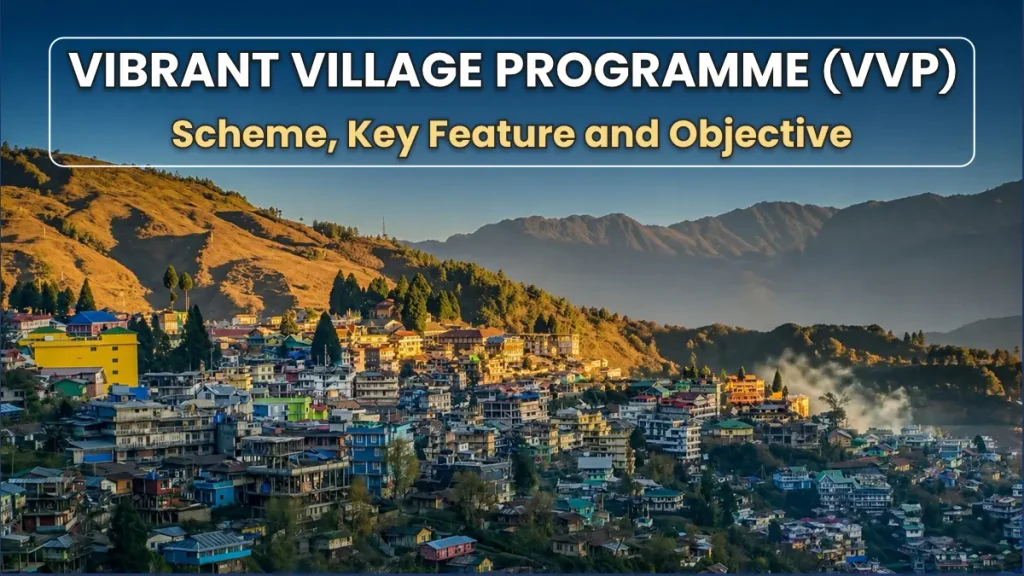

Vibrant Villages Programme (VVP) is a flagship initiative of the Ministry of Home Affairs (MHA) aimed at the comprehensive development of strategically located villages along India’s international land borders. It seeks to transform border villages from remote outposts into “first villages of India,” improve quality of life, create livelihood opportunities, reverse out-migration, and strengthen national security by treating border residents as the “eyes and ears” of the border-guarding forces.
The programme aligns with the vision of Viksit Bharat@2047 for “Safe, Secured & Vibrant land borders.” It builds upon the earlier Border Area Development Programme (BADP) by focusing intensively on selected strategic villages through a combination of direct interventions and convergence of existing schemes.
Objectives
- Create better living conditions and adequate livelihood opportunities in border villages.
- Reduce/out-migration and encourage reverse migration.
- Strengthen border security and control trans-border crime.
- Assimilate the border population with the national mainstream.
- Promote tourism, culture, skill development, entrepreneurship, and local economic activities (agriculture, horticulture, medicinal plants, cooperatives, SHGs, FPOs).
- Ensure saturation of key infrastructure through convergence.
Two Phases
Vibrant Villages Programme – Phase-wise Comparison
VVP-I
Approval: 15 February 2023
Launch: 10 April 2023 from Kibithoo, Anjaw district, Arunachal Pradesh
Type: Centrally Sponsored Scheme
Outlay: ₹4,800 crore (2022-23 to 2025-26/2026-27), of which ₹2,500 crore is for all-weather road connectivity
Coverage: Northern border (mainly China-facing)
Villages: 662 priority villages
Blocks/Districts: 46 blocks in 19 districts
States/UTs: Arunachal Pradesh, Himachal Pradesh, Sikkim, Uttarakhand, and Ladakh
Village break-up: Arunachal Pradesh – 455, Himachal Pradesh – 75, Sikkim – 46, Uttarakhand – 51, Ladakh – 35
Population covered: About 1.42 lakh
VVP-II
Approval: 2 April 2025
Launch: 20 February 2026 from Nathanpur village, Cachar district, Assam
Type: Central Sector Scheme (100% Centre funding)
Outlay: ₹6,839 crore (till FY 2028-29)
Coverage: Other international land borders (excluding northern border blocks already covered under VVP-I)
Villages: 1,954 strategic villages
Blocks: 334 blocks
States/UTs: Arunachal Pradesh, Assam, Bihar, Gujarat, Jammu & Kashmir (UT), Ladakh (UT), Manipur, Meghalaya, Mizoram, Nagaland, Punjab, Rajasthan, Sikkim, Tripura, Uttarakhand, Uttar Pradesh, and West Bengal
Combined (VVP-I + VVP-II)
Total villages: More than 2,616
Total outlay: ₹11,639 crore
VVP-I State-wise priority villages: Arunachal Pradesh (455), Himachal Pradesh (75), Sikkim (46), Uttarakhand (51), Ladakh (35). Population covered: ~1.42 lakh.
VVP-II excludes northern border blocks already covered under VVP-I to avoid duplication.
Key Focus Areas of Intervention
- Livelihood generation (agriculture, horticulture, medicinal plants/herbs, one-block-one-product, tourism).
- All-weather road connectivity (largely through PMGSY-IV convergence).
- Energization (grid + off-grid solar, micro-hydel).
- Village infrastructure (housing, health facilities, multi-purpose centres).
- Financial inclusion.
- Youth empowerment and skill development.
- Cooperatives, SHGs, and FPOs.
- Promotion of tourism, culture, and outreach activities.
- Education infrastructure (including SMART classes).
- Television and telecom connectivity.
The programme also aims for saturation of all villages in identified border blocks in four thematic areas: all-weather road connectivity, telecom connectivity, television connectivity, and electrification.
Interventions are guided by Village Action Plans prepared collaboratively, with border-specific, state-specific, and village-specific components. A High-Powered Committee chaired by the Cabinet Secretary can recommend relaxations in scheme guidelines for unique border challenges.
Implementation Progress (VVP-I, as of mid-2026)
- MHA has sanctioned ~1,248 projects (outlay ~₹3,020 crore).
- Additional ~1,655 projects sanctioned through convergence by other Central Ministries/Departments.
- Funds released to States/UT: ~₹953–960 crore.
- Projects completed: ~283–316.
- Roads: 111 projects (₹2,481.93 crore) to connect 134 previously unconnected villages.
- Connectivity: 528 villages with 4G; 625 with piped drinking water; 621 with electricity (on-grid/off-grid).
- Renewable energy: 140 off-grid solar projects + 7 micro-hydel projects.
- Tourism: 327 projects (~₹145 crore).
- Outreach: Over 8,500–8,800 activities (awareness camps, health/veterinary camps, fairs, skill training, etc.).
Recent reports (November 2026) indicate positive outcomes, including reverse migration in 40 border villages in Arunachal Pradesh, as stated by Home Minister Amit Shah. Local procurement by border forces (e.g., ITBP) is also providing assured markets to villagers.
Relevance for West Bengal
West Bengal is covered under VVP-II. Several villages along the India-Bangladesh and India-Bhutan borders have been selected, including:
Approximate allocation is around ₹3 crore per village in many cases, focusing on roads, digital connectivity, health, education, and livelihoods.
Strategic Significance
- India shares over 15,000 km of land border with seven countries.
- Border communities historically served as the first line of defence (e.g., local reports during the 1999 Kargil intrusion).
- By improving living standards and economic opportunities, VVP aims to maintain a settled, confident population that supports border management and internal security.
Official portal: vvp.mha.gov.in
Nodal Ministry: Ministry of Home Affairs (Department of Border Management)
The programme represents a shift from viewing border villages as the “last villages” to recognising them as the “first villages” of India, integrating development with security objectives.