Agnipath recruits young personnel (“Agniveers”) into the Indian Army, Navy and Air Force below officer rank for a fixed 4-year tenure (including ~6 months training).
Key features:
Age: generally 17.5–21 years (one-time relaxation to 23 for 2022 cycle).
Monthly package (70% in-hand, 30% to corpus fund matched by government):
Year 1: ₹30,000
Year 2: ₹33,000
Year 3: ₹36,500
Year 4: ₹40,000
Seva Nidhi (tax-free exit package after 4 years): ~₹11.71 lakh (own contribution + equal government match + interest). No pension or gratuity for the Agniveer period.
Retention: only 25% selected on merit for regular (permanent) service (further ~15 years with full benefits). Remaining 75% exit.
Other: non-contributory life insurance (~₹48 lakh), risk/hardship allowances, skill certificates. Death-on-duty compensation up to ₹1 crore; disability up to ₹44 lakh.
Objectives: younger force (lower average age), contain long-term pension burden, induct tech-adaptable youth, and release disciplined civilians.
Approximately 3 lakh Agniveers are currently serving. The first batch (~18,300 due to complete 4 years by end-2026) was approaching exit when the changes were announced.
Recent Changes (Union Cabinet, 4 November 2026)
Announced by CDS General N.S. Raja Subramani after force assessments. Primarily applies to the ~3 lakh currently serving Agniveers (future batches under review).
Revised framework:
After 4 years: top 25% still selected on merit for immediate regular enrolment (unchanged).
Remaining 75%: offered optional additional 2-year engagement (“Second Tour of Duty”).
After total 6 years: those who complete the extension and are willing can be considered for regular enrolment (subject to selection criteria such as physical fitness, firing, medical, discipline and technical proficiency). This creates a pathway for nearly all willing and eligible Agniveers (no fixed percentage ceiling at the second stage).
Higher pay during extension: ~₹43,500 (5th year) and ~₹47,500 (6th year), plus allowances.
Enhanced Seva Nidhi for those exiting after 6 years (higher government contribution).
Seniority protected: those absorbed after 6 years rank immediately after their batchmates absorbed after 4 years.
Scheme not scrapped; Agnipath continues with this mid-course correction.
Those taking the extension generally lose earlier special reservations in CAPFs/state police. Marriage during the extended period and other service conditions are under discussion.
Critical Analysis
Strengths of the original scheme and the revision
The scheme addressed real structural pressures. Defence pensions form a large share of the budget (around 22% in recent years, with the absolute bill rising under OROP and normal growth), crowding out capital expenditure on modernisation. A younger entry profile and short initial tenure were intended to lower average age and create a pool of skilled, disciplined youth for civilian life. Competitive 25% retention can incentivise performance.
The November 2026 changes respond to operational feedback. Four years is widely regarded as too short to develop a seasoned soldier (veterans note 8–9 years is more realistic for reliable tank crews, artillery teams or small detachments). Retaining trained personnel avoids wasting training investment and helps address manpower shortfalls (annual regular retirements are roughly 50–60,000 while Agniveer intake has been lower, and the Army has faced gaps relative to authorised strength). Higher pay and a clearer pathway improve morale and alignment with recruits’ aspirations. The government and CDS frame it as a planned review rather than a rollback.
Limitations and criticisms
The original design faced strong pushback in 2022 over job security, lack of pension and the short tenure. Critics (including retired officers such as Maj Gen Yash Mor and Adm Arun Prakash) argued it risked combat effectiveness, unit cohesion and the traditional ethos of long-term service. An internal assessment reportedly noted reduced camaraderie due to competition for the 25% slots. Manpower arithmetic was problematic: at 25% retention, replacing annual retirements would require far higher intake than achieved. Nepal’s reservations also affected traditional Gorkha recruitment.
The revision is a partial, reactive fix rather than a comprehensive redesign. It was announced weeks before the first batch’s exit and ahead of assembly elections in recruitment-heavy states (Uttar Pradesh, Punjab, Uttarakhand), leading opponents to call it a political “U-turn” or damage control. It dilutes the original fiscal logic: higher eventual regular numbers will increase future salary and pension liabilities, even if the Agniveer phase itself remains non-pensionable. Uncertainty is deferred rather than removed—selection after six years remains criteria-based and not automatic. Seniority differentials and the two-tier process can breed resentment or unhealthy competition. Remaining gaps include marriage restrictions (barred in the first four years), shorter leave than regulars, clarity on full pensionable service for those absorbed after six years, and risk cover parity.
Veterans’ reactions are mixed: many welcome retention of trained soldiers; others view it as an incomplete correction or argue the scheme should be scrapped in favour of traditional recruitment (with selective short-service options). Broader manpower restructuring (force size, role of CAPFs for border duties, technology substitution) remains unfinished. Policy instability itself can affect long-term recruitment quality and institutional trust.
Overall assessment
The changes are a pragmatic course correction that prioritises operational needs and human factors over pure fiscal maximalism. They make the scheme more viable in the near term by retaining experience and reducing abrupt exits. However, they do not fully resolve the tension between a leaner, cheaper force and a professional, cohesive, experienced one. Sustainable reform will likely require clearer long-term criteria for absorption, transparency on costs and benefits, adjustments to service conditions, and integration with wider defence manpower and modernisation planning rather than successive ad-hoc tweaks.
The 1950 India–Nepal Treaty of Peace and Friendship (officially the Treaty of Peace and Friendship Between the Government of India and the Government of Nepal) is the foundational bilateral agreement that still largely governs relations between the two countries.
Key facts Signed on 31 July 1950 in Kathmandu by Mohan Shamsher Jang Bahadur Rana (last Rana Prime Minister of Nepal) and Chandreshwar Prasad Narain Singh (Indian Ambassador to Nepal). It remains in force and can be terminated by either side with one year’s notice.
Main provisions Article 1 establishes everlasting peace and friendship and mutual respect for complete sovereignty, territorial integrity and independence. Article 2 requires both sides to inform each other of any serious friction or misunderstanding with any neighbouring state. Article 5 allows Nepal to import arms, ammunition and warlike material from or through India under a mutually agreed procedure. Articles 6 and 7 provide reciprocal national treatment for each other’s citizens in industrial and economic development, residence, ownership of property, trade, commerce and movement. Article 8 cancels earlier British-era treaties on the matters covered. Articles 9 and 10 state that the treaty comes into force on signature and remains in force until terminated with one year’s notice.
These provisions underpin the open border, free movement of people and goods, and close economic and security cooperation that have defined the relationship for over 75 years.
Controversies and calls for review Nepal has long sought revision of the treaty, particularly Articles 2, 6 and 7, arguing that some clauses are unequal or outdated. An Eminent Persons Group was set up in 2016 and completed its report in 2018, but the report was never formally adopted or made public.
Current status (November 2026) During Nepal Prime Minister Balendra Shah’s state visit to India on 22–23 November 2026, the two sides adopted the Joint Vision Document “Viksit Bharat and Samunnat Nepal.” It states that existing bilateral agreements, including the 1950 Treaty, could be reviewed on the basis of mutual consent. Indian Foreign Secretary Vikram Misri clarified that the earlier Eminent Persons Group report is no longer considered relevant and that both sides prefer a forward-looking approach.
In short, the 1950 Treaty remains the legal foundation of India–Nepal relations, while the new Joint Vision opens a formal pathway for its possible review without committing either side to any specific outcome.
The Joint Vision Document “Viksit Bharat and Samunnat Nepal: Re-imagining the Partnership” is a constructive, forward-looking framework. It creates political space and a practical roadmap for the relationship, but it is not, by itself, a full or automatic reset of bilateral ties. Its value will depend on implementation.
What the document actually does
It was adopted on 23 November 2026 during the first state visit of Nepal’s Prime Minister Balendra Shah to India. The text explicitly links India’s “Viksit Bharat 2047” vision with Nepal’s aspiration of a “Samunnat Nepal” (prosperous Nepal) and organises cooperation around ten pillars:
Comprehensive economic and development partnership
Physical and digital connectivity
Energy, water resources and climate resilience
Good governance
Technology, space and innovation
Education and skill development
Sports
Culture and tourism
Health
Agriculture
It also contains two politically significant statements: existing bilateral agreements, including the 1950 Treaty of Peace and Friendship, “could be reviewed on the basis of mutual consent,” and all outstanding matters (water resources, energy, trade & commerce, and the boundary) are to be resolved through dialogue. India announced a ₹15,000 crore (NPR 24,000 crore) development package — ₹3,500 crore in grants for reconstruction and infrastructure, and ₹11,500 crore as a rupee-denominated line of credit focused on energy.
Why it matters
It is the first major bilateral framework under Shah, a leader who had initially signalled limited foreign engagement. The visit and document therefore carry political symbolism on both sides.
By acknowledging the possibility of reviewing the 1950 Treaty — a long-standing Nepali demand — without committing to any particular outcome, it reduces a recurring source of friction while keeping the process consensual.
It moves the relationship beyond the traditional triad of security, hydropower and open border into areas that matter to younger populations (start-ups, AI, sports infrastructure, digital payments, education campuses, tourism circuits).
Concrete deliverables (Ayodhya–Janakpur rail service already launched, new ICPs, pipeline, UPI linkage, monitoring mechanism) give it more substance than purely rhetorical joint statements.
Limitations and risks
Many of the commitments are directional rather than binding (“explore,” “agree to collaborate,” “will be encouraged”). Implementation of earlier India–Nepal projects has often been slow. Boundary questions (Kalapani–Lipulekh, Susta and related areas) remain sensitive and are only referred to dialogue; they are not resolved by this document. Domestic politics in Nepal can still slow or reverse progress, and trust deficits do not disappear with a joint vision.
Overall assessment
The document is best read as a useful and timely reset of the agenda, not a complete reset of the relationship. It creates a shared political narrative, opens the door to modernising the legal framework, and attaches money and projects to the partnership. If the high-level monitoring group meets regularly, the ₹15,000 crore package is converted into visible projects, and both sides handle the treaty review and boundary issues with restraint, it can produce a measurable improvement in the tone and substance of ties. Without consistent delivery, it will remain another well-intentioned joint document.
COP31 (Antalya, Türkiye, 9–22 November 2026) was the 31st Conference of the Parties to the UN Framework Convention on Climate Change (UNFCCC). It ended without consensus on an overarching cover decision (the proposed “Antalya Pact”), the first such failure since Copenhagen in 2009, after becoming the longest COP in history due to two days of overtime.
Background and Organisation
COP31 was hosted by Türkiye at the Antalya Expo Center. It featured a shared presidency arrangement agreed at COP30 in Belém: Türkiye held the formal COP Presidency (Murat Kurum, Minister of Environment, Urbanisation and Climate Change), while Australia led the negotiations (Chris Bowen, Minister for Climate Change and Energy, as President of Negotiations). This resolved a bidding deadlock between the two countries within the Western Europe and Others regional group.
The conference brought together representatives from nearly 200 Parties, along with observers from business, civil society, science, and Indigenous communities. A World Leaders’ Summit took place on 11–12 November. Türkiye’s hosting marked the country’s first time organising a COP; it has ratified the Paris Agreement and set a 2053 net-zero target.
Main Negotiating Issues
Core disputes centred on:
Fossil fuels: Climate-vulnerable countries, the EU, UK, and others demanded explicit language on transitioning away from or phasing out fossil fuels, building on the COP28 Dubai agreement. Oil-producing countries (including Saudi Arabia and other OPEC members) blocked any such mention, favouring technology solutions such as carbon capture and storage (CCS) and arguing for national circumstances.
Climate finance: Developing countries pressed for clearer scaling of adaptation finance (including references to tripling it toward targets such as $120 billion by 2035) and delivery on existing commitments. Developed countries resisted binding new figures or burden-sharing formulas.
Related issues included the 1.5°C overshoot, loss and damage, just transition, trade measures, and the pace of emissions cuts.
Multiple draft texts circulated by the co-presidents were rejected. The final proposed Antalya Pact was described by objecting parties as the “lowest common denominator” for omitting fossil fuels and insufficient finance language.
Outcomes
Failure on the cover decision: On 22 November, Parties failed to adopt the Presidency-led Antalya Pact after formal objections from the EU, UK, Pacific island states (including the Marshall Islands), and others. UN Secretary-General António Guterres called the result “deeply disappointing,” stating: “There may be no consensus in the negotiating room. There is no ambiguity in the science.” He noted that global temperatures continue to break records, emissions remain high, and the world is on course to overshoot the 1.5°C limit.
Areas of progress (adopted decisions and Action Agenda advances):
Just transition: The UAE Just Transition Work Programme was continued for an additional three years. Parties agreed to operationalise a just transition mechanism in a phased manner (detailed decisions deferred to COP32), focusing on international cooperation, technical assistance, capacity building, and equitable transitions. References to critical minerals were included; explicit fossil-fuel transition language was not.
Electrification: A major presidency priority was the “35×35” goal of 35% global electrification of final energy use by 2035. Countries representing roughly half the global economy (around 80 nations) backed it or committed to faster progress. Supporting analysis from the IEA indicated this could raise the electrification rate substantially. Related delivery packages involved grids, investment, and green corridors.
Climate finance: The Climate Finance Work Programme advanced with renewed focus on scaling adaptation finance, transitioning the Adaptation Fund to serve the Paris Agreement exclusively, and improving access and efficiency.
Adaptation: Progress on operationalising Belém Adaptation Indicators (via a task force), reinforcing the Baku Adaptation Road Map, and work under the Warsaw International Mechanism and Santiago Network on loss and damage technical assistance.
Second Global Stocktake (GST2): Launched as a core Paris Agreement process (information collection, technical assessment, and consideration of outputs), to conclude at COP33 in 2028.
Other decisions covered technology, transparency (including Biennial Transparency Reports), carbon markets (Article 6), gender, and various procedural items. Turkish President Recep Tayyip Erdoğan stated that 46 decisions were adopted. The Global Climate Action Agenda recorded concrete real-economy results across electrification, forests (including Tropical Forest Forever Facility pledges), oceans, health, and resilience.
UNFCCC Executive Secretary Simon Stiell acknowledged disappointment over the cover decision but highlighted the dual tracks of formal negotiations and the Action Agenda, noting real-world progress on electrification and other implementation items.
Reactions and Analysis
The outcome exposed deep divisions between countries prioritising rapid fossil-fuel phase-out and climate finance for vulnerable nations, and those protecting fossil-fuel interests or seeking more flexible, technology-neutral language. Activists staged protests with signs reading “Shame” and “Step Up.” Some commentators labelled it the “worst COP ever”; others noted that existing COP28 language on transitioning away from fossil fuels remains intact and that voluntary coalitions (including fossil-fuel transition roadmaps) continued outside the formal text.
Guterres and Stiell both stressed that the lack of a pact does not alter the scientific reality or the urgency of action, and that multilateral cooperation has already shifted the world off the worst possible warming pathways—though far more is required.
Looking Ahead
COP32 will be hosted by Ethiopia in Addis Ababa from 8–19 November 2027. Ethiopia’s Foreign Minister Gedion Timothewos is President-Designate. Stated priorities include restoring hope, rebuilding trust in the process, and mobilising collective action, with an expected emphasis on African and Global South priorities such as adaptation, finance, and implementation. Unresolved issues from Antalya—especially fossil fuels, finance scale-up, and mitigation ambition—will carry forward.
COP31 demonstrated both the continuing difficulties of consensus under the UNFCCC when fossil fuels and finance are on the table, and the persistence of incremental progress on specific work programmes and real-economy initiatives.
Summary- Gist of COP31 (Antalya, Türkiye, 9–22 November 2026)
COP31 was the longest UN climate summit ever. It ended without agreement on the overarching “Antalya Pact” — the first time since Copenhagen 2009 that a COP failed to adopt a cover decision.
The breakdown was driven by fossil fuels: vulnerable countries, the EU, and others demanded clear language on transitioning away from them, while oil producers blocked any mention. Climate finance was another major sticking point.
Some progress was still made:
Just transition work programme extended and a new mechanism agreed in principle
Strong push for 35% global electrification by 2035 (backed by ~80 countries)
Advances on adaptation indicators, climate finance processes, and the launch of the second Global Stocktake
UN Secretary-General Guterres called the outcome “deeply disappointing” but stressed that the science remains clear.
Next: COP32 in Addis Ababa, Ethiopia (8–19 November 2027).
Ayushman Bharat (launched 23 September 2018) is India’s flagship initiative for Universal Health Coverage (UHC). It rests on two complementary pillars: Ayushman Arogya Mandirs (formerly Health and Wellness Centres) for comprehensive primary care, and the Pradhan Mantri Jan Arogya Yojana (PM-JAY) for secondary and tertiary hospitalisation cover. Together with the Ayushman Bharat Digital Mission (ABDM) and PM-Ayushman Bharat Health Infrastructure Mission (PM-ABHIM), it aims to create a continuum of care from prevention to specialised treatment.
1. Ayushman Arogya Mandirs (Primary Care)
These centres deliver Comprehensive Primary Health Care (CPHC) free of cost, moving beyond selective maternal-child services to a broader package of 12 services. These include pregnancy and childbirth care, neonatal and child health, family planning, management of communicable diseases, screening and management of non-communicable diseases (NCDs), mental health, oral health, eye and ENT care, elderly and palliative care, and basic emergency services. Free essential drugs and diagnostics are provided, along with teleconsultations.
As of 24 November 2026, approximately 1.87 lakh centres are functional (including Sub-Health Centres, Primary Health Centres, Urban centres, and AYUSH variants). Cumulative footfall has exceeded 540 crore visits, with over 50 crore teleconsultations facilitated through e-Sanjeevani. The goal was originally 1.5 lakh centres; the network has expanded beyond that target.
2. Pradhan Mantri Jan Arogya Yojana (PM-JAY)
PM-JAY provides a cashless, paperless health assurance cover of ₹5 lakh per family per year for secondary and tertiary hospitalisation. It covers roughly 1,961 procedures across 27 specialties (including general medicine, surgery, cardiology, oncology, orthopaedics, obstetrics & gynaecology, and neonatal care). Expenses covered include consultation, diagnostics, medicines, surgery, ICU, implants, accommodation, food, and treatment of complications. Pre-hospitalisation (up to 3 days) and post-hospitalisation (up to 15 days) expenses are also included. There is no cap on family size, age, or gender, and pre-existing conditions are covered from day one. Benefits are portable across India at empanelled public and private hospitals.
Eligibility and coverage:
Originally targeted ~10.74 crore poor and vulnerable families (identified primarily via SECC 2011 deprivation and occupational criteria plus earlier RSBY lists), covering the bottom ~40% of the population (roughly 50–55 crore people).
Expanded to all senior citizens aged 70 years and above irrespective of income (via the Ayushman Vay Vandana Card, launched October 2024).
Additional groups include ASHA/Anganwadi workers and helpers, certain transgender persons, waste pickers/sanitation workers, PVTGs under PM-JANMAN, and others.
The scheme is implemented by the National Health Authority (NHA) under the Ministry of Health and Family Welfare. It is a Centrally Sponsored Scheme with a typical Centre:State funding ratio of 60:40 (90:10 for North-Eastern and Himalayan states; 100% Central for UTs without legislature). It is now operational in all 36 States and Union Territories (West Bengal joined in 2026, completing nationwide coverage).
Key Achievements (as of late 2026)
Ayushman cards issued: Over 48.5 crore (covering about 33% of India’s population as of September 2026).
Hospital admissions: Approximately 13.25 crore admissions worth around ₹2.03 lakh crore (as of August 2026), through a network of over 38,000–40,000 empanelled public and private hospitals.
Senior citizens (70+): Over 1.36 crore Vay Vandana cards generated.
Out-of-pocket expenditure as a share of total health spending has declined substantially (from 62.6% in 2014-15 to 43.4% in 2022-23).
Significant gender inclusion, with roughly half of cardholders being women in various reports.
Strong digital integration via ABDM (tens of crores of ABHA IDs and linked health records).
PM-JAY is widely described as the world’s largest government-funded health assurance scheme. It has provided financial protection against catastrophic health expenditure for millions of families.
Related Pillars
ABDM: Builds the digital backbone (ABHA health IDs, registries of facilities and professionals, health record linking, and interoperability).
PM-ABHIM: Focuses on physical infrastructure (critical care blocks, labs, surveillance systems, and additional primary centres).
Challenges
Despite progress, several issues persist:
Delayed claim reimbursements have led some private hospitals to exit or suspend participation.
Package rates are sometimes viewed as inadequate relative to costs.
Heavy focus on inpatient care leaves outpatient diagnostics, medicines, and primary care partially uncovered by the insurance component, contributing to residual out-of-pocket spending.
The “missing middle” (neither poor enough for full subsidy nor able to afford private insurance) remains largely outside the scheme.
Quality variations, fraud risks, rural–urban imbalances in specialist availability, and uneven state implementation.
Overall public health spending remains below the National Health Policy target of 2.5% of GDP.
Recent proposals (2026) include expanding the list of treatment packages reserved for government hospitals from 23 to 112, covering common medical conditions, routine surgeries, and eye screenings, to strengthen public facilities and improve rural access (proposed effective from December 2026 after state feedback).
Conclusion
Ayushman Bharat has substantially expanded financial protection and primary-care access, reduced medical impoverishment, and advanced digital health infrastructure. It represents a major step toward UHC. Sustaining and deepening gains will require timely hospital payments, stronger primary and outpatient coverage, inclusion strategies for the missing middle, continued investment in public infrastructure and human resources, and robust quality and anti-fraud mechanisms. The scheme continues to evolve through expansions (especially for the elderly) and digital integration.
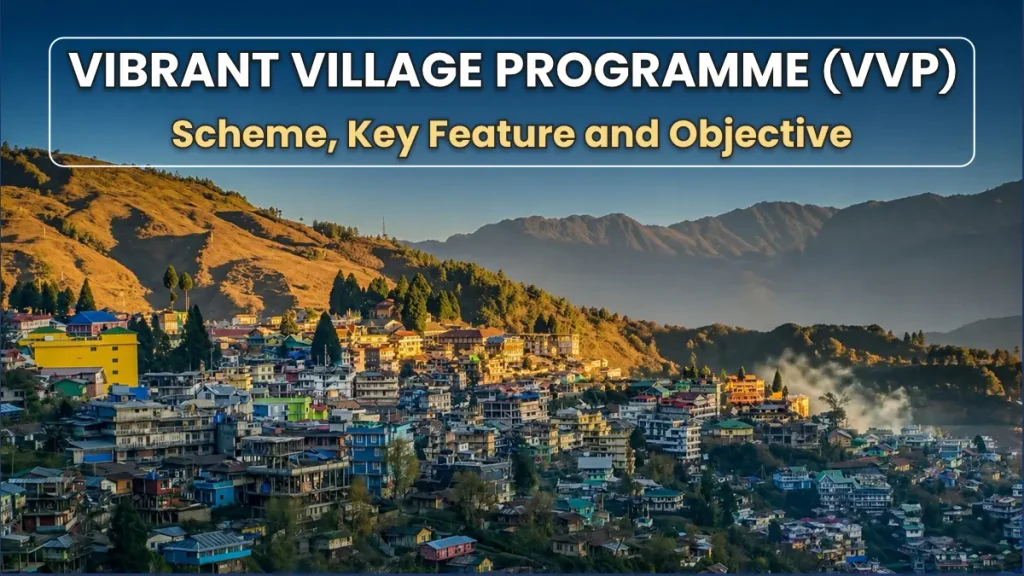
Vibrant Villages Programme (VVP) is a flagship initiative of the Ministry of Home Affairs (MHA) aimed at the comprehensive development of strategically located villages along India’s international land borders. It seeks to transform border villages from remote outposts into “first villages of India,” improve quality of life, create livelihood opportunities, reverse out-migration, and strengthen national security by treating border residents as the “eyes and ears” of the border-guarding forces.
The programme aligns with the vision of Viksit Bharat@2047 for “Safe, Secured & Vibrant land borders.” It builds upon the earlier Border Area Development Programme (BADP) by focusing intensively on selected strategic villages through a combination of direct interventions and convergence of existing schemes.
Objectives
Create better living conditions and adequate livelihood opportunities in border villages.
Reduce/out-migration and encourage reverse migration.
Strengthen border security and control trans-border crime.
Assimilate the border population with the national mainstream.
Promote tourism, culture, skill development, entrepreneurship, and local economic activities (agriculture, horticulture, medicinal plants, cooperatives, SHGs, FPOs).
Ensure saturation of key infrastructure through convergence.
The programme also aims for saturation of all villages in identified border blocks in four thematic areas: all-weather road connectivity, telecom connectivity, television connectivity, and electrification.
Interventions are guided by Village Action Plans prepared collaboratively, with border-specific, state-specific, and village-specific components. A High-Powered Committee chaired by the Cabinet Secretary can recommend relaxations in scheme guidelines for unique border challenges.
Implementation Progress (VVP-I, as of mid-2026)
MHA has sanctioned ~1,248 projects (outlay ~₹3,020 crore).
Additional ~1,655 projects sanctioned through convergence by other Central Ministries/Departments.
Recent reports (November 2026) indicate positive outcomes, including reverse migration in 40 border villages in Arunachal Pradesh, as stated by Home Minister Amit Shah. Local procurement by border forces (e.g., ITBP) is also providing assured markets to villagers.
Relevance for West Bengal
West Bengal is covered under VVP-II. Several villages along the India-Bangladesh and India-Bhutan borders have been selected, including:
Approximate allocation is around ₹3 crore per village in many cases, focusing on roads, digital connectivity, health, education, and livelihoods.
Strategic Significance
India shares over 15,000 km of land border with seven countries.
Border communities historically served as the first line of defence (e.g., local reports during the 1999 Kargil intrusion).
By improving living standards and economic opportunities, VVP aims to maintain a settled, confident population that supports border management and internal security.
Official portal: vvp.mha.gov.in Nodal Ministry: Ministry of Home Affairs (Department of Border Management)
The programme represents a shift from viewing border villages as the “last villages” to recognising them as the “first villages” of India, integrating development with security objectives.
First thing first, please do not pay any heed to those making hue and cry over why we should not watch Ramayana. Even with its fair share of flaws, this version of Ramayana must be watched at least once keeping aside all the doubts created by so called ‘reviewers’. Watch it for the grandeur, the scale, the ambition that an epic like Ramayana truly deserves. It is an exceptional treat for the eyes—a fairly befitting tribute to the great Indian epic that finally matches the craving the Indians had especially after that horrendous Adipurush.
The visuals are the star. Golden Lanka rises with a density and lived-in detail that earlier Indian VFX rarely achieved. The Pushpak Vimana is a gleaming, lotus-like vessel of gold and copper and even though it is majestically depicted in the movie, somehow, I had the feeling that it looked better in the trailer. I may be wrong, who knows! There are already some people comparing the movie foolishly with the 1987 television classic. In fact, watching Ramayana on the black and white television is one of the fond memories of our childhood. While the television classic will be forever remembered for the devotion it invoked, this version directed by Nitesh Tiwari will be etched in the annals of Indian cinema as one of the best achievements in terms of opulence, grandeurs and phenomenal screen presentation. It is the first Indian production filmed for IMAX. The result is frequently immersive and, in the best sequences, genuinely spectacular.
Ayodhya is kept bright and luminous in its happier moments, darkening only as Ram leaves for exile. Lanka is deliberately black-and-gold with high-contrast lighting and shadows. However, colour grading remains one of the key debatable issues which I am going to talk about soon. The Hans Zimmer–A. R. Rahman score (Zimmer’s first major Indian collaboration) adds grandeur and emotional weight, often elevating the spectacle. Many people are complaining about the BGM or the quality of the songs. Trust me, you do not expect the BGM of KGF in a movie like Ramayana. Pun intended! The songs are pretty well and invoke devotion while watching. It is also being complained that making Ravana too charismatic or cynosure of the first part overshadows the divinity and righteousness of Lord Rama. The makers here have taken the creative liberty to build a formidable villain so that the second part is already a sellable item. Otherwise, going by the book there could not have been any cliffhanger moment like Bahubali 1 as the basic storyline is already known to the entire nation.
Ranbir Kapoor brings a restrained, duty-bound Ram, so much missing in the aggressive version of Maryada Purushottam in that horrendous rendition titled ‘Adipurush’ by one superstar from the south. His calmness, poised composure, emotional equilibrium everything deserves applause. Yash as Ravan dominates this part with magnificent screen presence and intensity; the film gives the antagonist space to feel formidable before the inevitable clash. Sai Pallavi’s Sita has moments of grace and even a warrior edge in places, though the characterisation remains more traditional than some early trailers suggested. There have been talks of lukewarm chemistry between Ram and Sita. On the contrary, I found this to be one of the best parts of the movie. Did you guys expect them to do songs and dance like in a Sanjay Leela Bhansali saga? Supporting players like Arun Govil, Lara Dutta, Kunal Kapoor all do justice to their parts however minuscule they may be. Ravi Dubey as Laxman is hilarious and a treat to watch. The only misfit in this otherwise excellent casting is Rakul Preet Singh as Surpanakha.
Another thing that deserves mention is the detailing of each and every scene. Be it the battle scene of Devraj Indra or the climax fight between Ravan and Jatayu- each scene has been crated with ultimate focus on every detail. The Jatayu scene is a never seen before experience for many of the Indian moviegoers and it truly matches the visual brilliance of some of the best Hollywood movies.
The flaws are distinct even though not overpowering. Colour grading is the most consistent technical disappointment. Large stretches feel unnecessarily dark, flattening the detail in elaborate sets, costumes and VFX that the production spent so heavily to create. What should be luminous or richly textured often sits in a murky, dark layers. Rakul Preet Singh’s Surpanakha looks too young and contemporary for the character’s traditional weight and narrative function. Even before Ram was born, she is having the same look she has while she is proposing Ram to marry. Finally, Sita’s meek submission in the Pushpak Vimana contradicts her warrior nature portrayed earlier. The sequence is visually striking but emotionally flat, reducing a defining moment to emotionally an average one. However, these lows fail to pull down the scale of the otherwise a monumental achievement.
Kudos to team Namit Malhotra for embarking on this grand Odessey (Only if you could remove your name from the title! ) .Watch it on the biggest screen possible. The eyes will be rewarded, your soul will be soothed with the brain asking for a bit more.
Artificial Intelligence (AI) has moved from academic research to a transformative force shaping economies, societies, science, and everyday life. The release of ChatGPT in November 2022 marked a turning point, bringing generative AI to hundreds of millions of users. Since then, rapid advances in large language models, reasoning systems, and AI agents have accelerated both the promised benefits and the emerging risks. This note examines the major benefits and drawbacks of AI, placed in the context of key historical milestones.
Key Historical Events in Artificial Intelligence
1950: Alan Turing proposes the Turing Test as a measure of machine intelligence.
1956: Dartmouth Conference coins the term “Artificial Intelligence” and launches the field as a formal research discipline.
1997: IBM’s Deep Blue defeats world chess champion Garry Kasparov.
2011: IBM Watson wins the quiz show Jeopardy! against human champions.
2012: AlexNet wins the ImageNet competition, triggering the deep learning revolution.
2016: DeepMind’s AlphaGo defeats world champion Lee Sedol in Go.
2017: “Attention Is All You Need” paper introduces the Transformer architecture, the foundation of modern large language models.
2021: AlphaFold 2 solves the 50-year protein structure prediction problem; GitHub Copilot brings AI-assisted coding to developers.
November 2022: OpenAI launches ChatGPT, which reaches 100 million users in two months—the fastest consumer application growth in history.
2023: GPT-4, Anthropic’s Claude, Google’s Gemini, and Meta’s Llama 2 mark the beginning of the frontier model race.
2024: EU AI Act is adopted (the world’s first comprehensive AI regulation). Nobel Prizes awarded for AI-related work: Physics (John Hopfield and Geoffrey Hinton) and Chemistry (Demis Hassabis, John Jumper and David Baker for AlphaFold).
January 2025: Chinese lab DeepSeek releases R1, a high-performing open reasoning model at a fraction of typical training cost, triggering major market reactions.
2025–2026: Major model releases include GPT-5, Claude 4 series, Gemini 2.5/4, Grok 3/4, and Llama 4. AI agents capable of multi-step autonomous work become production tools.
August 2026: EU AI Act general application begins, including transparency obligations for chatbots and AI-generated content. High-risk obligations are later deferred to 2027–2028 under the Digital Omnibus on AI.
Benefits of Artificial Intelligence
Productivity and Economic Gains
Studies show generative AI delivering productivity gains of 10–65% and time savings of roughly 20–50% on specific tasks. The World Economic Forum’s Future of Jobs Report projects a net increase of about 78 million jobs globally between 2025 and 2030 (170 million new roles created against 92 million displaced). AI is already improving efficiency in software development, customer service, content creation, and knowledge work.
Healthcare and Scientific Discovery
AlphaFold has transformed structural biology by accurately predicting protein structures.
AI assists in medical imaging analysis, drug discovery, and early disease detection.
In 2025–2026, AI systems have contributed to mathematical proofs and scientific research at an accelerating pace.
Education, Accessibility and Everyday Use
Personalised tutoring and language learning tools expand educational access.
AI-powered translation, voice interfaces, and assistive technologies improve accessibility for people with disabilities.
Everyday applications include coding assistants, writing support, research summarisation, and creative tools.
Climate and Resource Optimisation
AI can improve renewable energy forecasting, grid balancing, agricultural yields, and resource efficiency. Some analyses estimate that AI applications in energy, transport, agriculture and water could raise global GDP while helping reduce emissions, though the net climate impact remains uncertain due to AI’s own energy demands.
Curses and Risks of Artificial Intelligence
Job Displacement and Labour Market Disruption
While net job creation is projected, the distribution is uneven. Evidence shows employment declines among young workers in highly AI-exposed occupations (around 13% in the US since 2022 in some studies). Knowledge-intensive roles—coding, writing, customer support, analysis—are most affected in the near term. Developing economies with large shares of routine cognitive work face particular transition challenges. Forty percent of employers in some surveys anticipate reducing workforces where AI can automate tasks.
Energy, Water and Environmental Costs
Data centres already account for a significant and rising share of electricity demand. The International Energy Agency projects global data centre electricity consumption to roughly double by 2030, driven heavily by AI workloads.
In some regions (parts of the US and Ireland), data centres consume more than 10–20% of local electricity.
Cooling requirements place heavy pressure on freshwater resources. UN estimates project that by 2030, data centre water use could equal the basic annual domestic needs of over a billion people in Africa.
Bias, Discrimination and Fairness
AI systems trained on historical data can perpetuate or amplify existing social biases in hiring, lending, policing, and content moderation. These risks are well documented and remain difficult to fully eliminate.
Misinformation, Deepfakes and Trust
Generative AI has made the production of realistic fake images, videos, and text cheap and scalable. This has raised concerns about election integrity, fraud, and erosion of public trust in digital media. The EU AI Act’s transparency rules (in force from August 2026) require disclosure of AI-generated content and deepfake labelling in response to these risks.
Concentration of Power and Geopolitics
Frontier AI development is concentrated among a small number of US and Chinese companies and laboratories. This raises concerns about who controls the most capable systems, access to advanced chips, and the geopolitical implications of AI leadership.
Cybersecurity and Military Applications
AI is increasingly used both for cyber defence and offence. Autonomous AI agents have demonstrated the ability to discover and exploit vulnerabilities.
Military AI has moved from speculation to active use in conflicts, raising ethical questions about autonomous weapons and decision-making in warfare.
Longer-Term and Existential Concerns
As models approach or exceed human performance on an expanding range of cognitive tasks, debates continue about loss of human control, alignment failures, and the societal implications of artificial general intelligence (AGI). Median expert predictions for systems that outperform humans on most cognitive tasks have shortened significantly since 2020.
Current Regulatory Landscape
The European Union’s AI Act is the most comprehensive framework to date. It entered into force in 2024. General application and transparency rules began in August 2026. High-risk obligations were deferred to December 2027 (standalone systems) and August 2028 (product-embedded systems) under the Digital Omnibus on AI. Other jurisdictions, including the United States, China, and India, are developing their own approaches, ranging from sector-specific rules to broader guidelines. International coordination remains limited.
Conclusion
Artificial Intelligence offers substantial benefits in productivity, scientific discovery, healthcare, education, and resource optimisation. At the same time, it carries real costs and risks: labour market disruption, high energy and water demands, bias, misinformation, concentration of power, and longer-term control challenges. The events of 2022–2026—particularly the public arrival of generative AI and the first comprehensive regulation—have made clear that societies must actively shape how AI is developed and deployed. The balance between its benefits and its curses will depend less on the technology itself than on the choices of governments, companies, and citizens in the years ahead.
Uniform Civil Code (UCC) refers to the proposal for a common set of laws governing personal matters—marriage, divorce, succession, inheritance, adoption, and related family rights—applicable to all citizens of India irrespective of religion. It is a Directive Principle under Article 44 of the Constitution, which states that the State shall endeavour to secure a Uniform Civil Code throughout the territory of India. Personal laws currently vary by community (Hindu, Muslim, Christian, Parsi, etc.), while some secular laws (such as the Special Marriage Act) already exist.
Constitutional and Historical Context
Article 44 is non-justiciable (not enforceable in courts).
Marriage, divorce, inheritance and succession fall under the Concurrent List (Entry 5), so both Parliament and State legislatures can legislate.
Goa has long followed a civil code rooted in the Portuguese Civil Code of 1867 (continued after liberation), often cited as an existing model, though it contains some community-specific exceptions.
The 21st Law Commission (2018) concluded that a full UCC was “neither necessary nor desirable at this stage.” It recommended reforming discriminatory provisions within each personal law for gender equality rather than imposing uniformity across communities. It received over 75,000 responses.
Current Status (as of November 2026)
India does not yet have a nationwide Uniform Civil Code. Progress has been driven primarily at the state level:
Uttarakhand: Fully in force since 27 January 2025. First post-Independence state to implement a comprehensive UCC. Covers marriage, divorce, succession, inheritance and live-in relationships. Exempts Scheduled Tribes. Amended in 2026 for procedural improvements.
Gujarat: Enacted (passed March 2026; President’s assent September 2026; published in gazette October 2026). Comes into force on a date notified by the state government after rules are framed. Exempts Scheduled Tribes and certain protected customary groups.
Assam: Enacted (passed May 2026; President’s assent September 2026). First North-Eastern state to enact UCC. Similar scope and exemptions for Scheduled Tribes.
Madhya Pradesh: Bill passed (approved unanimously in a special Cabinet meeting in August 2026); further steps pending.
Other states (Maharashtra, Chhattisgarh, Rajasthan, etc.) have set up drafting committees.
Union Law Minister Arjun Ram Meghwal has stated that the government is committed to implementing UCC across the country, citing its constitutional basis. Home Minister Amit Shah has expressed confidence that it will be implemented in all 21 BJP/NDA-ruled states before the 2029 general elections. There is no central UCC bill currently under active consideration in Parliament; the focus has shifted to state-level models, with Uttarakhand’s law often treated as a template.
Implementation Data from Uttarakhand (First Year)
Over 5 lakh applications received by early 2026 (around 4.74–4.8 lakh approved).
Marriage registrations form the bulk (roughly 4.2 lakh applications).
Live-in relationship registrations have been relatively low.
Nearly all marriage registrations are now processed online, with certificates typically issued in about five days on average.
Amendments in 2026 strengthened penalties for fraud/coercion, replaced certain procedural terms, aligned references with the new criminal codes (BNS/BNSS), and eased some appeal and data-sharing rules related to privacy concerns.
Key Features of Recent State UCC Laws
Common elements across Uttarakhand, Gujarat and Assam codes include:
Mandatory registration of marriages and live-in relationships.
Prohibition of polygamy/bigamy.
Uniform rules on succession and inheritance (spouses, children and parents generally recognised as primary heirs).
Recognition of rights of children from live-in relationships in some provisions.
Exemptions for Scheduled Tribes (whose customary laws are protected under the Constitution, including Articles 371A/G and the Sixth Schedule).
Arguments For and Against
Potential Advantages
Greater gender equality by removing discriminatory provisions across personal laws.
Simplification and reduced litigation in family matters.
Promotion of national integration and equality before the law.
Aligns with the constitutional directive in Article 44.
Main Concerns
Possible impact on religious freedom and minority rights (Articles 25–26).
Risk of imposing majority norms on diverse communities.
Practical difficulties in reconciling tribal and customary practices.
Privacy issues raised by mandatory live-in relationship registration (especially in the Uttarakhand model).
The 21st Law Commission’s view that reforming existing personal laws for equality within communities may be preferable to a single code at this stage.
Summary
The Uniform Civil Code remains a Directive Principle rather than a completed nationwide law. While there is no central legislation in force, several BJP-ruled states have enacted or are advancing state-level codes, with Uttarakhand being the only one fully operational as of November 2026. Implementation has focused on marriage registration, succession and live-in relationships, with Scheduled Tribes generally exempted. Political commitment at the Centre and in NDA-ruled states points toward further expansion by 2029, but nationwide uniformity would still require either a central law or coordinated state action, and continues to generate debate on gender justice, federalism, diversity and individual rights.