
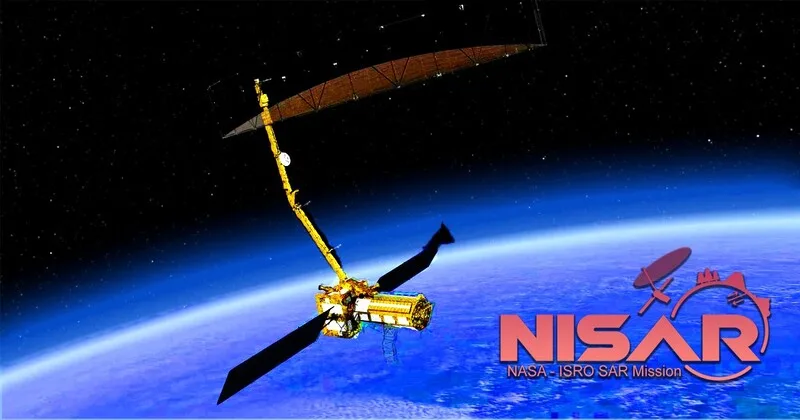
NISAR, A Gamechanger in Space Technology

Designed to provide a detailed view of the Earth to observe and measure some of the planet’s most complex processes, including ecosystem disturbances, ice-sheet collapse, natural hazards, sea level rise, and groundwater issues, NISAR is a pioneer in space technology. Its radar, the first of its kind in space, will systematically map Earth, measuring changes of our planet’s surface as small as a centimetre.

India crossed a milestone in its space and climate ambitions on Wednesday with the successful launch of the NASA-ISRO Synthetic Aperture Radar (Nisar) satellite from the Satish Dhawan Space Centre in Sriharikota. The Rs. 12,000-crore mission has been over a decade in the making and is being considered as one of the world’s most advanced Earth observation missions. The 2393-kilogram satellite lifted off at 5:40 pm IST, July 30 aboard ISRO’s Geosynchronous Satellite Launch Vehicle (GSLV) into the vacuum of space.

The Nisar mission, a $1.5 billion joint venture between the Indian Space Research Organisation (ISRO) and the United States’ National Aeronautics and Space Administration (NASA), is now set to revolutionise climate monitoring and disaster response, not just for India, but worldwide.

First Dual-Band Radar Satellite for Earth Observation

Why it is so special?

NISAR is the world’s first Earth-observing satellite with dual-frequency synthetic aperture radar (SAR).

L-band radar (1.257 GHz) from NASA can penetrate dense forests and soil layers to detect ground deformation and subsurface movement.

S-band radar (3.2 GHz) from ISRO is optimised for surface-level changes like crop growth, biomass estimates, and water levels.

This dual-frequency advantage allows for all-weather, day-and-night imaging, even through clouds, smoke, or vegetation cover.

This combination of NASA’s L-band radar and ISRO’s S-band radar enables Nisar to capture the faintest shifts on Earth’s surface — whether under forests, clouds, or even in darkness — detecting movements as small as a few millimetres.

The implications for India, often at the frontline of climate change impacts and natural disasters, are profound.

Nisar’s freely accessible, near-real-time data will empower Indian researchers, disaster managers, and policymakers to monitor glacier movements in the Himalayas, detect fault-line shifts before earthquakes, track agricultural cycles, and manage water resources more effectively.

With this tool, India is set to improve forecasting for floods, droughts, and landslides, enabling rapid response and informed policy decisions.

NISAR is designed to support research and operations across six broad themes:

Solid Earth Processes – Tracking earthquakes, landslides, and land deformation.

Ecosystems – Monitoring forests, woody biomass, and biodiversity.

Ice and Snow Dynamics – Measuring glacial movements and polar ice thickness.

Coastal and Ocean Monitoring – Tracking shoreline erosion, oil spills, and storm surges.

Disaster Response – Providing near-real-time damage maps after floods, quakes, or cyclones.

Agriculture and Infrastructure – Supporting food security and monitoring subsidence near dams, roads, and reservoirs.

During natural disasters, NISAR can provide damage proxy maps within five hours, crucial for emergency relief planning and response.

The mission exemplifies balanced international collaboration:

ISRO contributed the spacecraft bus, the entire S-band radar system, Ka-band telemetry systems, and launch support via GSLV Mk-II.

NASA provided the L-band radar, radar structure, antenna, onboard avionics, and high-capacity data systems.

The satellite was integrated and tested in Bengaluru, symbolising “Made-in-India” ownership of a global science instrument.

To get my guidance for English/Bengali/ Economics or overall Guidance for WBCS or any other exams,please call or whatsapp @ 6295350330. This is the official number of Adhyayan Academy. My much awaited descriptive English /Bengali Course for 1 year is starting from 1st September. Admission is going on for my Clerkship Main/ WBSSC Group C Course. Mock Test Course for PSC Miscellaneous Main has also started.

For regular updates, follow us @ FB, YouTube or Telegram with following links

FB- https://www.facebook.com/Adhyayanacademyslg/

YouTube- https://www.youtube.com/@theadhyayanacademy

Telegram- https://t.me/theadhyayanacademy

NASA Astronaut Kate Rubin’s Casts Her Vote From Space

NASA astronaut Kate Rubins points to the International Space Station’s “voting booth” where she cast her vote from space this month. This is actually Rubins’ second time to vote from low-Earth orbit, having cast her first vote from space in 2016 when she was an Expedition 48-49 crew member.

Voting in space has been possible since 1997 when a bill passed to legally allow voting from space in Texas. Since then, several NASA astronauts have exercised this civic duty from orbit.

Kathleen Rubins was selected by NASA in 2009. Rubins completed her first spaceflight on Expedition 48/49, where she became the first person to sequence DNA in space. She spent 115 days in space and conducted two spacewalks. She holds a Bachelor of Science in Molecular Biology from the University of California and a Ph.D. in Cancer Biology from Stanford University Medical School Biochemistry Department and Microbiology and Immunology Department. Dr. Rubins conducted her undergraduate research on HIV-1 integration in the Infectious Diseases Laboratory at the Salk Institute for Biological Studies. She worked as a Fellow/Principal Investigator at the Whitehead Institute for Biomedical Research and headed 14 researchers studying viral diseases that primarily affect Central and West Africa.  She is currently serving aboard the International Space Station for a six-month mission as a flight engineer for the Expedition 63/64 crew.

Personal Data:
Born in 1978 in Farmington, Connecticut, and raised in Napa, California, where her father, Jim, still resides. Her mother, Ann Hallisey resides in Davis, California. She enjoys running, cycling, swimming, flying, scuba diving and reading. 

Education:
Graduated from Vintage High School in 1996, received a Bachelor of Science degree in Molecular Biology from the University of California, San Diego, in 1999 and a Ph.D. in Cancer Biology in 2005 from Stanford University Medical School Biochemistry Department and Microbiology and Immunology Department.

Experience:
Dr. Rubins conducted her undergraduate research on HIV-1 integration in the Infectious Diseases Laboratory at the Salk Institute for Biological Studies. She analyzed the mechanism of HIV integration, including several studies of HIV-1 Integrase inhibitors and genome-wide analyses of HIV integration patterns into host genomic DNA. She obtained her Ph.D. from Stanford University and, with the U.S. Army Medical Research Institute of Infectious Diseases and the Centers for Disease Control and Prevention, Dr. Rubins and colleagues developed the first model of smallpox infection. She also developed a complete map of the poxvirus transcriptome and studied virus-host interactions using both invitro and animal model systems.

Dr. Rubins then accepted a Fellow/Principal Investigator position at the Whitehead Institute for Biomedical Research (MIT/Cambridge, Massachusetts) and headed a lab of 14 researchers studying viral diseases that primarily affect Central and West Africa. She traveled to the Democratic Republic of Congo to conduct research and supervise study sites. Work in the Rubins Lab focused on poxviruses and host-pathogen interaction as well as viral mechanisms for regulating host cell mRNA transcription, translation and decay. In addition, she conducted research on transcriptome and genome sequencing of filoviruses (Ebola and Marburg) and Arenaviruses (Lassa Fever) and collaborative projects with the U.S. Army to develop therapies for Ebola and Lassa viruses. Dr. Rubins has published and presented her work in numerous papers at international scientific conferences and in scientific journals.

NASA Experience:
Rubins was selected in July 2009 as one of 9 members of the 20th NASA astronaut class. Her training included scientific and technical briefings, intensive instruction in International Space Station systems, spacewalks, robotics, physiological training, T 38 flight training and water and wilderness survival training.

Spaceflight Experience:
Expeditions 48 and 49 (July 2016 through October 2016.)On July 7th, 2016, Dr. Rubins launched from the Baikonur Cosmodrome in Kazakhstan to the International Space Station aboard the first test flight of the new Soyuz MS spacecraft. Together the international crew of Expeditions 48 and 49 conducted or participated in more than 275 different scientific experiments including research in molecular and cellular biology, human physiology, fluid and combustion physics, Earth and space science and technology development. Dr. Rubins was the first person to sequence DNA in space, eventually sequencing over 2 billion base pairs of DNA during a series of experiments to analyze sequencing in microgravity. Dr. Rubins also grew heart cells (cardiomyocytes) in cell culture, and performed quantitative, real-time PCR and microbiome experiments in orbit.

Dr. Rubins conducted two spacewalks totaling 12 hours, 46 minutes. During her first spacewalk, Rubins and Jeff Williams installed the first International Docking Adapter, a new docking port for U.S. commercial crew spacecraft. During the second, they performed maintenance of the station external thermal control system and installed high-definition cameras, enabling never-before seen images of the planet and space station. Jeff Williams and Rubins successfully captured SpaceX Dragon commercial resupply spacecraft and then returned science experiment samples to earth. During Expedition 49, Rubins and crewmate Takuya Onishi grappled Orbital ATK’s Cygnus resupply spacecraft, providing several tons of supplies and research experiments for future work on the orbital outpost.

Rubins has logged 115 days in space and 12 hours and 46 minutes of spacewalk time.  She is currently serving aboard the International Space Station for a six-month mission as a flight engineer for the Expedition 63/64 crew.

Awards/Honors:
Popular Science’s Brilliant Ten (2009), National Science Foundation Predoctoral Fellowship (2000), Stanford Graduate Fellowship – Gabilan Fellow (2000), UCSD Emerging Leader of the Year (1998), Order of Omega Honor Society Scholarship Award (1998).

Have a look at this wonderful video of her in space

News and Video Courtesy- NASA