
India-US Bilateral Relation- Modi-Harris Talks- Joe Biden- Quad Meet

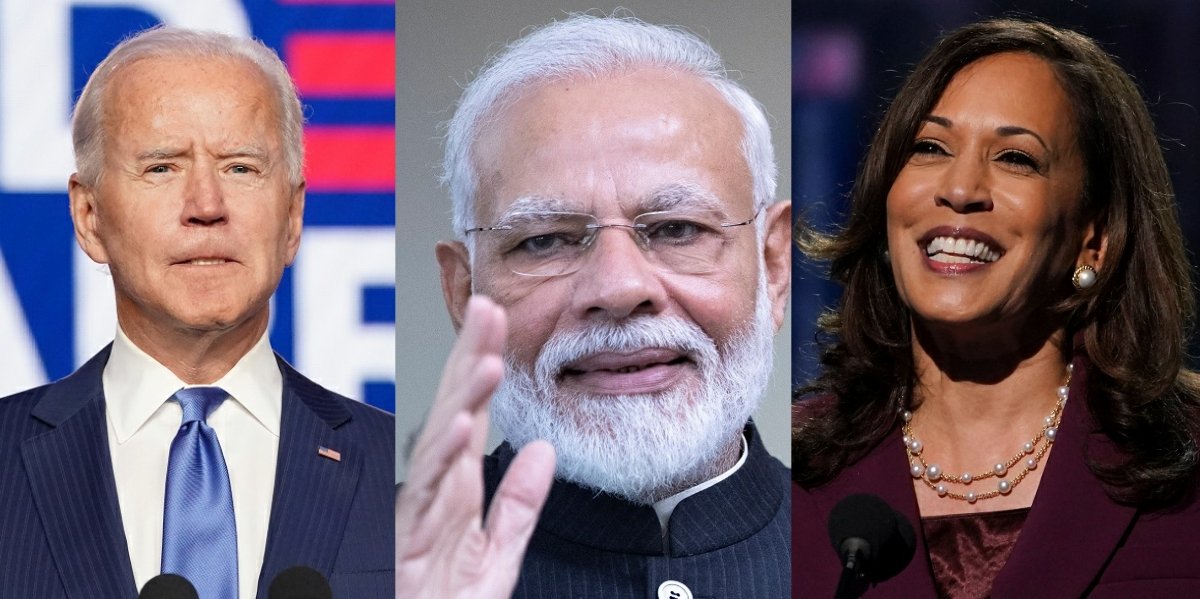
Ahead of his much anticipated first-ever bilateral talk with US President Joe Biden, Indian Prime Minister Narendra Damodardas Modi will meet the illustrated Vice President Kamala Harris on Thursday amidst the ongoing Quad talks involving the USA, India, Australia, and Japan. The timing of the meet is historically significant. Exactly two years back, Modi was received on the US soil amidst much fanfare in the extravagant Howdy Modi show. In 1958, Shyamala Gopalan, Kamala’s mother had arrived on Uncle Sam’s land after finishing her B.Sc. in Home Science at the Irwin College, New Delhi to do her study to find out “protein contribution of the chapatis”.

Since Shyamala’s arrival, world politics has seen a sea change in the dynamics whereas, since Modi’s last arrival on the US soil, much water has flown on US domestics politics as well. Two years back, it was a favorable Indian outing with India’s natural ally, the megalomaniac Donald Trump on power. Priorities of both nations now have changed. The ouster of Trump and the pandemic breakout have changed the complexion of the relationship between the two great nations.

Kamala Harris, despite her Indian origins, is not considered a great friend of the Indian rightists. She is a Left-Liberal in her ideologies. Her parents Donald Harris and Shyamala Gopalan had been prominent social rights activists in the US during their growing years. Even though Harris is Half-Indian, and she is often found performing Hindu rituals, she considers herself an Afro-American, highlighting her paternal lineage even though her parents divorced when she was just seven. This identity trick may be considered a strategic move. The number of Indians living in the US is only around four million whereas the Blacks are manifolds the figure. So, who is more important to be wooed in terms of vote bank?

Normally, a meeting with the US VP should not have bagged so much media attention. But Kamala is not an ordinary Vice President. She had played a key role in establishing the Biden regime and Joe Biden has returned the favors by allocating her important portfolios like heading the Space Force, Covid response, Immigration, etc. She enjoys so much of power hitherto unheard of in the history of American politics in recent times.

The Bilateral Talks are to cover a plethora of subjects like strengthening the relationships between the two nations, reinforcing the Quad grouping (Quad is Quadrilateral Security Dialogue involving the USA, India, Australia, and Japan) more efficient handling of the pandemic scenario, mitigating the climate crisis, maintaining the supply chain with emphasis on the vaccine and semiconductor supplies and so on. But there is a hint that Kamala Harris may discuss democratic, social and civil rights with PM Modi. Now, this is an interesting hint. Kamala Harris as mentioned earlier has often been a critic of India’s domestic governance under PM Modi and the alleged incessant violation of civil rights in India. So, what she might be interested in while discussing such sensitive issues with the Indian Premier raises much interest.

It may be pertinent to point out that at present the grounds of US interference in India’s domestic matters are flimsy and unlikely. The Biden Government is under tremendous domestic and international pressure owing to the Taliban insurgence, increasing threat to internal security, the never-ending Covid crisis, and continuous rise of China in the global socio-economic and political scenario. How the talks unfold is now of paramount importance for both the nations as India’s leverage as an emerging international force to be reckoned with cannot be ruled out. Let us presume that both nations grab the opportunity to usher in a new era in the bilateral and multilateral goals of both.

Read

NASA Astronaut Kate Rubin’s Casts Her Vote From Space

NASA astronaut Kate Rubins points to the International Space Station’s “voting booth” where she cast her vote from space this month. This is actually Rubins’ second time to vote from low-Earth orbit, having cast her first vote from space in 2016 when she was an Expedition 48-49 crew member.

Voting in space has been possible since 1997 when a bill passed to legally allow voting from space in Texas. Since then, several NASA astronauts have exercised this civic duty from orbit.

Kathleen Rubins was selected by NASA in 2009. Rubins completed her first spaceflight on Expedition 48/49, where she became the first person to sequence DNA in space. She spent 115 days in space and conducted two spacewalks. She holds a Bachelor of Science in Molecular Biology from the University of California and a Ph.D. in Cancer Biology from Stanford University Medical School Biochemistry Department and Microbiology and Immunology Department. Dr. Rubins conducted her undergraduate research on HIV-1 integration in the Infectious Diseases Laboratory at the Salk Institute for Biological Studies. She worked as a Fellow/Principal Investigator at the Whitehead Institute for Biomedical Research and headed 14 researchers studying viral diseases that primarily affect Central and West Africa.  She is currently serving aboard the International Space Station for a six-month mission as a flight engineer for the Expedition 63/64 crew.

Personal Data:
Born in 1978 in Farmington, Connecticut, and raised in Napa, California, where her father, Jim, still resides. Her mother, Ann Hallisey resides in Davis, California. She enjoys running, cycling, swimming, flying, scuba diving and reading. 

Education:
Graduated from Vintage High School in 1996, received a Bachelor of Science degree in Molecular Biology from the University of California, San Diego, in 1999 and a Ph.D. in Cancer Biology in 2005 from Stanford University Medical School Biochemistry Department and Microbiology and Immunology Department.

Experience:
Dr. Rubins conducted her undergraduate research on HIV-1 integration in the Infectious Diseases Laboratory at the Salk Institute for Biological Studies. She analyzed the mechanism of HIV integration, including several studies of HIV-1 Integrase inhibitors and genome-wide analyses of HIV integration patterns into host genomic DNA. She obtained her Ph.D. from Stanford University and, with the U.S. Army Medical Research Institute of Infectious Diseases and the Centers for Disease Control and Prevention, Dr. Rubins and colleagues developed the first model of smallpox infection. She also developed a complete map of the poxvirus transcriptome and studied virus-host interactions using both invitro and animal model systems.

Dr. Rubins then accepted a Fellow/Principal Investigator position at the Whitehead Institute for Biomedical Research (MIT/Cambridge, Massachusetts) and headed a lab of 14 researchers studying viral diseases that primarily affect Central and West Africa. She traveled to the Democratic Republic of Congo to conduct research and supervise study sites. Work in the Rubins Lab focused on poxviruses and host-pathogen interaction as well as viral mechanisms for regulating host cell mRNA transcription, translation and decay. In addition, she conducted research on transcriptome and genome sequencing of filoviruses (Ebola and Marburg) and Arenaviruses (Lassa Fever) and collaborative projects with the U.S. Army to develop therapies for Ebola and Lassa viruses. Dr. Rubins has published and presented her work in numerous papers at international scientific conferences and in scientific journals.

NASA Experience:
Rubins was selected in July 2009 as one of 9 members of the 20th NASA astronaut class. Her training included scientific and technical briefings, intensive instruction in International Space Station systems, spacewalks, robotics, physiological training, T 38 flight training and water and wilderness survival training.

Spaceflight Experience:
Expeditions 48 and 49 (July 2016 through October 2016.)On July 7th, 2016, Dr. Rubins launched from the Baikonur Cosmodrome in Kazakhstan to the International Space Station aboard the first test flight of the new Soyuz MS spacecraft. Together the international crew of Expeditions 48 and 49 conducted or participated in more than 275 different scientific experiments including research in molecular and cellular biology, human physiology, fluid and combustion physics, Earth and space science and technology development. Dr. Rubins was the first person to sequence DNA in space, eventually sequencing over 2 billion base pairs of DNA during a series of experiments to analyze sequencing in microgravity. Dr. Rubins also grew heart cells (cardiomyocytes) in cell culture, and performed quantitative, real-time PCR and microbiome experiments in orbit.

Dr. Rubins conducted two spacewalks totaling 12 hours, 46 minutes. During her first spacewalk, Rubins and Jeff Williams installed the first International Docking Adapter, a new docking port for U.S. commercial crew spacecraft. During the second, they performed maintenance of the station external thermal control system and installed high-definition cameras, enabling never-before seen images of the planet and space station. Jeff Williams and Rubins successfully captured SpaceX Dragon commercial resupply spacecraft and then returned science experiment samples to earth. During Expedition 49, Rubins and crewmate Takuya Onishi grappled Orbital ATK’s Cygnus resupply spacecraft, providing several tons of supplies and research experiments for future work on the orbital outpost.

Rubins has logged 115 days in space and 12 hours and 46 minutes of spacewalk time.  She is currently serving aboard the International Space Station for a six-month mission as a flight engineer for the Expedition 63/64 crew.

Awards/Honors:
Popular Science’s Brilliant Ten (2009), National Science Foundation Predoctoral Fellowship (2000), Stanford Graduate Fellowship – Gabilan Fellow (2000), UCSD Emerging Leader of the Year (1998), Order of Omega Honor Society Scholarship Award (1998).

Have a look at this wonderful video of her in space

News and Video Courtesy- NASA