



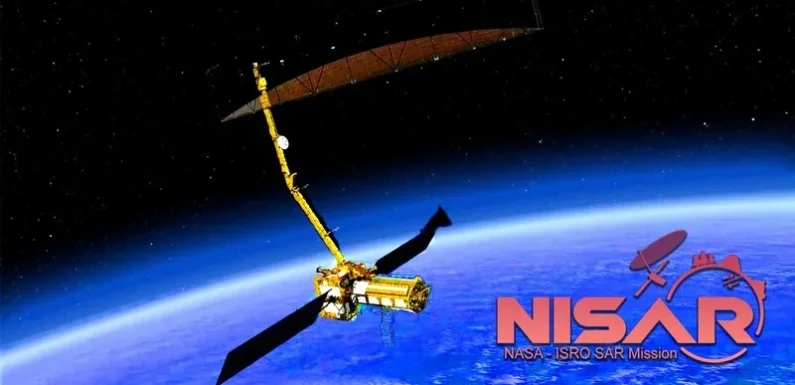
Designed to provide a detailed view of the Earth to observe and measure some of the planet’s most complex processes, including ecosystem disturbances, ice-sheet collapse, natural hazards, sea level rise, and groundwater issues, NISAR is a pioneer in space technology. Its radar, the first of its kind in space, will systematically map Earth, measuring changes of our planet’s surface as small as a centimetre.
India crossed a milestone in its space and climate ambitions on Wednesday with the successful launch of the NASA-ISRO Synthetic Aperture Radar (Nisar) satellite from the Satish Dhawan Space Centre in Sriharikota. The Rs. 12,000-crore mission has been over a decade in the making and is being considered as one of the world’s most advanced Earth observation missions. The 2393-kilogram satellite lifted off at 5:40 pm IST, July 30 aboard ISRO’s Geosynchronous Satellite Launch Vehicle (GSLV) into the vacuum of space.
The Nisar mission, a $1.5 billion joint venture between the Indian Space Research Organisation (ISRO) and the United States’ National Aeronautics and Space Administration (NASA), is now set to revolutionise climate monitoring and disaster response, not just for India, but worldwide.
First Dual-Band Radar Satellite for Earth Observation
Why it is so special?
NISAR is the world’s first Earth-observing satellite with dual-frequency synthetic aperture radar (SAR).
L-band radar (1.257 GHz) from NASA can penetrate dense forests and soil layers to detect ground deformation and subsurface movement.
S-band radar (3.2 GHz) from ISRO is optimised for surface-level changes like crop growth, biomass estimates, and water levels.
This dual-frequency advantage allows for all-weather, day-and-night imaging, even through clouds, smoke, or vegetation cover.
This combination of NASA’s L-band radar and ISRO’s S-band radar enables Nisar to capture the faintest shifts on Earth’s surface — whether under forests, clouds, or even in darkness — detecting movements as small as a few millimetres.
The implications for India, often at the frontline of climate change impacts and natural disasters, are profound.
Nisar’s freely accessible, near-real-time data will empower Indian researchers, disaster managers, and policymakers to monitor glacier movements in the Himalayas, detect fault-line shifts before earthquakes, track agricultural cycles, and manage water resources more effectively.
With this tool, India is set to improve forecasting for floods, droughts, and landslides, enabling rapid response and informed policy decisions.
NISAR is designed to support research and operations across six broad themes:
Solid Earth Processes – Tracking earthquakes, landslides, and land deformation.
Ecosystems – Monitoring forests, woody biomass, and biodiversity.
Ice and Snow Dynamics – Measuring glacial movements and polar ice thickness.
Coastal and Ocean Monitoring – Tracking shoreline erosion, oil spills, and storm surges.
Disaster Response – Providing near-real-time damage maps after floods, quakes, or cyclones.
Agriculture and Infrastructure – Supporting food security and monitoring subsidence near dams, roads, and reservoirs.
During natural disasters, NISAR can provide damage proxy maps within five hours, crucial for emergency relief planning and response.
The mission exemplifies balanced international collaboration:
ISRO contributed the spacecraft bus, the entire S-band radar system, Ka-band telemetry systems, and launch support via GSLV Mk-II.
NASA provided the L-band radar, radar structure, antenna, onboard avionics, and high-capacity data systems.
The satellite was integrated and tested in Bengaluru, symbolising “Made-in-India” ownership of a global science instrument.
To get my guidance for English/Bengali/ Economics or overall Guidance for WBCS or any other exams,please call or whatsapp @ 6295350330. This is the official number of Adhyayan Academy. My much awaited descriptive English /Bengali Course for 1 year is starting from 1st September. Admission is going on for my Clerkship Main/ WBSSC Group C Course. Mock Test Course for PSC Miscellaneous Main has also started.
For regular updates, follow us @ FB, YouTube or Telegram with following links
FB- https://www.facebook.com/Adhyayanacademyslg/
YouTube- https://www.youtube.com/@theadhyayanacademy
Telegram- https://t.me/theadhyayanacademy
