


This article consists of the following contents which are extremely important for any competitive examination for both objective and descriptive questions.
History of space research in India
Major milestones of India’s space technology
Indian Regional Navigation Satellite System
Rakesh Sharma
Gaganayan Mission
Chandrayaan Mission with special emphasis on Chandrayaan 3
Axiom 4 and Shubhanshu Shukla
The space research activities were initiated in India during the early 1960’s, when applications using satellites were in experimental stages even in the United States. With the live transmission of Tokyo Olympic Games across the Pacific by the American Satellite ‘Syncom-3’ demonstrating the power of communication satellites, Dr. Vikram Sarabhai, the founding father of Indian space programme, quickly recognized the benefits of space technologies for India.
As a first step, the Department of Atomic Energy formed the INCOSPAR (Indian National Committee for Space Research) under the leadership of Dr. Sarabhai and Dr. Ramanathan in 1962. The Indian Space Research Organisation (ISRO) was later formed on August 15, 1969. The prime objective of ISRO is to develop space technology and its application to various national needs. It is one of the six largest space agencies in the world. The Department of Space (DOS) and the Space Commission were set up in 1972 and ISRO was brought under DOS on June 1, 1972.
Since inception, the Indian space programme has been orchestrated well and had three distinct elements such as, satellites for communication and remote sensing, the space transportation system and application programmes. Two major operational systems have been established – the Indian National Satellite (INSAT) for telecommunication, television broadcasting, and meteorological services and the Indian Remote Sensing Satellite (IRS) for monitoring and management of natural resources and Disaster Management Support.
Major milestones in Indian Space Programme
Indian Space Programme began at Thumba Equatorial Rocket Launching Station (TERLS) located at Thumba near Thiruvanathapuram. Thumba was selected for being rocket launching station because geomagnetic equator of the earth passes over Thumba. The geomagnetic equator of the earth passes over Thumba.
On November 21, 1963, the first sounding rocket was launched from TERLS. The first rocket, a Nike-Apache was procured from the US. A sounding rocket is a rocket, which is intended for assessing the physical parameters of the upper atmosphere.
The Satellite Telecommunication Earth Station was set up at Ahmedabad on January 1, 1967.
India’s first indigenous sounding rocket, RH-75, was launched on November 20, 1967.
Aryabhata – First Indian Satellite was launched on April 19, 1975. It was launched from the former Soviet Union. It provided India with the basis of learning satellite technology and designing.
During 1975-76, ISRO along with NASA developed means of using space communications system for TV broadcasting. This resulted in the creation of the project Satellite Instructional Television Experiment (SITE). It was a one-year program covering Indian villages and districts. The main purpose of SITE was to experiment usage of satellite broadcasting to educate the masses. SITE, hailed as ‘the largest sociological experiment in the world’ benefited around 200,000 people, covering 2400 villages of six states and transmitted development-oriented programmes using the American Technology Satellite (ATS-6).
During January 1, 1977 — January 1, 1979, Satellite Telecommunication Experiments Project (STEP), a joint project of ISRO-and Post and Telegraphs Department (P&T) using the Franco-German Symphonie satellite was taken up. Conceived as a sequel to SITE which focused on Television, STEP was for telecommunication experiments.
Bhaskara-I – an experimental satellite for earth observations was launched on June 7, 1979.
First Experimental launch of SLV-3 with Rohini Technology Payload on board (August 10, 1979). Satellite could not be placed in orbit. Satellite Launch Vehicle-3 (SLV-3) is the first launch vehicle of India.
Ariane Passenger Payload Experiment (APPLE), an experimental geo-stationary communication satellite was successfully launched on June 19, 1981. It became the forerunner for future communication satellite system.
Indian National Satellite system (INSAT)-1A was launched on April 10, 1982. This system was for the communication, broadcasting and meteorology.
On April 2, 1984, the first Indo-Soviet manned space mission was launched. Wing Commander Rakesh Sharma (born 13 January 1949) became the first Indian citizen to go into space. He flew aboard in the Soviet rocket Soyuz T-11, as part of a three member Soviet-Indian crew as part of the Soviet Interkosmos programme.

Sharma retired as a wing commander and later joined Hindustan Aeronautics Limited (HAL) in 1987, serving as the chief test pilot in the HAL Nashik Division until 1992, before moving on to Bangalore to work as HAL’s chief test pilot. Sharma retired from flying in 2001
The first operational Indian Remote Sensing Satellite, IRS-1A was launched on March 17, 1988.
On March 24, 1987, the first developmental launch of Augmented Satellite Launch Vehicle (ASLV) that supported a larger payload than the SLV-3 and was meant to be low-cost happened.
Second developmental launch of Polar Satellite Launch Vehicle (PSLV) with IRS-P2, on board took place on October 15, 1994. Satellite successfully placed in Polar Sun synchronous Orbit. PSLV went on to become a favoured carrier for satellites of various countries due to its reliability and cost efficiency, promoting unprecedented international collaboration.
The first developmental launch of Geosynchronous Satellite Launch Vehicle (GSLV)-D1 with GSAT-1 on board took off from Sriharikota on April 18, 2001. It was developed keeping in mind the heavier and more demanding Geosynchronous communication satellites.
INSAT-4CR weighing 2130 kg and launched by GSLV-F04 on September 2, 2007 is the heaviest satellite launched from India.
PSLV-C11 successfully launches CHANDRAYAAN-1 from Sriharikota on October 22, 2008. Chandrayaan-1 is a scientific investigation – by spacecraft – of the Moon. The name Chandrayaan means “Chandra- Moon, Yaan-vehicle”, –in Indian languages (Sanskrit and Hindi) , – the lunar spacecraft. Chandrayaan-1 is the first Indian planetary science and exploration mission. Chandrayaan-1 was operational for 312 days till August 28, 2009.
November 5, 2013 – PSLV – C25 successfully launches Mars Orbiter Mission (Mangalyaan) Spacecraft from Sriharikota.
India’s communication satellite, GSAT-17 was inducted into the INSAT/GSAT system on June 29, 2017 from Kourou, French Guiana by Ariane-5 VA-238.
India’s Polar Satellite Launch Vehicle, in its forty-third flight (PSLV-C41) in XL configuration launched IRNSS-1I Satellite. The ‘XL’ configuration of PSLV is used for the twentieth time. The IRNSS-1I is the eighth satellite to join the NavIC navigation satellite constellation and was launched on April 12, 2018.
India’s next generation high throughput communication satellite, GSAT-11 was successfully launched on December 05, 2018 from Kourou launch base, French Guiana by Ariane-5 VA-246. Weighing about 5854 kg, GSAT-11 is the heaviest satellite built by ISRO.
Gaganyaan Programme – Two unmanned & one manned flight has been planned. Estimates for Phase-I expenditure- Rs 9023 Crores. Gaganyaan Programme will establish a broader framework for collaboration between ISRO, academia, industry, national agencies and other scientific organizations. The Gaganyaan Mission will be led by V. R. Lalithambika, the former Director of the Directorate of the Human Spaceflight Programme with ISRO Chairman S Somnath and S. Unnikrishnan Nair, Director of Vikram Sarabhai Space Centre. The Hindustan Aeronautics Limited (HAL)-manufactured crew module underwent its first uncrewed experimental flight on 18 December 2014. On 27 February 2024, Prime Minister Narendra Modi revealed the identities of the first four Indian astronauts (Gaganyatris): Gp Capt Prasanth Balakrishnan Nair, Gp Capt Ajit Krishnan, Gp Capt Angad Pratap and Gp Capt (then Wg Cdr) Shubhanshu Shukla. Axiom‑4 represents a milestone for the Indian Human Spaceflight Programme, integrating with ISRO’s Gaganyaan initiative. While Gaganyaan remains India’s independent crewed program, Ax‑4 provides the first opportunity for an Indian astronaut—Shubhanshu Shukla—to fly on a commercial mission to the ISS.
Geosynchronous Satellite Launch Vehicle, GSLV MkIII-M1 rocket, carrying Chandrayaan-2 spacecraft was launched from the Satish Dhawan Space Centre, Sriharikota in Andhra Pradesh on July 22, 2019. Chandrayaan-2 is India’s second mission to the moon. It comprises a fully indigenous Orbiter, Lander (Vikram) and Rover (Pragyan). The Rover Pragyan is housed inside Vikram lander. Chandrayaan-2 has several science payloads to facilitate a more detailed understanding of the origin and evolution of the Moon. To know more about Chandrayan 2, click here.
ISRO undertakes PSLV-C53/DS-EO mission on June 30, 2022. PSLV-C53 is the second dedicated commercial mission of New Space India Limited (NSIL).
Indian Regional Navigation Satellite System (IRNSS): NavIC
IRNSS is an independent regional navigation satellite system being developed by India. It is designed to provide accurate position information service to users in India as well as the region extending up to 1500 km from its boundary, which is its primary service area. An Extended Service Area lies between primary service area and area enclosed by the rectangle from Latitude 30 deg South to 50 deg North, Longitude 30 deg East to 130 deg East.
IRNSS will provide two types of services, namely, Standard Positioning Service (SPS) which is provided to all the users and Restricted Service (RS), which is an encrypted service provided only to the authorised users. The IRNSS System is expected to provide a position accuracy of better than 20 m in the primary service area.
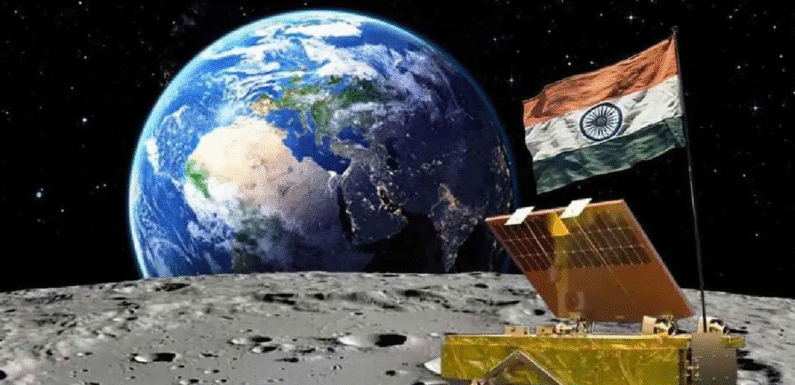
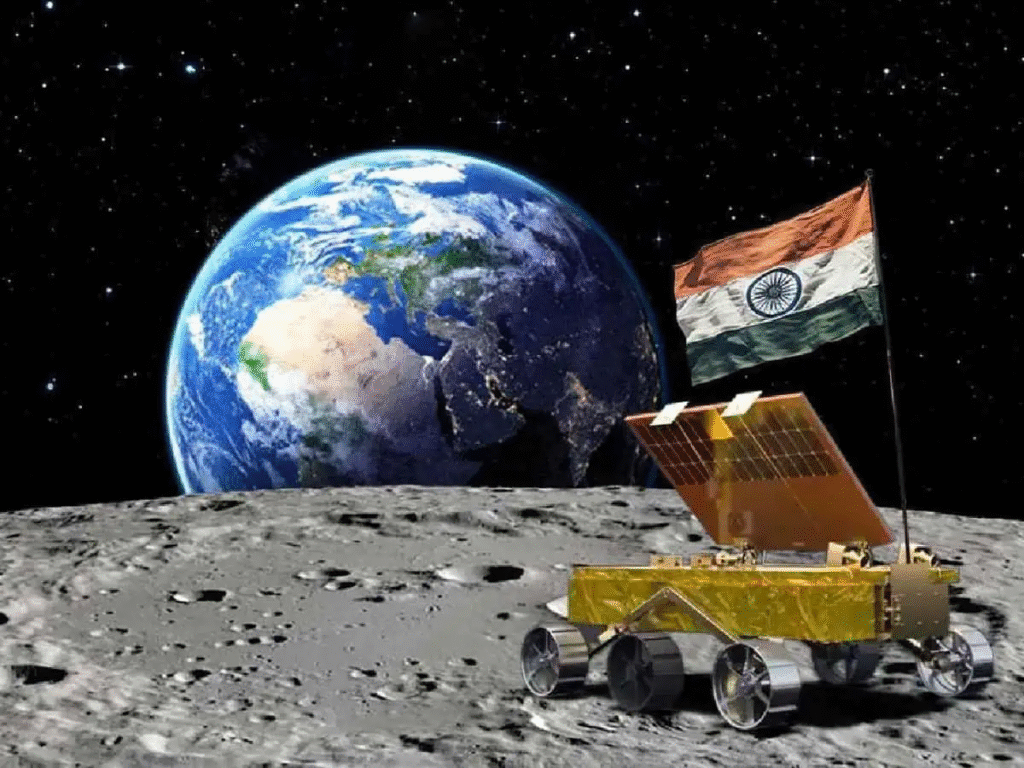
Chandrayaan-3 was a lunar mission by ISRO focused on demonstrating safe landing and roving capabilities on the Moon. It was a follow-up mission to Chandrayaan-2 to demonstrate end-to-end capability in safe landing and roving on the lunar surface. It consisted of a Lander (Vikram), a Rover (Pragyan), and a Propulsion module. The mission successfully landed on the lunar south pole on August 23, 2023, making India the first country to achieve this feat. On July 14, 2023, Chandrayaan- 3 took off from the Satish Dhawan Space Centre in Sriharikota. The spacecraft seamlessly entered lunar orbit on August 5, 2023. The historic moment unfolded when the lander made a successful touchdown near the Lunar south pole on Aug 23, 2023.The mission’s objectives included conducting in-situ scientific experiments on the lunar surface, such as analysing the elemental composition and thermal properties.
- Major Findings:
Lunar Surface Temperature Surprise: Chandra’s Surface Thermophysical Experiment (ChaSTE) measured temperatures reaching 70 degrees Celsius, surprising scientists who expected temperatures between 20 to 30 degrees Celsius.
Lunar Surface Elements Confirmed: The Laser-Induced Breakdown Spectroscopy instrument onboard ‘Pragyan’ rover confirmed the presence of Sulphur on the lunar surface near the south pole. Elements such as Aluminium, Calcium, Iron, Chromium, Titanium, Manganese, Silicon, and Oxygen were also detected.
Leadership in Space Technology:
It joins the elite group of nations—Russia, the US, and China—with demonstrated lunar soft-landing capability
India’s indigenous cryogenic engines and efforts to declutter the orbit showcase its leadership in space technology.
Positioning India as a global hub in the New Space economy
Built on a shoestring budget of just Rs 715 Crore, it is a landmark in India’s quest for the space.
Increasing interest in space tourism may lead to private space parks.
Convergence with smart space robots can create in-orbit manufacturing hubs, fostering economic activities
Over 500 space-tech startups, MSMEs, and industries fuel the New Space movement in India.
Shubhanshu Shukla is a group captain and test pilot with the Indian Air Force (IAF) and gaganyatri (astronaut) with the Indian Space Research Organisation (ISRO). As of July 2025, he is serving as the mission pilot for Axiom Mission 4, a privately organised mission to the International Space Station (ISS). Shukla is the first ISRO astronaut to visit the ISS and the second Indian to travel to space, following Rakesh Sharma’s mission in 1984.
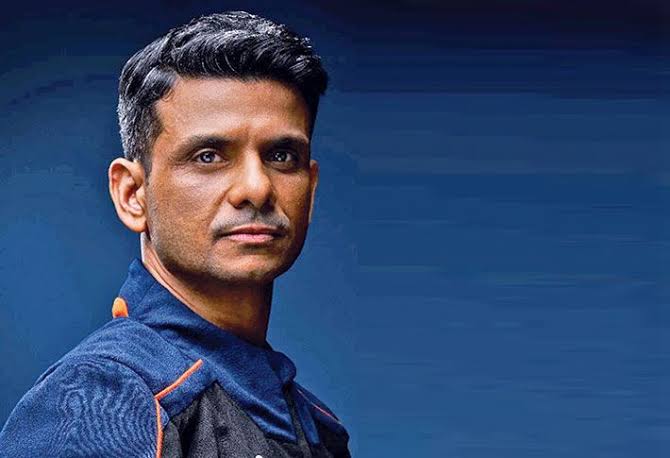
Axiom Mission 4 (Ax‑4) was a private crewed spaceflight to the International Space Station (ISS) operated by Axiom Space in partnership with SpaceX and NASA. The mission launched atop a SpaceX Falcon 9 Block 5 rocket, which placed the Crew Dragon Grace spacecraft into low Earth orbit. This was the maiden flight of Grace (C213), the fifth and final Crew Dragon capsule to be built. The four-person crew included commander Peggy Whitson, an Axiom Space employee and former NASA astronaut; pilot Shubhanshu Shukla of the Indian Space Research Organisation (ISRO); and mission specialists Sławosz Uznański-Wiśniewski, a European Space Agency (ESA) project astronaut from Poland, and Tibor Kapu, representing the Hungarian Space Office. The mission marked the first government-sponsored human spaceflight in over 40 years, and only the second overall, for India, Hungary, and Poland. Each of these countries previously flew one astronaut as part of the Soviet Union’s Interkosmos program. While those earlier missions docked with Salyut 6 or Salyut 7, Ax-4 was the first government-sponsored mission from any of the three nations to reach the ISS.
LUPEX: Lunar Polar Exploration Mission- a collaborative effort between ISRO and JAXA(Japan), is poised to explore the Moon’s polar regions.
Shukrayaan 1: It is a planned mission to send an orbiter to Venus, the second planet from the Sun. It is expected to study Venus’s geological and volcanic activity, emissions on the ground, wind speed, cloud cover, and other planetary characteristics.
To get Saptarshi Sir’s guidance for PSC Miscellaneous Mains/ Clerkship Main/ English/Economy or for overall WBCS or other exam preparation, call or WhatsApp us @6295350330. Classes for PSC Miscellaneous Main and Clerkship Main have already started. WBCS New batch is also going on. You can also download our app for online guidance using the link
https://play.google.com/store/apps/details?id=co.penny.oecgd&pcampaignid=web_share
For free notes, daily quizzes, word games and many other surprises, please join our Telegram Group using the link below
