



Operation Barga was a land reform movement, throughout rural West Bengal for recording the names of sharecroppers (bargadars) while avoiding the time-consuming method of recording through the settlement machinery. It bestowed on the bargadars, the legal protection against eviction by the landlords (jotedars), and entitled them to the due share of the produce. Operation Barga was launched in 1978 and concluded by the mid-1980s. Introduced in 1978, and given legal backing in 1979 and 1980, Operation Barga became a popular but controversial measure for land reforms. The ultimate aim of these land reforms was to facilitate the conversion of the state’s bargadars into landowners, in line with the Directive Principles of State Policy of the Indian Constitution. To date, Op Barga has recorded the names of approximately 1.5 million bargadars. The initiative has been studied and admired as a model for land reform in other regions, emphasizing the importance of recognizing and protecting the rights of marginalized farmers.
The operation was divided into the following five distinct steps:
Identification of the priority pockets with large concentration of bargadars.
Camping by the Government Officials at the priority pockets.
Meeting between the bargadars and the government officials.
The collective participation of the villagers in the reconnaissance and field verification to establish the claims of sharecroppers.
Issue of temporary certificates called ‘parchas’ to confirm sharecroppers as evidence of their rights enabling them to obtain bank credit.
To begin with, group meetings between Officials and Bargadars were organized during “settlement camps” (also called “Reorientation camps”), where the bargadars could discuss their grievances. The first such camp was held at Halusai in Polba taluk in Hooghly district from 18 to 20 May 1978. An empirical analysis of the impact of Operation Barga on agricultural production, productivity, employment, income including its distribution and on the qualitative improvement in the utilization of barga land was conducted during the period 1986–88 in the three districts of Birbhum, Burdwan and Jalpaiguri in West Bengal.
Operation Barga was successful in enumerating the Bargadars. Over the period 1977–90, the fraction of registered sharecroppers rose from 23 to 65%. During the same period of time in West Bengal, there was expansion in public and private irrigation and there was technological change as well. These reforms, along with the guaranteed crop share and bargadar’s increased stake in the land led to an increase in agricultural output. By the end of 1982 about 1.2 million sharecroppers were recorded, out of the total estimated number of about 2.0-3.5 million.
By the end of June 1994 around 1460,000 bargadars had been recorded over an area of over 451,800 hectares. The most remarkable achievement of the programme, as reported in the 1986-88 study, was that it enhanced social status of the bargadars and security of tenancy.
West Bengal enjoyed a subsequent dramatic increase in farm output per unit of land, as well as farming incomes. By comparing the output of farms before and after the implementation of Operation Barga, economists concluded that both improved work motivation and investment occurred. One study suggested that Operation Barga was responsible for around 28% of the regional growth in agricultural productivity from 1979 to 1993. The empowerment of the bargadars also had positive spillover effects, as local governments became more responsive to the needs of poor farmers.
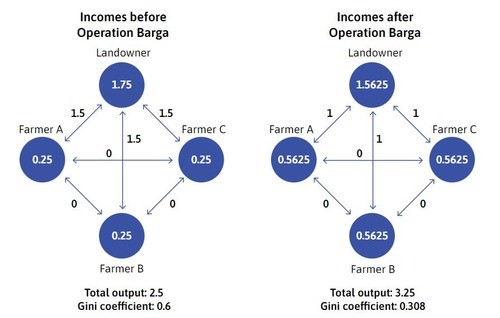
The above image shows how Operation Barga reduced Gini coefficient in WB
Operation Barga (and West Bengal’s land reforms in general) have been criticized for their small scope and inability to solve all the major problems. This criticism has been mainly due to policies not accounting for the high population-to-landmass ratio in Bengal (the highest in the country), the small and highly segregated land holding patterns and failure of the Government to develop agri-industrial markets for farm produce. These failures, critics contend, have distributed poverty rather than creating prosperity.
