



Background
On 22 April, Pakistan based terrorist group “The Resistance Front” (TRF) perpetrated a devastating attack in Pahalgam, India. In this attack 26 innocent tourists were killed in cold blood after segregating them based on their religion. TRF is an offshoot of the well-known Pakistan backed terrorist organisation Lashkar-e-Taiba.
The Response
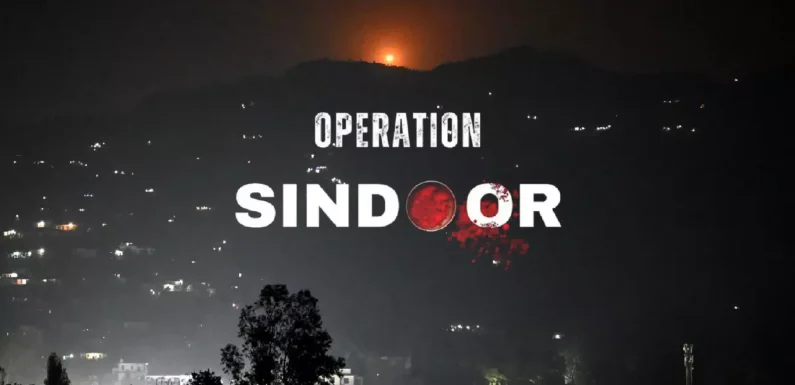
Post the attack, TRF claimed the responsibility for this attack not once but twice within a few hours. Pakistan’s subsequent refusal to acknowledge or curb these terrorists’ networks compelled India to take a responsible but resolute action. In response, on the night of 7–8 May 2025, the Government of India executed “Operation Sindoor,”. The response was non escalatory, precise and targeted terrorist training camps at nine different locations within Pakistan and Pakistan Occupied Kashmir. No military targets were engaged. However, in the early hours of 8 May, Pakistan, in an escalated response launched coordinated drone and missile strikes targeting over a dozen Indian military installations across the Northern and Western theatres, including Srinagar, Jammu, Pathankot, Amritsar, Ludhiana, Bathinda and Bhuj. India’s robust Integrated Counter-drone Grid and layered Air Defence systems intercepted these attacks, recovering debris conclusively traced to Pakistani origin.
Objective and Success
India’s strategic calculus in Operation Sindoor was informed by an unwavering objective: to uphold national sovereignty and protect civilian lives without precipitating a broader military conflagration. By confining military action to terrorist infrastructure, India underscored its non-escalatory posture and respect for established international norms. Pakistan’s reputation as the epicentre of global terrorism is rooted in a number of instances, there are several terrorist attacks around the world where Pakistani fingerprints have been found. Earlier in pursuit of justice for the victims of terrorist attack be it Mumbai in 2008, Pathankot in 2016, Pulwama in 2019 or many others, India provided forensic evidence and urged Pakistan to bring the perpetrators of these attacks to justice. India has also submitted an updated dossier to the UN 1267 Sanctions Committee, documenting Pakistan’s complicity in sheltering and abetting designated terrorist operatives.
Meanwhile, Pakistan’s repeated stone-walling of joint investigative teams despite India’s full cooperation in forensic, call-data and on-site evidence sharing for Mumbai 2008 and Pathankot 2016 probes reveals that its calls for new “joint investigations” are nothing more than delaying tactics. In these circumstances, India has also placed the Indus Water Treaty in abeyance: demographic changes, evolving climate realities and several such factors have led to fundamental changes in the circumstances in which the treaty was concluded. Constant refusal of Pakistan for Government-to-Government negotiations to discuss the modifications is itself a ‘Violation of the Treaty’ and a breach of its spirit of “goodwill and friendship”.
Weapons Used
Indian Air Force (IAF) used advanced systems like SCALP Cruise Missiles, HAMMER Precision-Guided Bombs, and Loitering Munitions also known as “kamikaze drones” to carry out these operations with high accuracy and minimal collateral damage.
Global Implications
Redefining Counter–Terrorism Norms: The operation legitimises conventional military force against sub-conventional terrorist threats, reshaping global counter-terror doctrines.
Erosion of International Mediation Space: India’s assertive stance signals diminishing reliance on third-party mediators, reinforcing its strategic autonomy in regional conflicts.
Doctrinal Influence on Democracies: Other nations grappling with cross-border terrorism may adopt similar proactive military postures, inspired by India’s precedent.
Turbulence in South Asian geopolitics: India-Pakistan relations further deteriorate, reducing the scope for diplomatic dialogue and regional cooperation.
China’s recalibrated strategy: Beijing may either deepen its strategic alignment with Pakistan or reassess its military calculus in the India-China-Pakistan triangle.
Challenges Ahead
Military Escalation Risks: Increased likelihood of Pakistani retaliation or cross-border escalation heightens fears of prolonged conflict or a two-front war with China.
Diplomatic Tightrope: India must balance military assertiveness with global expectations of restraint while maintaining the trust and support of key partners like the US and France.
Evolving Terrorist Threats: Terrorist groups may change tactics by focusing on soft targets, inciting communal unrest, or using asymmetric warfare to undermine internal peace.
Internal Security Vulnerabilities: Increased risk of radicalisation, cross-border infiltration, cyber-attacks, and urban terrorism demands enhanced vigilance and intelligence.
Pakistan’s propaganda leverage: Islamabad may exploit the operation to portray India as the aggressor, consolidate domestic unity, and push a victimhood narrative internationally.
Way Forward
Formally, national doctrine must be formulated outlining India’s response to cross-border terror, eliminating ambiguity and enhancing strategic credibility.
India must own & shape global narrative by presenting her actions as a lawful defence under international norms, particularly Article 51 of the UN Charter.
Upgrading border surveillance, integrating intelligence through fusion centres, and strengthening local policing to pre-empt future threats.
India must sustain global pressure on Pakistan by utilising her growing geopolitical and economic influence through G20, QUAD, SCO, and UNSC engagements.
India must maintain high preparedness for counter-escalation and reinforce deterrence through calibrated force posture and war gaming.
Final Words
Operation Sindoor is a principle-driven military response underpinned by strategic restraint. It was in response to a barbaric terrorist attack on innocent tourists which originated from Pakistan. India had a right to response which it did, in a responsible, restrained, measured and a non-escalatory manner. It marks a pivotal shift in India’s security doctrine—from reactive diplomacy to assertive deterrence—conveying a clear message that terrorism will invite swift retribution and that the responsibility to prevent escalation now rests with the adversary.
