


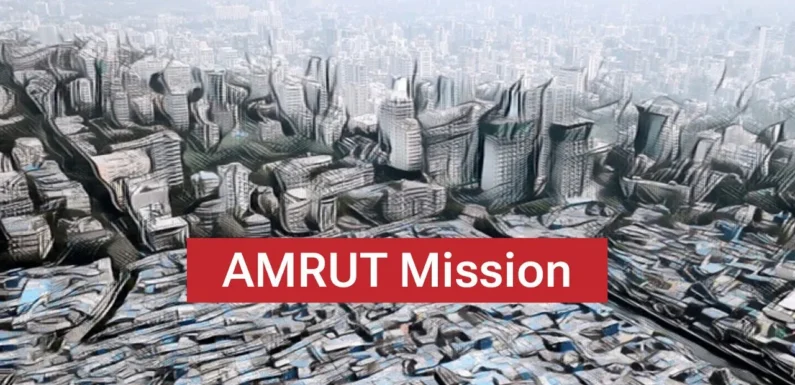
India marks a significant milestone as the Atal Mission for Rejuvenation and Urban Transformation (AMRUT) completes 10 years since its launch on June 25, 2015. Introduced as a transformative initiative to improve the quality of life in urban areas, AMRUT has focused on delivering basic infrastructure and services—especially water supply, sewerage, urban mobility, and green spaces—to citizens across 500 cities and towns and almost 60% of the total urban population of India.
Rajasthan was the first state in the country to submit State Annual Action Plan under (AMRUT). The scheme is dependent with public–private partnership (PPP) model. If required, various other schemes like Swachh Bharat Mission, Housing for All 2022, along with the local state schemes like that related to water supply and sewerage and other infrastructure related schemes can be linked to AMRUT.
Nodal Ministry: Ministry of Housing and Urban Affairs
Scheme Type: Centrally sponsored scheme, funds shared among States and UTs based on urban population and number of towns.
Mission
The purpose of Atal Mission for Rejuvenation and Urban Transformation (AMRUT) is to
- ensure that every household has access to a tap with assured supply of water and a sewerage connection
- (ii) increase the amenity value of cities by developing greenery and well-maintained open spaces (e.g. parks)
- (iii) reduce pollution by switching to public transport or constructing facilities for non-motorized transport (e.g. Walking and cycling).
Implementation
SAAP (State Annual Action Plans) is a consolidated plan of all the city level SLIPs (Service Level Improvement Plan) of all proposed AMRUT cities in the respective states. A formulation on City level SLIP is done based on diligent estimation of ambiguities in the availability of infrastructure like water supply, sewerage network, draining system, transportation facilities, available digital and internet facilities, industrial facilities etc. 135litres per capita per day is another factor in the process including water supply and sewerage connections to all urban households
AMRUT 2.0 was launched on 1 October 2021 for a period of 05 years. Its objectives are universal coverage of water supply from 500 cities to about 4,900 statutory towns in the country and coverage of sewerage/septage management in 500 cities covered in the first phase of the AMRUT scheme.
AMRUT 2.0 aims to promote the circular economy of water through the development of a City Water Balance Plan (CWBP) by recycling/reuse of treated sewage, rejuvenation of water bodies and water conservation.
Important Initiatives so far:
‘AMRUT Mitra’ involved 10,000+ women Self-Help Group (SHG) members.1,762 projects worth ₹147 crore approved. It involves women Self Help Groups (SHGs) in water demand management, water quality testing, water infrastructure operations, and other water sectoral projects. So far, 1762 projects worth ₹140 crore have been approved under this initiative
Drink from Tap (DFT) through 381 projects worth ₹23,490 crore sanctioned, likely to benefit 8 lakh households.3,630 contractors/officials trained.
3,032 water bodies approved for rejuvenation, covering 1.09 lakh acre area.
Capacities of States augmented by training over 90,000 contractors, plant operators, plumbers, women, youth, officials etc.
Challenges:
A NITI Aayog report indicates that around 21 major cities will deplete their groundwater, leaving 40% of India’s population without access to drinking water by 2030.
Nearly 31% of urban Indian households lack piped water while 67.3% are not connected to a piped sewerage system.
Pollution of water bodies: For example, large water bodies like Bellandur Lake (Bengaluru) have become heavily polluted due to industrial effluents and untreated sewage flowing into them.
Unplanned concretization prevents water from percolating into the soil and recharging the water table.
In Bengaluru, the number of lakes has decreased from 262 in 1961 to about 81 currently.
Conclusion
As AMRUT completes a decade, it marks a significant shift in India’s urban development approach, focused on inclusive planning, efficient service delivery, and sustainable growth. By strengthening local bodies and improving core services like water, sanitation, and green spaces, the Mission has laid a strong foundation for future-ready, liveable cities across the country.
Those willing to be a part of my biggest academic project ‘Eklavya Descriptive Bengali English Course’ 2025-26 are requested to send a WhatsApp to 6295350330, the official number of Adhyayan Academy. Before they send their WhatsApp, they are also requested to go through the article below
