



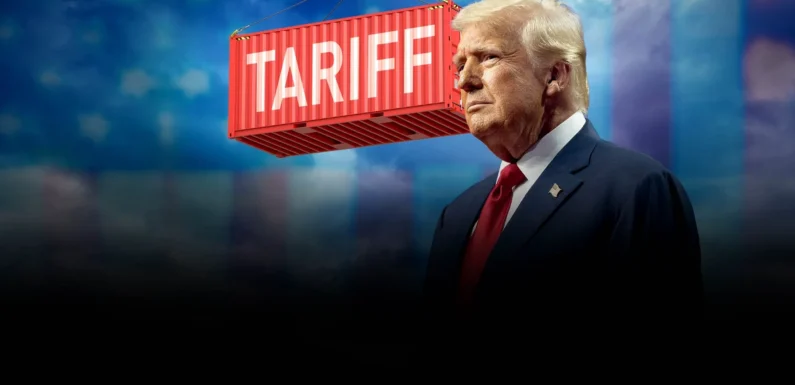
During his second presidency, United States president Donald Trump enacted a series of steep tariffs affecting nearly all goods imported into the United States. From January to April 2025, the average applied US tariff rate rose from 2.5% to an estimated 27 percent the highest level in over a century. After changes and negotiations, the rate was estimated as 18.4% as of July 2025. By July 2025, tariffs represented 5 percent of federal revenue compared to 2% historically.
A tariff or import tax is a duty imposed by a national government, customs territory, or supranational union on imports of goods and is paid by the importer.
Some logics in support of imposing tariff
- Protection of domestic industries
- Protection of environment against dumping of goods. For example- cheap plastic goods from China are indiscriminately dumped in a country like India
- Protection against domestic unemployment issue.
- According to the proponents of imposing tariff, tariffs can help reduce trade deficits, but according to the economists, tariffs do not determine the size of trade deficits and trade balances are driven by consumption. Rather, it is that a strong economy creates rich consumers who in turn create the demand for imports.
On April 24, 2025, U.S. President Donald Trump announced reciprocal tariffs, causing notable economic repercussions globally.
Economic Impact
Commodity and Market Reactions:
Crude oil prices have decreased by nearly 14%, driven by fears of a slowdown in global trade.
Stock markets are experiencing volatility and downturns.
Economic Uncertainty:
The announcement heightens concerns about a full-scale global trade war.
New trade tensions could result in higher inflation and slower economic growth.
Challenges for Policy Making:
Lower-income economies face challenges adapting to the new global order while managing domestic issues.
Tariff on India
Trump announced a 25% tariff on Indian imports, citing India’s tariff and non-tariff barriers and its energy and defence dealings with Russia as key reasons. While details of the additional penalty remain unclear, Trump has previously threatened a 10% extra tariff on BRICS nations, which could raise India’s effective tariff rate to 35%. Additionally, pending U.S. legislation proposes a 500% tariff on India, China, and Brazil for their continued engagements with Russia, adding further uncertainty to India-U.S. trade relations.
The Trump administration has outlined multiple justifications for imposing tariffs on India:
Trade Deficit: The U.S. goods trade deficit with India was $45.7 billion in 2024, representing a 5.4% increase from 2023. This growing imbalance has been a concern for the Trump administration, which views such deficits as evidence of unfair trading relationships.
India’s alleged Non-monetary Trade Barriers: The US considers India’s agricultural subsidies and sanitary and phytosanitary (SPS) measures for food safety as constraints for US exports. These measures, while defended by India as necessary for domestic food security and safety standards, are viewed by Washington as protectionist barriers that limit American agricultural access to Indian markets.
India’s BRICS Membership: The bloc is viewed by the USA as anti-dollar and a challenge to American economic hegemony. India’s participation in BRICS initiatives, including discussions on alternative payment systems and trade mechanisms, has raised concerns in Washington about the long-term implications for dollar dominance in global trade.
India-Russia Relations: An unspecified penalty is to be imposed due to India’s Defence and Energy imports from Russia. The USA in its proposed Russian Sanctions Act, 2025 aims to impose 500% duties on countries that buy oil or other petroleum products from Russia, indicating the severity of measures being considered.
Present Status
The United States stands as India’s largest trading partner, with bilateral trade reaching $131.84 billion in 2024-25. Both countries seek to more than double bilateral trade to $500 billion by 2030 and negotiate a multi-sector BTA (Bilateral Trade Agreement). India’s exports to the US totalled $87 billion, spanning sectors from electronics and pharmaceuticals to textiles and gems. However, this relationship has been characterized by a US goods trade deficit of $45.7 billion in 2024.
Impact on India
While U.S. importers will bear the direct cost of the new tariffs, Indian goods will become less competitive and more expensive in the U.S. market. On a macroeconomic level, the tariffs are expected to reduce India’s GDP growth by 0.2%, lowering forecasts from 6.6% to 6.4%, according to recent research.
However, the real impact will be sector-specific, hitting industries like garments, precious stones, auto parts, leather goods, and possibly electronics. These sectors may face pricing disadvantages compared to competitors from Vietnam, South Korea, and Indonesia, who benefit from lower tariffs.
Way Forward
Navigating this complexity will require diplomacy, strategic flexibility, and a vision from both nations to ensure their relationship remains beneficial despite challenges.
As negotiations continue, the resolution will depend on both countries’ willingness to find common ground between economic interests and geopolitical objectives in a global landscape.
As critics often say, Trump’s megalomania is something not experience by the world leaders since the days of Hitler. Inconsistency has been a hallmark of his maladministration. Often, his policies fail the basic standards of economics. India, in such tumultuous times must maintain composure in every dealing with America. Any knee-jerk reaction may be perilous for future relations with America. Dialogue based on logics and rationality must be the guiding force in dealing with such drastic measures by an egoist like Donald Trump.
Those willing to be a part of my biggest academic project ‘Eklavya Descriptive Bengali English Course’ 2025-26 are requested to send a WhatsApp to 6295350330, the official number of Adhyayan Academy. Before they send their WhatsApp, they are also requested to go through the article below
