


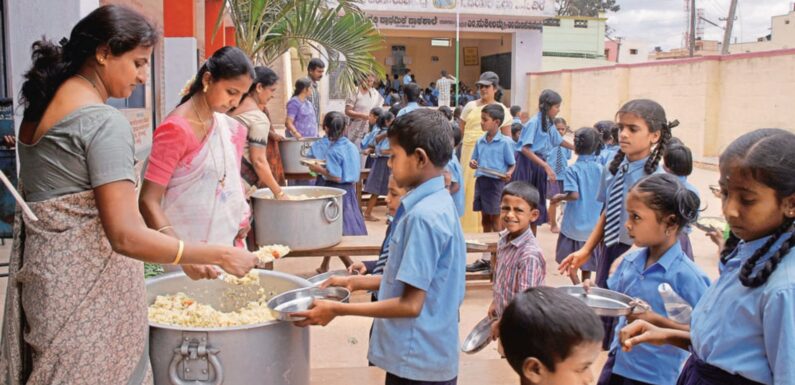
The Mid-Day Meal (MDM) scheme, rooted in India’s pre-independence era, aims to combat classroom hunger and promote universal education by providing nutritious meals to school children. The scheme’s twin objectives are to improve nutritional status and enhance school attendance among economically disadvantaged students.
It was launched in the year 1995. It is the largest school feeding programme of its kind in the world, covering students enrolled in government schools from Classes 1 to 8.
It supplies free lunches on working days for children in primary and upper primary classes in:
- Government, government aided, local body schools
- Education Guarantee Scheme, and alternate innovative education centres
- Madarsa and Maqtabs supported under Sarva Shiksha Abhiyan
- National Child Labour Project schools run by the ministry of labour
The Scheme has a legal backing under the National Food Security Act, 2013.
In 1925, a Mid Day Meal Programme was introduced for disadvantaged children in Madras Municipal Corporation.
By the mid-1980s three States viz. Gujarat, Kerala and Tamil Nadu and the UT of Pondicherry had universalized a same scheme with their own resources for children studying at the primary stage.
In 2001, the Supreme Court asked all state governments to begin this programme in their schools within 6 months.
By 2007, it was made mandatory to provide MDM up to class VIII.
Objectives of Mid-Day Meal Scheme
To increase the enrolment in the schools of the children who belong to disadvantaged sections of the society.
To increase the attendance of the children in government and government-aided schools.
To retain the children studying in class I to VIII.
To give nutritional support to the children studying in the elementary stage, especially in the drought-affected areas.
· To address hunger and malnutrition and improve socialisation among castes.
Features
Every school should have a hygienic cooking infrastructure for hygienically cooked mid-day meals.
The mid-day meals are to be served only on the school premises on all working days of the school.
The headmaster or headmistress is entitled to utilise the school funds on account of mid-day meal fund exhaustion.
Quality items with AGMARK are procured for cooking the mid-day meals in the schools.
Two or three adult members taste the cooked meals from the school management committee.
Food allowance is provided to the children when the cooked meals cannot be provided due to non-availability of food grains, cooking cost, fuel or absence of cook-cum-helper or any other reason, the State Government shall pay Food Security Allowance by 15th of the succeeding month.
Each State/UT has to set up State Steering-cum Monitoring Committees (SSMCs) at the State, District and Block level to oversee the implementation of this scheme, including establishing a mechanism to maintain the quality and nutritional standards of the meals.
This is a Centrally Sponsored Scheme. Hence, the cost is shared between the Centre (60%) and States (40%).
Nodal Ministry – Ministry of Education.
The scheme covers 11.80 crore children across Classes 1 to 8 (age group 6 to 14).
In September 2021, Mid-Day Meal Scheme was renamed as Pradhan Mantri POSHAN Scheme by incorporating changes like mandatory social audit, more community participation, inclusion of locally grown vegetables, increasing field visits etc.
In the Global Hunger Index (GHI) 2024, India’s rank is 105th out of 127 countries, placing it in the “serious” category, according to the report. India’s ranking places it below many neighbouring countries, including China, Nepal, Myanmar, Sri Lanka, and Bangladesh. Effective implementation of the scheme will not only help to reduce increasing drop out rates but also will help in improving India’s global position.
Establishing robust monitoring mechanisms is vital for maintaining the scheme’s integrity. Regular inspections, feedback loops involving parents and communities, and the use of technology can enhance transparency and accountability. When stakeholders actively participate in monitoring, it becomes easier to identify and rectify issues promptly. Continuous evaluation, adaptive strategies, and a collaborative effort among governments, communities, and non-governmental organizations are vital to sustaining and enhancing the scheme’s impact. Besides, incorporating other schemes as done in West Bengal in case of Kanyashree is another way to ensure better implementation of the scheme.
Those willing to be a part of my biggest academic project ‘Eklavya Descriptive Bengali English Course’ 2025-26 are requested to send a WhatsApp to 6295350330, the official number of Adhyayan Academy. Before they send their WhatsApp, they are also requested to go through the article below
