



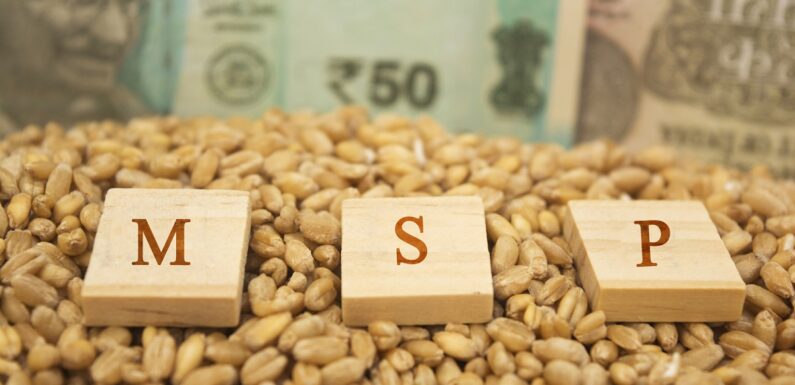
Minimum Support Price (MSP) is a form of market intervention by the Government of India to insure agricultural producers against any sharp fall in farm prices. The minimum support prices are announced by the Government of India at the beginning of the sowing season for certain crops on the basis of the recommendations of the Commission for Agricultural Costs and Prices (CACP). MSP is price fixed by Government of India to protect the producer – farmers – against excessive fall in price during bumper production years. The minimum support prices are a guarantee price for their produce from the Government. The major objectives are to support the farmers from distress sales and to procure food grains for public distribution. In case the market price for the commodity falls below the announced minimum price due to bumper production and glut in the market, government agencies purchase the entire quantity offered by the farmers at the announced minimum price. This concept was introduced in 1966-67 during the Green Revolution as part of agricultural reforms, MSP serves as a safety measure taken by the union government to protect farmers from financial losses and maintain food security. Government fixes minimum support prices (MSPs) for 22 mandated agricultural crops.
Cost of Production: The primary factor includes expenses on seeds, fertilizers, irrigation, and labour. Farmers are assured a minimum margin of 50% over the production cost.
Demand and Supply: The government analyses market trends and consumer demand to determine appropriate pricing.
Market Price Trends: Domestic and international price comparisons ensure that the MSP remains competitive.
Inter-Crop Price Parity: A balanced pricing structure across different crops encourages diversified farming.
Terms of Trade: The government assesses the relationship between agricultural and non-agricultural sectors to maintain fair trade conditions.
Concerns
Limited Coverage: According to the Shanta Kumar Committee’s 2015 report, only 6% of farmers benefit from the MSP. Mainly those in regions with access to procurement infrastructure, such as Punjab and Haryana, while a large number of farmers in other states are left out.
Skewed Crop Focus: The MSP system is focused primarily on a few crops, especially rice and wheat, leading to a lack of incentive for farmers to grow other crops, which affects crop diversification and can contribute to overproduction of these staple crops.
Overburdening Procurement System: The MSP often leads to large-scale government procurement, especially of rice and wheat, causing storage challenges and wastage, and straining the Food Corporation of India’s (FCI) resources.
Environmental Impact: The focus on certain water-intensive crops like rice (supported by MSP) leads to environmental concerns such as groundwater depletion, particularly in regions like Punjab.
Dependence on Middlemen: In some cases, even when MSP is declared, farmers face difficulties in accessing procurement agencies directly, leading to dependence on middlemen who may exploit them by offering lower prices.
Initiatives for Crop Insurance
Crop insurance schemes in India aim to protect farmers from financial losses due to crop failure or damage caused by natural disasters, pests, and diseases. These schemes play a vital role in stabilizing farmers’ incomes and ensuring the sustainability of agriculture.
Key Objectives of Crop Insurance:
Financial Protection: Mitigate losses from crop failure.
Stability in Farm Income: Enable farmers to recover from adverse events and reinvest in agriculture.
Credit Accessibility: Assures banks of repayment, encouraging credit to the agricultural sector.
Encouragement of Modern Practices: Reduce risks associated with adopting new farming techniques.
Though the Government of India has initiated efforts for providing crop insurance to farmers since independence, a major boost was given in the form of the Comprehensive Crop Insurance Scheme (CCIS) in 1985 during the Seventh Five Year Plan period, which covered the risk in the cultivation of major crops against natural calamities and pests and diseases
The National Agricultural Insurance Scheme (NAIS) which is also known as the Rashtriya Krishi Bima Yojana replaced CCIS in 1999–2000. NAIS operates in all States and Union Territories of India. Insurance coverage and financial support to farmers would be given in the event of failure of any of the notified crops as a result of natural calamities, pests and diseases.
NAIS is implemented by the Agriculture Insurance Company of India Ltd (AIC) and the scheme helps the farmers to adopt new and innovative farming practices and scientific modern technology. It is promoted by General Insurance Corporation of India, National Bank of Agriculture and Rural Development (NABARD), United India Insurance Company Limited, National Insurance Company Limited, Oriental Insurance Company Limited and The New India Assurance Company Limited and it is directly controlled by the Ministry of Finance, Government of India.
In India, Pradhan Mantri Fasal Bima Yojana was also launched by the government in 2016 for agricultural insurance in the country. It was set up in line with the One Nation-One Scheme theme.
Pradhan Mantri Fasal Bima Yojana (PMFBY)
Objective: To provide financial support to farmers in case of crop loss due to natural calamities.
Key Features:
Premium rates for farmers:
Kharif crops: 2% of the sum insured.
Rabi crops: 1.5% of the sum insured.
Commercial and horticultural crops: 5% of the sum insured.
The remaining premium is subsidized by the Central and State Governments.
Coverage for pre-sowing to post-harvest losses, including localized calamities (e.g., hailstorms).
Technology Use: Remote sensing, drones, and GPS for faster claim assessment and transparency.
