



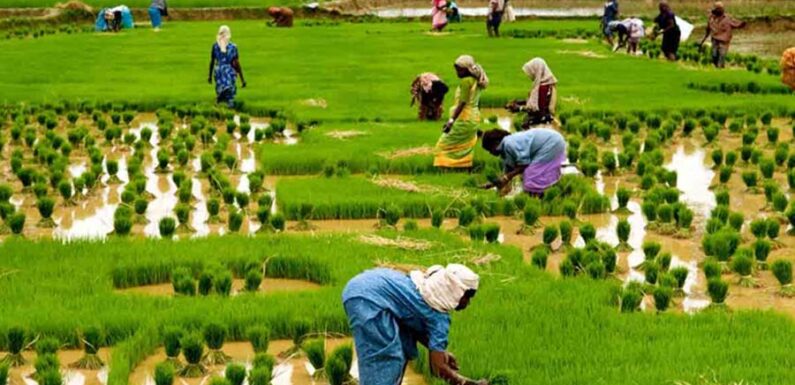
The Green Revolution was a phenomenon that started in the 1960s and saw the transformation of Indian agriculture into a contemporary industrial system through the application of technology, including the employment of high-yielding variety (HYV) seeds, mechanized farm equipment, irrigation systems, pesticides, and fertilizers. This phase was a part of the greater Green Revolution initiative started by Norman E. Borlaug, which used agricultural science and technology to boost agricultural output in the developing world, and was primarily directed by agricultural scientist M. S. Swaminathan in India. It led to Borlaug winning the Nobel Peace Prize in 1970 for his work in developing High Yielding Varieties (HYVs) of wheat. He also became famous as the ‘Father of Green Revolution’ in the world. On the other hand, Swaminathan was known as the ‘Father of Green Revolution in India’. The Bengal Famine, which killed approximately 4 million people in eastern India due to hunger, occurred in 1943 in India, making it the world’s worst recorded food crisis. After independence, India was dependent on other nations for foodgrains.
Green Revolution can be traced back to Dr. Norman Borlaug’s discovery of a new dwarf variety of wheat seed.
Impacts
• Tens of millions more tonnes of grain are being harvested annually as a result of the high-yield variety seeds.
• In 1978–1979, the Green Revolution led to a record grain output of 131 million tonnes.
• India was now recognized as one of the top agricultural producers in the world.
• Between 1947 and 1979, the yield per unit of agricultural land increased by more than 30%.
• By building connected facilities like factories and hydroelectric power plants, the Green Revolution also generated a large number of jobs for industrial employees as well as agricultural labourers.
Negative Impacts
• India has not succeeded in implementing the idea of high-yield variety seeds across all crops or geographical areas.
• In terms of crops, it mostly focused on food grains and excluded other types of agricultural products.
• Only the states of Punjab and Haryana demonstrated the finest Green Revolution outcomes regionally.
• Environmentalists and others have studied the long-term repercussions of the green revolution and claim that it exacerbated sociological, economic, and environmental issues like farmer suicides, rural indebtedness, and droughts.
• According to reports, the usage of pesticides has deteriorated the soil, which has caused many agricultural systems to fail across the nation, harming the farmers’ livelihoods as well as the food and water supplies.
• The disparity in farmer income increased inter-personal as well as inter-regional disparities/inequalities in India.
• A rise in the incidence of malaria as a result of waterlogging, a shift in balanced cropping patterns in favour of wheat and rice, pushing pulses, oilseeds, maize, and barley to the margins, and other negative effects.
• High Farm Input Costs -Farm inputs include fertiliser, insecticides, pesticides, HYV seeds, farm labour costs, and so on. Such an increase disadvantages small and medium-sized farmers.
• Groundwater Depletion- It is another negative consequence of the green revolution. The majority of irrigation in dry areas of Punjab, Haryana, and Western Uttar Pradesh was done with excessive use of groundwater. Today’s fresh groundwater situation in these states is concerning.
• Farmers Suicides- Suicides among farmers appear to be concentrated in areas with high commercialization of Indian agriculture and high peasant debt. Farmers growing cash crops appeared to be far more vulnerable than those growing food crops. The decline began with the commercialization of the countryside and a massive drop in agricultural investment. The privatisation of many resources has exacerbated the situation.
Overall, the Green Revolution was a major achievement for many developing countries, especially India and gave them an unprecedented level of national food security.
It represented the successful adaptation and transfer of the same scientific revolution in agriculture that the industrial countries had already appropriated for themselves.
However, lesser heed was paid to factors other than ensuring food security such as environment, the poor farmers and their education about the know-how of such chemicals.
As a way forward, the policymakers must target the poor more precisely to ensure that they receive greater direct benefits from new technologies and those technologies will also need to be more environmentally sustainable.
Also, taking lessons from the past, it must be ensured that such initiatives include all of the beneficiaries covering all the regions rather than sticking to a limited field.
While we’ve had one green revolution already, in the words of Dr Swaminathan, today we need an “evergreen revolution” — one that combines science with ecology.
Green Revolution 2.0 has to be about varieties that can withstand extreme temperature and rainfall variations, while yielding more, using less water and nutrients accompanied by better crop planning, sustainable development ideas and market intelligence.
