

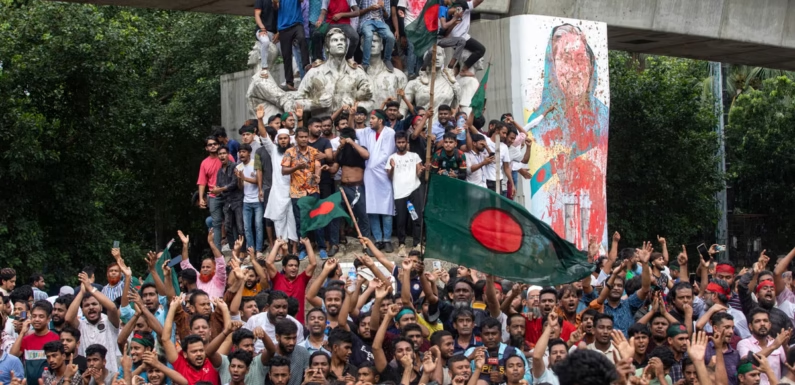
The July Revolution, also known as the July Mass Uprising or the Student-People’s Uprising was a pro-democracy mass uprising in Bangladesh in 2024. It began as a quota reform movement in early June 2024, led by the Students Against Discrimination, after the Bangladesh Supreme Court invalidated the government’s 2018 circular regarding job quotas in the public sector. By early August, the movement evolved into a non-cooperation movement. On 4 August, thousands of protesters convened at Dhaka’s Shahbag intersection in the morning, obstructing it as a form of civil disobedience to demand the resignation of the government. This was followed by hundreds of casualties. The following day, the protesters called for the Long March to Dhaka in defiance of a nationwide curfew to press Sheikh Hasina to resign. The long march of crowded people to Ganabhaban forced her to resign. She, along with her sister Sheikh Rehana, then fled the country to India via military on 5 August 2024. Hasina’s ouster triggered a constitutional crisis, leading to the formation of an interim government led by the country’s only Nobel laureate, Muhammad Yunus, as the chief adviser.
By early August 2024, the unrest resulted in a significant death toll. Initial official reports claimed 215 deaths, but a United Nations investigation later confirmed that at least 650 people were killed. In August, the Interim Government’s Health and Welfare Adviser, Nurjahan Begum, reported that over 1,000 individuals had been killed in the uprising and more than 400 students had lost their eyesight. Additionally, more than 20,000 were injured, and over 11,000 were arrested nationwide. Among the deceased were at least 32 children, according to UNICEF. In January 2025, the interim government of Bangladesh published a gazette containing the initial finalized list of 834 recorded deaths. However, the actual number of casualties may be higher due to restrictions imposed by the previous government, which included barring hospitals from sharing data, confiscating CCTV footage, and burying some victims without proper identification. There were visuals of Indians especially the Hindus were being tortured, temples were being demolished and the statues of the founding father of Bangladesh being destroyed all over the country.
On 12 February 2025, the United Nations Office of the High Commissioner for Human Rights published a thorough report on the events that took place from 1 July to 5 August 2024, which suggested a death toll of 1,400.
Triggered by the reinstatement of a quota system for allocation of civil service positions, initially peaceful student protests in Bangladesh that started in mid-June 2024 were followed by violence and serious human rights violations committed by security forces. Hundreds of people were killed, including at least 32 children, and thousands injured. There are strong indications, warranting further independent investigation, that the security forces used unnecessary and disproportionate force in their response to the situation. Alleged violations included extrajudicial killings, arbitrary arrests and detention, enforced disappearances, torture and ill-treatment, and severe restrictions on exercise of freedoms of expression and peaceful assembly.
Bangladesh introduced a Reservation Policy in 1972. Till 1976, 80 per cent of Government jobs fell under the Reserve category and only 20 per cent of jobs were to be filled on the basis of merit. 30 per cent was reserved for freedom fighters, 10 per cent for war-affected women, and, 40 per cent for the backward districts.
In 1976, the quotas were decreased from 80 per cent to 60 per cent. In 1982, the quotas were reduced to 55 per cent, with three changes. One, the 10 per cent quota for women was thrown open to all women, not just war-affected women. Two, the quota for backward districts was further reduced from 20 per cent to 10 per cent. And, three, a new five per cent quota was introduced for indigenous communities. In 1997, the children of freedom fighters became eligible for the reservation. And, in 2010, it was extended to include grandchildren of freedom fighters.
In 2012, the quotas were increased to 56 per cent by giving a one per cent quota to persons with disabilities. Protests against Bangladesh quota policy were not new. Anti-quota protests took place six years ago. Then, like now, the protests began at Shahbagh in Dhaka, before spreading to other parts of the country.
In January 2018, a petition was filed in the Dhaka High Court seeking re-evaluation of quota policy. In March that year, Dhaka High Court rejected the petition. Protests broke out in April. In October of 2018, the Government abolished the quota for freedom fighters’ families.
On 5 June 2024, the Dhaka High Court ruled that the 2018 Government decision to abolish the quota was illegal, and, re-instated the quota. Subsequently, the Government moved the country’s top court against the High Court ruling. On 1 July, protests broke out. On 4 July, the Bangladesh Supreme Court upholds the High Court ruling. On 11 July, the Supreme Court suspended the High Court ruling, pending a hearing on the Government’s appeal on 7 August.
A combative Bangladesh Prime Minister Sheikh Hasina tried to suppress the movement and initially launched verbal attacks against those who were protesting and called them ‘Razakars’. Razakar is a Persian word meaning volunteer. But, in Bangladesh, it is a pejorative term that stands for traitor. It is used for those accused of collaborating with Pakistan’s Army in 1971 to betray the country. The Razakar was a paramilitary force created by Pakistan to commit war crimes, including massacring civilians, looting, and, rape. The Bangladesh Government brands all collaborators of the Pakistani forces as Razakar.
The Dhaka High Court said: “The freedom fighters are pride of our nation. Thus, we are of the view that during the period of August 15, 1975, to 1996, the freedom fighters, their children and grandchildren have been suffering socially, economically and politically, which makes them one of the most backward sections of the citizen of this country”.
There were compelling arguments to be made against quotas, too. For one, protesters argued that a problem arises when freedom fighters’ quota-holders use it multiple times: First at the time of university admission and later when applying for coveted government jobs. And, two, Bangladesh is facing high youth unemployment. That, coupled with stagnant job-growth in private sector makes a government job with a regular source of income that much more desirable to youths.
Post-Hasina, India lacks deep institutional links with the interim government and broader political spectrum. India’s decision to host Sheikh Hasina in exile has been perceived in Bangladesh as political interference, further exacerbating tensions. Bangladesh is a key partner in China’s Belt and Road Initiative (BRI) and receives significant Chinese investments in infrastructure projects such as ports, roads, energy, telecom, and the Teesta River Restoration. Illegal immigration from Bangladesh continues to strain India’s northeastern states, causing socio-economic and political tensions. The Rohingya refugee crisis has further complicated the issue.
Bangladesh is India’s largest trade partner in South Asia, while India is its second-largest trade partner in Asia. In FY 2023-24, the total bilateral trade stood at USD 12.9 billion.
India’s exports to Bangladesh stood at USD 11.06 billion and India’s imports from Bangladesh were at USD 1.8 billion.
Persistent issues of cross-border terrorism, insurgency support, and trafficking remain with Insurgent groups like United Liberation Front of Asom have reportedly operated camps in Border regions.
Despite economic ties, public perception has soured due to perceived Indian interference in Bangladesh’s internal politics. On the other hand, hatred towards India is not new in Bangladesh. Bangladesh’s mostly uneducated young generation is continually taught by the fundamentalists there to harbour hatred against India in the name of religion. India’s role and Indira Gandhi’s role in the independence of Bangladesh from the clutches of the Pakistan are continually undermined by the heretics there. Coupled with the notorious allies like Pakistan and China, Bangladesh is a constant source of concern for India even though as a nation it has reached the unfathomable bottom of moral, intellectual and existential degradation.
Prime Minister Narendra Modi met with Bangladesh’s Chief Adviser Muhammad Yunus in Bangkok on the sidelines of the BIMSTEC (Bay of Bengal Multi-Sectoral Technical and Economic Cooperation) Summit. This marks their first official interaction since the ouster of former Prime Minister Sheikh Hasina. This opens new vistas for relationship between the two nations. However, India must work on her diplomatic, commercial, cultural and historical leverage on the neighbour. Protection of the Indians irrespective of their religions in Bangladesh must be a priority of the Government. China’s influence on the tiny, inefficient nation must be met with a counter policy of assistance on the basis of loyalty. The water treaty, trade leverages, linguistic proximity, far superior military and intellectual prowess -everything must be rationally, judicially and diplomatically used to make the relation work in favour of India.
