

1971 3–16 December Third war with Pakistan, culminating in the creation of Bangladesh
Himachal Pradesh becomes the 18th Indian state
A cyclone in the Bay of Bengal, in Orissa State in India, kills 10,000.
16 December – Victory Day of Bangladesh: The Pakistan Army surrenders to the Joint Force i.e. Mukti Bahini (Freedom Force) and the Indian Armed Forces, officially ending the Bangladesh Liberation War and creating the new nation state of Bangladesh.
24th Constitutional amendment act:
Affirmed the power of Parliament to amend any part of the constitution including Fundamental Rights.
India defeated West Indies in Port of Spain Trinidad for the first time ever to clinch the rubber 1-0. Sunil Gavaskar creates world record for scoring 774 runs in four tests. Ajit Wadekar was the captain.
India defeated England in the third and the final Test at the Oval. This happens to be India’s first victory ever on the English soil.
Contempt of Courts Act, 1971
North-Eastern Council Act, 1971
North-Eastern Areas (Reorganisation) Act, 1971
Twenty-year treaty of friendship signed with Soviet Union.
1972 Manipur, Tripura and Meghalaya get statehood.
Japan Air Lines Flight 471 crashed at Palam, Delhi killing 82 of the 87 on board.
India and Bangladesh sign a friendship treaty, after the withdrawal of the Indian troops.
Following Pakistan’s surrender to India in the Indo-Pakistani War of 1971, both nations sign the historic bilateral Simla Agreement, agreeing to settle their disputes peacefully.
Expulsion of Indians from Uganda under Idi Amin regime
M. G. Ramachandran, forms the All-India Anna Dravida Munnetra Kazhagam by splitting from Dravida Munnetra Kazhagam starting a new phase in Dravidian movement
Jharkhand Mukti Morcha was formed for independent statehood of Jharkhand from Bihar on birthday of Birsa Munda
Armed Forces (Assam and Manipur) Special Powers (Amendment) Act amended to include new states and union territories of Northeast India.
Supreme Court of India began hearing of Kesavananda Bharati v. State of Kerala case
Wild Life (Protection) Act, 1972 enacted.
Postal Index Number (PIN Code) introduced in India.
India won Bronze in Hockey in Olympics. India’s only medal in that edition.
1973 P. V. Narasimha Rao resigns as Chief minister of Andhra Pradesh following the resignation of ministers from Coastal Andhra post the 1972 Jai Andhra movement.
Verdict of Kesavananda Bharati v. State of Kerala pronounced. Supreme Court of India upholds basic structure doctrine
Project Tiger launched
Finance Minister Yashwantrao B. Chavan presented a budget with a large deficit, leading to it being called the “Black Budget”.
State of Mysore is renamed Karnataka State.
Chipko movement in Garhwal division
Indira Gandhi inaugurates world’s first Women Police Station in the world at Kozhikode
Bharatiya Jana Sangh leader Atal Bihari Vajpayee and two other leaders drove a Bullock cart to the Parliament of India on the first day of winter session to protest against fuel price hike in India following the oil crisis.
Foreign Exchange Regulation Act was passed.
Code of Criminal Procedure (CrPC) was enacted
1974 18 May the Smiling Buddha is the first nuclear device in underground test.
Bihar Movement started as a movement by students in Bihar led by the veteran Gandhian socialist Jayaprakash Narayan, against misrule and corruption in the Government of Bihar.
smallpox epidemic in East India
A railway strike started by 1.7 million workers of Indian Railways. The strike lasted for 20 days till 27 May 1974 and was the largest recorded industrial action in the world.
Sirima–Gandhi Pact signed to solve the statelessness of Sri Lankan Tamils
India played the first ever ODI. Opposition- England. Played in England.
Coal Mines (Nationalisation) Act, 1973
Thirty-fourth Amendment:
This amendment primarily focused on land reforms and included revised ceiling laws in the Ninth Schedule of the Constitution.
Thirty-fifth Amendment:
This amendment related to the status of Sikkim, granting it the status of an “Associate State” of India.
1975 15 May Sikkim becomes part of Indian Union after a referendum in the Sikkim Assembly.
Satyajit Ray’s documentary Sikkim banned.
Indira Gandhi became the first Prime Minister of India to testify in a court. She appeared before Allahabad High Court in State of Uttar Pradesh v. Raj Narain case
The first Indian satellite, Aryabhata, goes into Earth’s orbit.
Farakka Barrage across Ganges commissioned in West Bengal.
Justice Jagmohanlal Sinha declared PM Indira Gandhi’s election to parliament from Rae Bareli (Lok Sabha constituency) in 1971 Indian general election null and void.
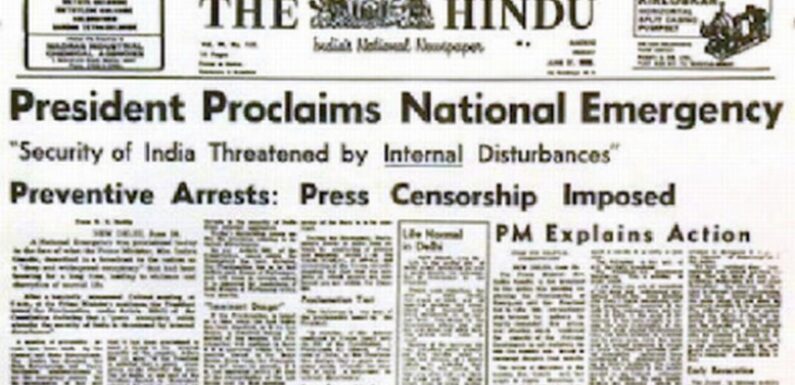
A state of emergency is declared by Prime Minister Indira Gandhi during which the press is censored and 100,000 are jailed.
Kerala Legislative Assembly passed the Kerala Scheduled Tribes (Restriction on Transfer of Lands and Restoration of Alienated Lands) Act, 1975, for restoring land rights to tribals
India’s pathetic performance in 1975 World Cup Cricket. Only victory against East Africa.
Sarvepalli Radhakrishnan, philosopher and statesman, first Vice President of India and second President of India died.
1976 The Rajan case, an infamous case of Police brutality during the Emergency Period. The victim, P. Rajan, a final year Engineering student at Regional Engineering College, Calicut was arrested by police, taken to Kakkayam and allegedly tortured severely which led to his death. It is believed that his body was thrown into the Kakkayam Dam.
A family planning initiative involves the vasectomy of thousands of men and tubal ligation of women, either for payment or under coercive conditions. (The minimum age for marriage is also raised to 21 years for men and 18 years for women.) The son of then-Prime Minister Indira Gandhi, Sanjay Gandhi, is largely blamed for what turned out to be a failed program.
The 42nd amendment Act, 1976, was enacted during the Emergency by the Indian National Congress government headed by Indira Gandhi, changing “Sovereign Democratic Republic” to “Sovereign Socialist Secular Democratic Republic” and modifying “unity of the Nation” to “unity and integrity of the Nation”.
The Regional Rural Banks Act, 1976:
This act established Regional Rural Banks to provide credit and other facilities to small and marginal farmers, agricultural laborers, and artisans in rural areas
India competed at the 1976 Summer Olympics in Montreal, Quebec, Canada and won no medal. This was the first Olympics since 1928 in which the Indian Men’s hockey team did not win an Olympic Medal.
Death of singer Mukesh.
The Indian cricket team defeated the West Indies in a test match at Port of Spain, successfully chasing a then-record target of 403 runs.
Mother Teresa was nominated for the Nobel Peace Prize.
An Indian Airlines Boeing 737 was hijacked to Lahore.
1977 Prime Minister Indira Gandhi, via a radio broadcast, announced that the Lok Sabha would be dissolved and fresh elections would be held in March.
Indira Gandhi’s Congress Party loses general elections. Janata Party comes to power. The Communist Party of India (Marxist) comes into power in West Bengal.
The first non-Congress government sweeps to power following Indira Gandhi’s defeat at the general elections. Morarji Desai becomes prime minister.
M. G. Ramachandran sworn in as Chief Minister of Tamil Nadu. He became the first film actor to be the Chief Minister of an Indian state.
More than 10,000 people die when the 1977 Andhra Pradesh cyclone hits India’s southeast coast. The storm disrupts life for 5.4 million people in 830 villages, and damages 14,000 km2 of cropland.
Emergency was withdrawn in March.
1978 Air India Flight 855, a Boeing 747 passenger jet, crashes into the Arabian Sea after taking off shortly near Bombay, killing all 213 on board.
Morarji Desai led government demonetizes high denomination banknotes
Indira Gandhi is re-elected to the Indian parliament
Indira Gandhi is arrested and jailed for a week for breach of privilege and contempt of parliament.
Operation Barga was a land reform initiative launched in West Bengal, India, in 1978.
The 44th Amendment of the Indian Constitution, enacted in 1978, primarily aimed to address the excesses of the Emergency period (1975-1977) and restore some of the fundamental rights that had been curtailed. It made significant changes to the constitution, including removing ‘Right to Property’ from the list of fundamental rights and making it a legal right. It also introduced safeguards regarding the declaration of national emergencies and strengthened the powers of the judiciary.
India won 15 medals at the Commonwealth Games.
Air Chief Marshal Idris Hassan Latif: He became the first Muslim Chief of Air Staff of the Indian Air Force.
The Janata Party’s internal strife created an opening for Indira Gandhi’s political comeback.
Launch of District Industrial Centre by Minister of Industries George Fernandes
1979 President of India makes official the decision to set up the Mandal Commission
The police under direction of Jyoti Basu, Chief Minister of Communist Party of India (Marxist) -led government of West Bengal, surrounds and opens fire on unarmed refugee settlement of Morichjhapi island in Sunderbans, West Bengal. (Marichjhapi massacre)
The Janata Party splits. Chaudhary Charan Singh becomes Prime Minister.
Charan Singh of Bharatiya Lok Dal, coalition partner of Janata Party became Prime Minister of India with outside support of Congress (I).
C. H. Mohammed Koya sworn in as Chief minister of Kerala. He is the first Muslim League leader to become Chief Minister of an Indian state.
Morvi dam burst, the worst flood disaster in independent India, happens in Gujarat, killing 15000 people
Mother Teresa was awarded Nobel Peace Prize at Oslo
TRYSEM scheme launched.
Dhyan Chand, legendary field hockey player died
Jay Prakash Narayan died.
