

The EVM was designed by a team led by A.G. Rao and Ravi Poovaiah, professors at IIT Bombay. The system was developed for the Election Commission of India by state-owned Electronics Corporation of India (ECIL) and Bharat Electronics Ltd (BEL). Starting in the late 1990s, they were introduced in Indian elections in a phased manner.
The EVMs were first trialled in May 1982 in the by-election to Paravur assembly constituency in Kerala in a limited number of polling stations.
In 1998, the machines were used on an experimental basis across 25 state assembly constituencies during the assembly elections in Rajasthan, Madhya Pradesh and Delhi.
In May 2001, EVMs were used in all constituencies for the state assembly elections in Tamil Nadu, Kerala, Puducherry and West Bengal. In 2004, in the General Election, the EVMs were used in all 543 Parliamentary Constituencies for the first time. Since the time, all state assembly and parliamentary elections are held using the EVMs.
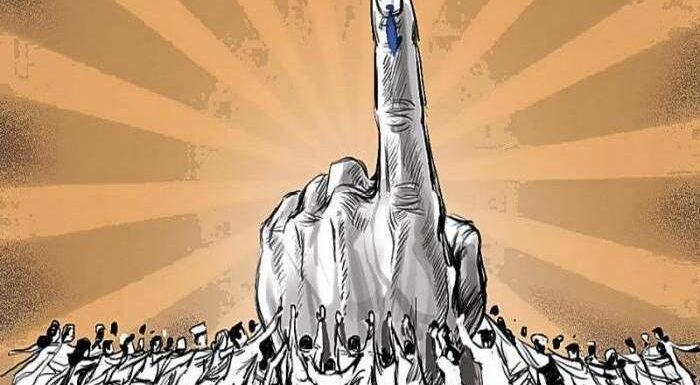
Speaking about innovative solutions, the photosensitive indelible ink was developed to mark the fingers of those who cast their vote, to prevent electoral fraud like double voting. To this day, the special formula to create this ink has not been made public. Research into indelible ink was commenced by the Council of Scientific and Industrial Research (CSIR). In the 1950s, M. L. Goel worked on this research at the Chemical Division of the National Physical Laboratory of India. The ink used contains silver nitrate, which makes it photo-sensitive.
Chaudhary Charan Singh was the only PM of India who did not face the parliament.
Morarji Desai was the oldest PM of India at the time of taking oath (84 years) and he was the first PM to resign. He ws also the first non-Congress PM of India.
BR Ambedkar was defeated in the 1951 LS Election.
Bhairon Singh Shekhawat was the first Vice-President to resign. Jagdeep Dhankhar was the second.
VP Singh was the first PM to step down after facing no confidence motion.
The only person who worked twice as the Acting Prime Minister for 13 days each – Gulzarilal Nanda.
The original name of Lal Bahadur Shastri was Lal Bahadur Varma. He got the surname Shastri (Scholar) after passing out from Kashi Vidyapeeth in Varanasi.
Indira Gandhi was the first person who belonged to Rajya Sabha during nomination as Prime Minister.
Rajiv Gandhi was Pilot by profession. He was the youngest ever Prime Minister of India. He was sworn in as Prime Minister the same day when Indira Gandhi was assassinated.
P V Narsimha Rao was the first Prime Minister from non-Hindi belt (South India).
P V Narsimha Rao was the only PM who was multilinguist and knew and speak 14 languages – Marathi, Hindi, Oriya, Bengali, Gujrati, Tamil, Urdu, English, French, Arabic, Spanish, German and Parsian apart from mother tongue Telugu.
First visually impaired person to become member of parliament – Sadhan Gupta. He belonged to CPI(M) from West Bengal.
The Delimitation Commission, set up under the Delimitation Act, 2002, was entrusted with the task of readjusting all parliamentary and assembly constituencies in the country in all the states of India, except the state of Jammu and Kashmir, based on population ascertained in 2001 Census.
Atal Bihari Vajpayee was the first parliamentarian to give a speech in Hindi to the United Nations General Assembly.
Between 1952 and 2020, two seats were reserved in the Lok Sabha for members of the Anglo-Indian community. They were nominated by the President of India on the advice of the Government of India. In 2020, it was abolished under the 104th Constitutional Amendment Act, 2019.
Lok Sabha constituency in India in terms of number of electors.
Largest: Malkajgiri
State/UT: Telangana
Smallest: Lakshadweep
State/UT: Lakshadweep
Lok Sabha constituency in India in terms of area.
Largest: Ladakh
Smallest: Chandni Chowk
Parliament Library is the second largest library in India after National Library of Belvedere Estate, Kolkata. Parliament library was founded in year 1921.
The old Parliament building was designed by Edwin Lutyens and Herbert Baker and was inaugurated by Lord Irvin, the then Governor General of India in 1927.
Narendra Modi was born in the year India became a Republic, 1950.
in 1980, Dr Prannoy Roy and Ashok Lahiri conducted the first exit poll for India Today magazine, which they repeated during the 1984 election. In 1996, an exit poll was conducted by Doordarshan, by journalist Nalini Singh, with the fieldwork and data gathering carried out by Centre for the Study of Developing Societies (CSDS).
The first IAS officer to become a Member of Parliament (MP) was Yashwant Sinha. He served as an IAS officer before resigning to enter politics and later became an MP. He served as the Minister of Finance from 1990 to 1991 and again from 1998 to 2002, and also as the Minister of External Affairs from 2002 to 2004.
In November 2013, NOTA was introduced in five state elections. Even if the number of electors opting for the NOTA option is more than the number of votes polled by any of the candidates, the candidate who secures the largest number of votes has to be declared elected.
Postal voting in India is done only through the “Electronically Transmitted Postal Ballot Papers (ETPB)” system of the Election Commission of India, where ballot papers are distributed to the registered eligible voters, and they return the votes by post. When the counting of votes commences, these postal votes are counted before those from the Electronic Voting Machines.
During the first election, India’s population was 36 Crore out of which 17.3 crore had the right to vote and the voter turnout was 45.7%
There were 489 seats in the first LS Election. The number of constituencies was increased to 543 in 1977.
The Indian Constitution’s 61st Amendment lowered the age of majority from 21 to 18 for voting in the Lok Sabha and Legislative Assemblies. The Constitution (61st Amendment) Act, 1988, amended Article 326 of the Indian Constitution.
n the 2014 general election, VVPAT was operational in 8 constituencies (Lucknow, Gandhinagar, Bangalore South, Chennai Central, Jadavpur, Raipur, Patna Sahib and Mizoram) as a pilot project.
The last election in India cost around Rs 1 Lakh crore in comparison to a meagre Rs 38 Crore in the first election in 1951.
