

2000 US President Bill Clinton makes a groundbreaking visit to improve ties.
India marks the birth of its billionth citizen.
Miss India Lara Dutta crowned Miss Universe 2000 in Cyprus.
Pen Power, an Encyclopedia of published letters to the editors from some 200 letter writers was released by M.V.Kamath, Chairperson of Prasar Bharati. The veteran journalist declares that Pen-Power should be prescribed as a text book in all Journalism colleges.
Rajesh Pilot, a senior member of the opposition Congress party, dies in a car crash.
More than 50 people are killed when a Boeing 737 passenger plane crashes in a residential area of Patna.
The government announces the launch of a National Population Stabilization Fund to help promote family planning programs in the country
Nanoor massacre by Communist Party of India (Marxist) workers in West Bengal.
Thousands of women demonstrate in New Delhi in support of the government’s proposed “reservations bill” which will guarantee women one-third of all parliamentary seats
1 November – Chhattisgarh, carved out of Madhya Pradesh, becomes India’s 26th state.
6 November – Buddhadeb Bhattacharjee was sworn in as the new chief minister of West Bengal following the retirement of Jyoti Basu, the world’s longest-serving elected communist leader.
9 November – Uttaranchal, now known as Uttarakhand, carved out of Uttar Pradesh, becomes India’s 27th state.
15 November – Jharkhand, carved out of Bihar, becomes India’s 28th state.
Miss India first runner-up Priyanka Chopra wins the Miss World 2000 title.
The Information Technology Act 2000 comes into force
In 2000 Olympics, the country’s only medal was a bronze won by Karnam Malleswari in the women’s 69 kg weightlifting event. It was the first Olympic medal won by an Indian woman.
21st century
2001 1 January – Calcutta officially becomes Kolkata, reverting to its precolonial name.
Gujarat earthquake shakes Western India with a maximum Mercalli intensity of X (Extreme), leaving 13,805–20,023 dead and about 166,800 injured.
JULY- Vajpayee meets Pakistani President Pervez Musharraf in the first summit between the two neighbours in more than two years. The meeting ends without a breakthrough or even a joint statement because of differences over Kashmir.
More than 100 million people – almost 2% of the world’s population – attend the Maha Kumbh Mela festival in Allahabad, making it the largest gathering of human beings in history.
As per 2001 Census of India, India becomes the second nation in the world to register one billion people in its population. The first was China in 1979
Tehelka Sting operation. Disgrace for Defence Minister George Fernandez and BJP leader Bangaru Laxman
The famous Eden test victory by India
The country’s first ever private FM radio station – Radio City – is launched in Bangalore.
Famed Bandit Queen turned M.P. Phoolan Devi is assassinated by masked gunman at the gate of her New Delhi residence at the age of 37.
Madhavrao Scindia dies.
Keshubhai Patel resigns his position as chief minister of Gujarat following the poor showing of his BJP in elections there. He is replaced by the BJP’s general secretary, Narendra Modi.
Sikkim becomes the first state in India to launch online lottery, Playwin.
The Energy Conservation Act, 2001
Deaths- RK Narayanan (Novelist), Sivaji Ganesan, Ashok Kumar, Harshad Mehta
Attack on Parliament
2002 Direct flights to China are set to resume for the first time in 40 years after diplomatic talks between the two countries.
One of the worst violence unleashed against Muslims after 59 Hindu pilgrims killed aboard a fire in a train allegedly started by a local Muslim mob in Godhra.
Dr. Avul Pakir Jainulabdeen Abdul Kalam , India’s Missile Man became President.
2002 Gujarat violence: Three day violence against Muslim community in the city of Ahmedabad, Gujarat and surroundings begins leaving over 500 dead. The violence came after the death the previous day of 58 who died in Godhra, near Vadodara (the exact circumstances remain unclear).
Gulbarg Society massacre: During the 2002 Gujarat riots, a mob attacked the Gulbarag Society, a lower-middle-class neighborhood in Chamanpura, Ahmedabad. Most of the houses were burnt, and at least 35 victims including a former Congress Member of Parliament Ehsan Jafri, were burnt alive, while 31 others went missing after the incident, later presumed dead, bringing the total of the dead to 69.
Bilkis Bano case
The Delimitation Commission, set up under the Delimitation Act, 2002, was entrusted with the task of readjusting all parliamentary and assembly constituencies in the country in all the states of India, except the state of Jammu and Kashmir, based on population ascertained in 2001 Census.
President’s rule is imposed on the northern state of Uttar Pradesh as no party could command a majority after the recent elections.
Vice President Krishan Kant dies of a heart attack.
Russian President Vladimir Putin visits India
Dhirubhai Ambani dies
2003 PM Vajpayee is in China. India concedes that Tibet is an integral part of China. China agrees to recognise Sikkim’s accession to India
The first Pravasi Bharatiya Divas (PBD) was celebrated in 2003
Prime Minister Vajpayee announced India’s first lunar mission, Chandrayaan-1, during his Independence Day address.
Kalpana Chawla, Indian-American Astronaut and first Indian woman to go to space dies in Space Shuttle Columbia disaster.
India put up a great show at the ICC Cricket World Cup in South Africa after poor performances in the past and go on to the Finals. They were defeated by Australia in the Finals.
Anju Bobby George won a bronze medal in the women’s long jump at the World Athletics Championships, becoming the first Indian to achieve this feat
2004 Groundbreaking meeting is held between government and moderate Kashmir separatists.
Surprise victory for Congress Party in general elections. Manmohan Singh is sworn in as prime minister.
India, along with Brazil, Germany and Japan, launches an application for a permanent seat on the UN Security Council.
India begins to withdraw some of its troops from Kashmir.
Thousands are killed when tsunami, caused by the 2004 Indian Ocean earthquake off the Indonesian coast, devastate coastal communities in the south and in the Andaman and Nicobar Islands.
Karnataka khadi gramodyoga samyukta sangha (kkgss) becomes the official flag maker of India.
Bandit Veerappan Killed by Tamil Nadu and Karnataka Special Task Force members
2005 The National Consumer Disputes Redressal Commission in a landmark judgement rule that hospitals are duty bound to accept accident victims, that patients in critical condition and that doctors cannot first demand fees before agreeing to treat the patient and that a relative’s consent is not necessary if there is no family member present at the time.
The Right to Information Act, which grants citizens the right to access government records, came into force, marking a significant step towards transparency and accountability in governance.
A major oil-for-food scandal involving former External Affairs Minister Natwar Singh and others came to light, shaking the political landscape.
The year 2005 was also designated as the International Year of Microcredit by the United Nations.
Disaster Management Act, 2005: This act established a framework for effective disaster management in India, including the creation of the National Disaster Management Authority.
Protection of Women from Domestic Violence Act, 2005
State Emblem of India (Prohibition of Improper Use) Act, 2005
The Mahatma Gandhi National Rural Employment Guarantee Act, 2005
Kashmir earthquake strikes with a maximum Mercalli intensity of VIII (Severe), leaving 86,000–87,351 people dead, 69,000–75,266 injured, and 2.8 million homeless.
In line with the suggestions of the Supreme Court, the Election Commission asks the chief electoral officers of Bihar, Jharkhand and Haryana to do videography of proceedings inside polling stations without violating the secrecy of vote.
2006 NREGA -India’s largest-ever rural jobs scheme is launched, aimed at lifting around 60 million families out of poverty.
US and India sign a nuclear agreement during a visit by US President George W. Bush. The US gives India access to civilian nuclear technology while India agrees to greater scrutiny for its nuclear programme.
2006 Varanasi bombings: A terrorist attack in Varanasi killed at least 15 people and left more than 50 injured.
11 July 2006 Mumbai train bombings: A series of coordinated bomb attacks struck several commuter trains in Mumbai, India during the evening rush hour.
Singur protests begins against Tata Nano factory
The Nathula Pass between India and China, sealed during the Sino-Indian War, re-opened for trade after 44 years.
A suspected terrorist attack killed five people on a train in Belakoba a remote area Jalpaiguri of West Bengal.
A 90% iron meteorite weighing 6.8 kilograms fell in Kanvarpura village in Rajasthan, near Rawatbhata, where the Rajasthan Atomic Power Station is located
2007 Nandigram violence – Clashes between opposition parties, the governing Communist Party of India (Marxist) and police in Nandigram, West Bengal. On 14 March, 14 villagers were killed in police firing.
India and Pakistan sign an agreement aimed at reducing the risk of accidental nuclear war.
Samjhota 68 passengers, most of them Pakistanis, are killed by bomb blasts and a blaze on a train travelling from New Delhi to the Pakistani city of Lahore.
Maoist rebels in Chhattisgarh state kill more than 50 policemen in a dawn attack.
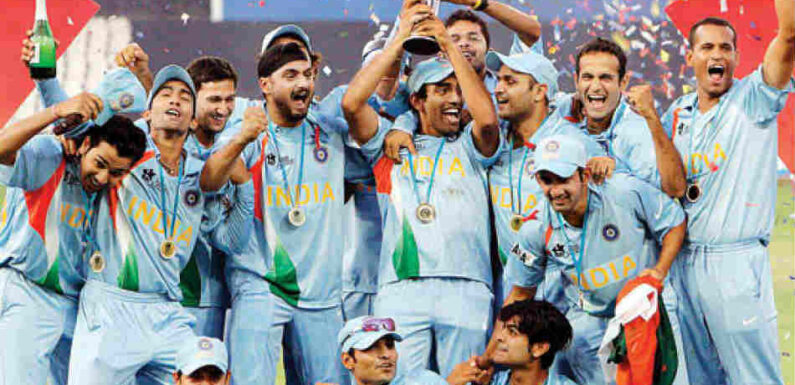
India won the ICC t20 world cup 2007 by beating their rivals Pakistan in the final
Protests over Bangladeshi feminist writer Taslima Nasreen turn into deadly riots; troops are deployed
India’s first commercial space rocket is launched, carrying an Indian satellite.
Government announces its strongest economic growth figures for 20 years – 9.4% in the year to March.
Pratibha Patil becomes first woman to be elected president of India
Maintenance and Welfare of Parents and Senior Citizens Act, 2007
2008 Indian car manufacturer Tata launches the Nano, claimed to be the world’s cheapest car.
Union Health and Family Welfare Minister Anbumani Ramadoss dedicates to the nation the first in-vitro fertilisation (IVF) facility in the public sector set up at the All-India Institute of Medical Sciences (AIIMS) in New Delhi.
Central government launches Dhan Laxmi scheme in seven states. Under this scheme an insurance cover of ₹ 100,000 would be provided for the girl child at her birth. The scheme aims to improve the girl-child ratio.
Tata Motors buys two British automobile manufacturing companies, Jaguar and Land Rover, from Ford, their American owners.
First Field Marshal of Indian Army Sam Manekshaw died.
Pope Benedict XVI announces the canonization of Sister Alphonsa Muttathupadathu, the first woman of Indian origin to be canonized as a saint by the Roman Catholic Church, and the first canonized saint of the Syro-Malabar Catholic Church.
Following approval by the US Congress, President George W. Bush signs into law a nuclear deal with India, which ends a three-decade ban on US nuclear trade with Delhi. Known as 123 Agreement.
Aravind Adiga, is awarded the 2008 Man Booker Prize for his debut novel, The White Tiger.
India successfully launches its first mission to the moon, the uncrewed lunar probe Chandrayaan-1.
The 2008 Mumbai attacks (often called the 26/11 attacks) kill 174 people, including 9 of the 10 terrorists from Lashkar-e-Taiba, an Islamic terrorist organisation based in Pakistan. India decides not to attack Pakistan in retaliation.
Shooter Abhinav Bindra wins the gold in the 10 m Air Rifle event at the 2008 Summer Olympics in Beijing. He became the first Indian to win an individual gold medal at the Olympic Games.
Wrestler Sushil Kumar wins a bronze medal in the Men’s 66 kg Freestyle Wrestling category at 2008 Summer Olympics in Beijing.
Boxer Vijender Kumar became the first Indian boxer to win an Olympic medal when he won bronze medal in the middleweight category at 2008 Summer Olympics in Beijing.
Cricketer Sourav Ganguly announces retirement from Test Cricket.
2009 Kapil Dev, Sunil Gavaskar and Bishan Singh Bedi figure among the 55 players in the ICC’s inaugural Hall of Fame list.
India and Russia sign deals worth $700 million, according to which Moscow will supply Uranium to Delhi.
Resounding general election victory gives governing Congress-led alliance of PM Manmohan Singh an enhanced position in parliament, only 11 seats short of an absolute majority.
Indian Member of Parliament Meira Kumar becomes the first female Speaker of the House of the People.
Delhi court decriminalizes gay sex
Cyclone Aila ravages the east coast
India launches its first nuclear submarine, the INS Arihant.
India successfully test-fires its nuclear-capable “Dhanush” missile off the Orissa coast
Right of Children to Free and Compulsory Education Act (RTE), 2009
2009 Andhra Pradesh helicopter crash: A Bell 430 helicopter crashes during a flight in southern India. Fatalities included Y. S. Rajasekhara Reddy, the Chief Minister of the Indian state of Andhra Pradesh
